


Cat Care And Management. Continued
Description
This section is from the book "Cats And All About Them", by Frances Simpson. Also available from Amazon: Cats And All About Them.
Cat Care And Management. Continued
If it is a first litter or if the mother is not reliable, a foster-mother should be in readiness. For preference in such cases get a strong English cat, as they are more robust than Persians, and often far more loving mothers. Four kittens are enough for any average cat to bring up. In the selection of a foster-mother the age of both litters should be about the same (at any rate within a week) as the mother's milk varies according to the age of her offspring, and not only this, but new-born kittens require more maternal watching and warmth than kittens of three or four weeks old. If it should happen that the mother dies or deserts her babies or has no milk, and a foster cannot be found, you must do your best to bring them up by hand. This involves much care and patience. A hot-water bottle covered with flannel comforts the tiny mites. They should be fed every two hours during the day (and at least twice during the night) for the first fortnight with milk and water and a tiny pinch of sugar. Up to the end of the first week the proportion of milk and water should be one part milk and two parts water, including a little lime water. At the end of the first week it should be half and half till three weeks is reached, when it should be three parts milk and one water.
At three weeks old, if milk is not given, Mellin's Food is to be highly recommended, and the proportions of "Mellin's," milk, and water are given with the directions for "infants and invalids," and common sense tells one which of the directions to adopt. At five or six weeks old, solid food ought to be given in very small quantities - three quarters of a teaspoonful of the finest and most tender minced raw meat twice a day (but not given consecutively), Mellin's food two or three times; and a little thin arrowroot may be given for a change, beef-tea or a tiny helping of fish mixed with warm milk. This same diet only in rather larger quantities may be given till eight weeks old; from that age to three months a little rice and gravy, Spratt's puppy biscuit (very finely mashed), Salvo's or Freeman's food or Phoenix with gravy. Rabbit-broth or fishy flavour can be introduced, and is very much enjoyed. Milk puddings too are good for kittens. Be sure to offer your cats grass, as it is nature's own medicine, and animals will not take it unless they need it. A nursing mother should have three solid meals a day, and milk twice if she will take it, but do not give her too heating and stimulating a diet, as it is apt to produce scurf in the kittens.
When this is noticed give the mother a pinch of sulphur powder on her first meal two or three times a week.
What fanciers dread most in their litters are bad eyes; if they are the result of cold they are not so hard to cure but the usual cause is debility and worms in the mother or other constitutional weakness. If the kittens are only a few weeks old the mother should have a worm dose as this affects the milk and acts on the kittens beneficially. The kittens themselves should not be dosed under three months old. It is cruel to take a kitten from the mother until eight weeks old. Never dose a cat for worms when in kitten after the first fourteen days as it would be more than likely to cause a miscarriage. These hapless events usually occur at the end of five weeks, and are generally caused by fright, chill, or weakness, or are the result of old age of either of the parents (generally the mother). If once a mishap has occurred history may repeat itself and especial care should be taken at the time which has proved the most critical to the mother in previous matings.
I should mention that diarrhoea is another ailment very common in kittens and there are various causes - chill, indigestion and worms. This troublesome complaint should at once be stopped or the kitten loses strength and succumbs. Fleas and those horrid little lice also work great havoc. And I have seen more than one victim to these pests, with deadly white lips, nose and mouth, the coat all rough and wiry, the kitten itself a bag of bones with no real disease except what the insects have caused, for they suck the blood, thus causing anaemia, and irritate the sufferer almost to madness. A tooth comb will get rid of all the dirt and nearly all the fleas; then rub a little insect powder into the fur, but never use insect powder on very young kits as the mother has a horror of it and might desert her kittens in consequence. It is often necessary to toothcomb young kittens. Mr. Ward, of Manchester, makes a very good powder which kills lice, but it does not destroy the vitality in the eggs at once, so the powdering will have to be repeated at intervals.
This powder has a very inoffensive smell, but I would not recommend using it on kittens until six weeks old.
I have not yet mentioned out-of-door catteries. These are best made of wood - raised up from the ground - and should be covered with felt or corrugated iron. There should be plenty of ventilation, avoiding draughts. A wired-in run is most desirable and ought to be covered over so that in wet weather the cats should not have to be shut in their rooms all day. There is no doubt that cats thrive best out of doors and can stand any amount of dry cold. Artificial heat ought not to be encouraged; it makes cats delicate and very susceptible to cold and other catty complaints; while invariably giving kittens weak eyes. The cattery cat is far better off with the temperature even, and with a nice comfortable bed in a cosy corner of her "room" - a box with plenty of warm hay for the winter months and paper for the summer months.
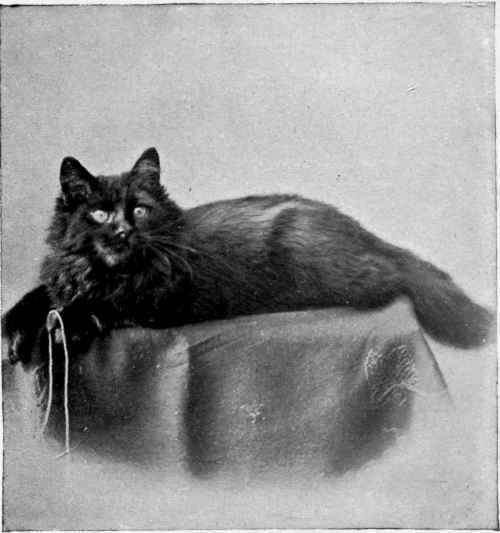
Mrs Robert Little's Othello Nottle, photo, Beckenham
Great attention should be paid to keeping the sanitary pans clean and well supplied with earth or saw-dust, otherwise pussy is encouraged to be dirty, for she will not go to a pan which has nothing but wet mould, and she much resents a pan that one of her neighbours has used. If two or three cats have to share accommodations it is best to have two or three pans about. Londoners especially should lay in a stock of Japanese mould, as supplied by Carter's of High Holborn. All feeding vessels should be kept scrupulously clean and never left standing about.
In advocating out-of-door catteries it must be understood that it would be madness to put a cat out in mid-winter which had hitherto been a house-cat. She would probably be dead from pneumonia within a week. But cats put out for the first time in the early summer thrive all the year round better than those who lead an indoor life. They have healthier appetites and grow better coats.
Speaking of coats reminds me that a cat comb and brush should be kept and each cat combed down once a day. It prevents their hair from matting, brings out the old coat, and causes the new coat to come on more quickly, and last, but certainly not least, it keeps the coat clean and free from insects.
I have spoken of nursing mothers and kittens, but not of stud cats, Stud cats require more meat and stimulating food than others; and a day should not pass without their having a plateful of meat. Raw meat occasionally is absolutely essential.
Never forget to keep your Tom cats well supplied with grass, for having no amount of exercise they require it
Above all things don't overwork your stud cat, and try to avoid inbreeding. I can highly recommend Boulton & Paul's capital houses for stud cats. I have had one for four years, and it has answered splendidly; and my cat Persimmon, who inhabits it, has never ailed anything. Mine is a double house, but I had the partition taken down, so that there is quite a fair-sized exercise ground.
A few words about gelded cats will not be out of place in this chapter, my remarks being applicable to both long and short haired neuters.
For reasons that are easily understood it is necessary, if you wish to have a house pet of unimpeachable manners, to have your male cat doctored when he arrives at years of discretion, or in this case I might say, indiscretion! I consider between five and six months the best time for a cat to be gelded. These cats grow to an enormous size, and their coats are generally very long and thick. They do not shed their fur to the same extent as ordinary cats. Certainly they should always be judged in a separate class at all shows. The neuter class at good shows is often most attractive and well filled. As a rule these cats are more docile and better-tempered than others, and though they are considered a lazy set, yet rats and mice will be generally kept under by the household pet. When fanciers are overwrought by disappointing litters, troublesome Toms and prolific females, I have more than once heard them exclaim: "I shall get rid of all my cats, and only keep neuters!"
Continue to:


My Books

