


Practical Hints On Kittens Care And Management
Description
This section is from the book "Cats And All About Them", by Frances Simpson. Also available from Amazon: Cats And All About Them.
Practical Hints On Kittens Care And Management
It is always advisable when buying a kitten to make inquiries as to the way in which it has been fed, so as to continue the same regime for at least a few days. Any sudden change of diet for young kittens is to be avoided.
For delicate kittens raw meat should be passed through a mincing machine, or if the animal is really extremely weak and ill, then let it be rubbed through a sieve, so that the digestive organs will have little or no work.
Teach your kittens when young to lap water. It is a capital thing for all animals, especially with a small bit of sulphur in it.
There is a great knack in teaching young kittens to feed themselves. When they are about three weeks is the time to try and get them to take a little milk and warm water: say about twice a day. I find a shallow plate is better than a saucer, for when the mites dip their mouths into the milk they do not get out of the depth! It is curious how stupid some kittens are in making the start towards independence iu feeding, whilst others in the same litter quickly master the difficulty of lapping on the surface of the milk. Some are taught better if the milk is held to their mouths in a spoon. Add a pinch of sugar to the milk and warm water.
In bringing up young kittens by hand, the mistake is often made of giving too much food and over-loading the little creatures, who in consequence suffer from acute indigestion. A teaspoonful of milk or Mellin's food at a time is sufficient, and this may be given every two or three hours. It is best to try and not awaken kittens in order to feed.
Of course one is sometimes obliged to feed by force, but this should be resorted to only as a last extremity. I have often spent an hour or more in trying, by all sorts of persuasive means, to get a kit to feed of her own sweet will, and have felt a throb of pride when my efforts have been crowned with success.
Some kittens will begin to feed themselves at three weeks, and be quite able to leave their mothers when they are five or six weeks old. I do not think, however, that kittens should be sent adrift till they are at least two months old, by which time they will have some idea of the method by which their careful and attentive mother has kept them clean and tidy.
I do not approve of raw fish, especially for young kittens, it is not easily digested and often causes diarrhoea.
There is a knack about teaching young kittens to be clean. As soon as they are able to scramble out of their basket care should be taken not to allow them to run into corners. When this occurs pick them up and put them in the pan of earth or mould provided for them. With patience and perseverance you will find the little creatures will accommodate themselves to circumstances and the pan!
The weakest part in a young kitten is, undoubtedly, the eye, and I think breeders will bear me out in my statement that they have a great deal of trouble with bad eyes in kittens. Several lotions and ointments are supplied, but sometimes I have found these irritating. Use sweet oil to keep the lids from sticking together, give plenty of fresh air and sunshine when possible, and leave the rest to the mother.
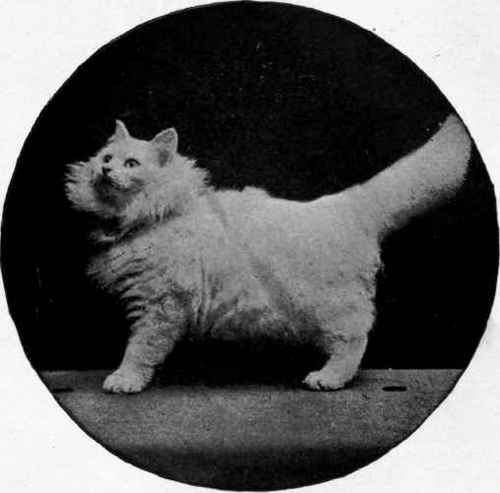
Mrs. Pettit's White Persian Piquante Pearl Russell & Sons, photo, London
A good guide as to the health of kittens is their weight; and a kitten to be in really prime condition should weigh one pound to every month, say up to six months old. So if you find a three-months-old kit much below three pounds you should feed him up.
It is a capital plan to teach your young kittens to sometimes take their food from a teaspoon, so that when it is necessary to administer a dose of medicine it comes more natural to them.
I have often noticed that very long-coated kittens are the most delicate, their strength having gone into their fur. I recently came across a litter of Blues that at three weeks old were enormous to look at on account of their extraordinary coats. They were really tiny limbed creatures, and they dropped off one by one without any apparent cause. I do not know if there is anything in the notion that if the male cat is very strong and healthy the offsprings will consist of more males than females, but from experience I have found that an old queen will almost invariably breed females largely in excess of males.
I believe that all kittens are born healthy, and, therefore, supposing the mother is weak and delicate, it is best to have a foster ready, and take each kit away as it is born, not allowing it to suck from the mother at all. I have recently heard of great success following this course. The mother was consumptive, but the four kittens given at once to a healthy foster are splendidly strong.
Kittens generally shed their first teeth when between five and seven months old. This is often a very critical time, and I have known several cases of convulsions occurring. Owners of cats should frequently examine the mouths of their pets, if they suspect any teething trouble. It is sometimes necessary to draw some of the old teeth to make way for the new comers. I can tell of one poor cat who refused all solid food, and for no apparent reason. I opened his mouth, and discovered a double row of teeth, and at once extracted several loose ones, which must have been the cause of great pain and discomfort.
I object to sawdust for young kittens. I have just heard of a case in point, where some of the small particles got into the kitten's ear, and the little creature, in its endeavour to get rid of the tickling, caused a bad sore by scratching.
There is no doubt that as a pick-me-up for delicate kittens the sea air is much to be recommended. It is quite wonderful to see the transformation in these little mites after a few days of sunshine by the sea. Their eyes become clear and bright and their appetites require something more than air and light to satisfy them.
You may, perhaps, observe a sort of roughness under the fur of your kitten, and fancy it is some skin trouble, whereas in reality it is quantities of flea dirt. This is very injurious. Use a small tooth comb, and then part the fur, and brush with rather a hard brush.
When kittens reach the age of four weeks they should begin to learn to lap. A shallow plate filled with milk and warm water is better than a saucer. Begin by just dipping the kits' mouths into the milk. They will rather resent this treatment at first, and make a spluttering, but the cunning ones will grasp the situation and make another attempt on their own account. They will quickly learn not to dip their heads too deep, and their joy is great when they find they can lap up the milk without nearly choking themselves.
Continue to:


My Books

