


Practical Hints On Mother And Young Cat Care And Management
Description
This section is from the book "Cats And All About Them", by Frances Simpson. Also available from Amazon: Cats And All About Them.
Practical Hints On Mother And Young Cat Care And Management
The best months for our pussies to have their families are April and May, then the young kittens have the summer before them, when they can enjoy plenty of out-door air and exercise.
Perhaps you may have noticed a decided partiality for bottom drawers that your puss will display as the date of the expected arrival draws near. I think in this respect a mother cat shows her good sense, for certainly if a bottom drawer can be spared, it is a very safe and convenient home for a litter of kits. They are out of draughts and danger, and if the drawer is left an inch or two open, they can get plenty of air. Of course, whilst the mother is nursing them a larger opening is necessary, so that she may jump in and out.
Do not allow your cats to have their kittens in outside catteries during cold weather. The mother is not able to attend to them properly till all are born into the world, and, therefore, the neglected ones are sometimes perished to death before they can cuddle up to get the natural warmth they so much require.
When cats are in kitten great care should be taken in handling them, and if it is really necessary to lift your puss, do so with both hands, placing one under her hind quarters. It is very injurious to attempt to pick up a cat in this interesting condition under the front paws, thus leaving the heaviest part of the body suspended.
It is most important that all female cats should be freed from worms before being allowed to breed, or even to mate. So often young kittens fall victims to these pests, having sucked in the disease with their mother's milk. I highly recommend Ward's worm powders, but as all vermifuges are weakening, a specially nourishing diet should be given at the same time.
After our puss has given birth to two, three, or four kittens, we are often led by her size to suppose there are more to follow. Sometimes we may be right, but more probably it is only a temporary enlargement, and in a day or two we become, perhaps, concerned to find the mother's sides very visibly decrease. Give hot milk and farinaceous food to your puss just at first after the birth of kittens.
Some pussies greatly resent being looked at during the first days of their motherhood. They will show their displeasure by carrying off their kittens and hiding them. I have just heard of a case where the kits mysteriously disappeared from their basket, and after diligent search the litter of four was found carefully packed away in one of the boots belonging to the gentlemen of the house ! It is best to place the bed in some secluded and dark corner, and not to trouble the family with frequent visits.
It is a bad habit to feed your puss in her hamper when she is nursing her kittens. She may be averse to coming out and leaving the precious family, but it is best for her to stretch her legs, and cleaner and nicer in every way.
It is after the first week or ten days that a nursing mother begins to feel a large family trying. There is really no immediate necessity for a foster when the mites are only a day or two old.
Don't distress yourself if your mother pussy refuses her usual saucer of milk when she is nursing a family. The instinct in animals, even in mere cats, is wonderful, and if puss prefers water to milk, be sure she has her reasons, which are unknown to the human mind.
When a cat is nursing let her have plenty of hot milk. This will be a great assistance to her in providing sufficient nourishment for her family. Warm Bovril or Kreochyle is also very sustaining, to which I find cats are very partial.
Sleep is almost as essential as food to young kittens, so when you see them cuddled up comfortably, do not disturb them and always avoid handling them. Perhaps through some disaster or because your puss deserts her kits, she is left with a lot of milk, It is best to give her a dose of castor oil and rub her breasts gently and frequently with camphorated spirit or eau de Cologne, diluted with a little warm water. In about three or four days the milk will dry up. It is very seldom that cats suffer from milk fever.
Don't let your Persian queens bring up more than four kittens. Try and secure a foster to assist if the litter is a larger one. It is when kittens are about a week old that the mother begins to feel the strain upon her. A nursing mother should have four good meals a day.
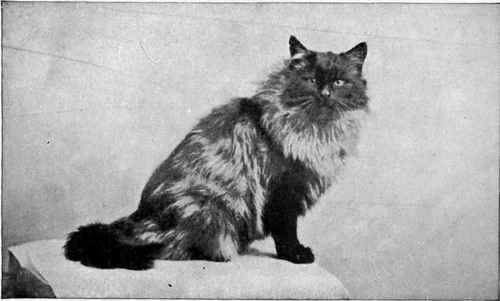
Mrs H. V. James' Smoke Champion Backwell Jogram
It is well to book a foster cat if our queens are not good mothers. The difficulty is generally to fix the date of the arrival of the foster mother's kittens. It is best to have the foster in the house a few days before the litter is expected. A cat should not be allowed to take a railway journey having just had a family, as the shaking is likely to upset the puss.
There is really no difficulty in transferring kittens to foster mothers, and it is well to keep common cats in view at about the period when our valuable queens are due to kitten. I have found the following plan answer splendidly. Take it for granted your Persian queen and the common or garden cat have litters about the same time. You proceed to painlessly destroy all but one of the foster's family. Then place two or three, or all of the valuable kittens in the nurse cat's bed, mixing them up with the one kitten, having in the meantime removed the mother. In this way the new kittens will become scented as it were with the surroundings, and on her return the mother will give a few sniffs, and probably cuddle down quite contentedly, with only a vague suspicion that something has happened.
Some cats will be excellent mothers to a large family, but if anything should happen to any of the litter and she is left with only one or two she will desert them. It is better to try and procure other kittens to put with her, and let her foster these with her own.
Kittens should not be taken from their mother before two months, and those that are left another month are generally the better for it. Not only is it well for the cat to suckle her young as long as possible, but the natural warmth is very essential for kittens of tender age. Avoid handling your cat when she is in kitten, and when the family arrives resist the temptation of picking up the tiny mites. Some mothers resent this, and will often hide away their offspring, and they have been known to eat them in consequence of undue interference.
I was once possessed of a lovely blue female, whose only fault was neglecting her offspring when about a fortnight old. I hit upon the plan of using the filler of a fountain pen. I charged this with warm milk and water, and placing the end in the kitten's mouth, I gently pressed the rubber. The kits sucked away with great glee. This is a much better mode of getting food down young kits' throats than by using a spoon. I believe Mr. Ward, of Manchester, has improved upon my patent, and a glorified fountain-pen filler is now provided by him. This has a piece of india-rubber fixed on the part of glass tube which is put in the kitten's mouth, and thus all risk of their biting the glass and breaking it is done away with. Let me recommend all breeders of kittens to have one of these useful articles amongst their catty requisites.
It is not very safe to put Keating's Powder on your baby kits, but, if troubled with fleas, sprinkle some amongst the hay at the bottom of their basket, under which place a newspaper. You will be astonished what a number of fleas, dead and dying, will be found on removing the basket. Change the hay frequently, and sprinkle fresh powder. In this way, both mother and kits will be kept free from these pests.
Don't have anything to do with red baize or flannel in making a bed for young kittens. If these materials get wet the dye comes out and stains the coats horribly. The other day I came across a little family of Blues with red tails!
In wintry weather it is risky sending our precious queens on long journeys. Make use of large sheets of brown paper as coverings to the hampers. This defies the wind much better than woollen wrappers or linings.
I am often asked how it is best to set about breeding Persian cats so as to make it pay, and I invariably answer by telling my inquirers to procure two thoroughly good, healthy pedigree queens. At the present time, I should suggest a Blue and a Silver. Send these to mate with well-known sires, and advertise the kittens just before they are ready to leave their mother, say at about eight weeks old.
Avoid the use of drugs of any kind for your cats when in kitten. Give extra food, and when the interesting event draws near, prepare a nice box or bed in a secluded corner. Some cats much prefer paper to hay or straw; others like a folded blanket.
Continue to:


My Books

