


Chapter XXXI. Colour Breeding
Description
This section is from the book "The Book Of The Cat", by Frances Simpson. Also available from Amazon: The Book Of The Cat.
Chapter XXXI. Colour Breeding
COLOUR breeding is a most fascinating pursuit ; but, unfortunately, the average cat fancier lacks the patience to follow it out to a satisfactory conclusion.
There is no doubt that by judicious crossbreeding new colours could be produced, and I think that they will be produced in time. I have seen a chocolate-brown cat and a yellow cat with black stripes, and no doubt they will appear again ; also chestnut-brown cats and white cats striped with black may be bred.
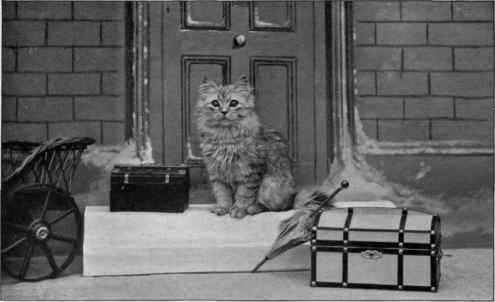
" Arrived Safely." (Photo: E. Landor, Ealing.)
The point which I wish to discuss on this occasion is not so much the experimental cross as the cross which is desirable to improve existing colours. I do not consider that a white cat should be crossed with any other colour. There is no advantage to be gained in this case by crossing, as we already have white cats good in bone, substance, head, shape, etc., and no other colour of cat possesses blue eyes. I do not for a moment suggest that good white cats have not been bred from coloured parents, but this is unnecessary and undesirable, because there is a risk of introducing coloured patches and smudges and yellow or green eyes, and there is no corresponding advantage to be gained. In the same way I do not consider that it is a good thing to breed from white cats with yellow or odd eyes. Blue-eyed kittens have been bred from two yellow-eyed parents, and frequently when one parent has yellow or odd eyes the kittens are all blue-eyed, but this can in no way be depended upon.
Black cats are a little more difficult to handle than whites, because a white is neces-sarily white, while there is sometimes a diversity of opinion where a black is concerned. The most important point to keep before us in black-breeding is the colour of eyes. Whatever we cross with we must be careful that we do not lose the orange eyes, for they are most elusive, and we are, theretore, somewhat limited in our selection of suitable crosses. A smoky or dirty black is an abomination, and for this reason I consider that from the point of view of the black cat all crosses with blues, smokes, or silvers should be avoided ; in any case a good silver would be impossible because of its green eyes. A rusty black is undesirable, but a rusty kitten usually makes a better-coloured cat than a smoky one, though there are notable exceptions to this rule. A good orange-eyed tortoiseshell or red tabby, or an orange, are all suitable mates for a black. A curious thing I have noticed is that the best blacks are bred from bright clear-coloured cats, and that dull colours, such as smokes, blues, and fawns, do not, as a rule, produce good - coloured kittens. For this reason I should prefer blacks bred from an orange-eyed silver tabby to those bred from a dark brown tabby.
On the whole, a brightly coloured tortoiseshell will be found to throw the best blacks.
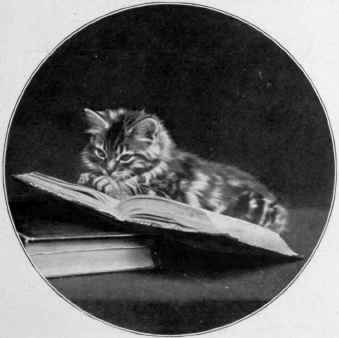
" Patricia," Brown Tabby. Bred By Miss Fanny Ellis, Toronto
Of the crossing of blues with any other colour I do not approve, because we have many different blue strains, among which can be found all the different points which are desired. Comparisons are odious, but if I refer to the Bath show of 1903 I can explain what I mean. "Skellingthorpe Patrick" is a beautiful cat in all points except eyes, but "Don Carlos" and several other blue males in the class had glorious orange eyes. I have often heard that crossing a blue with a white will produce very pale blue kittens; I have not found this to be so, and it seems unlikely, for mate a black cat with a white one as often as you like, and you may wait a lifetime before they breed a blue kitten ; therefore why should a dark blue and a white produce a pale blue kitten ? Sometimes crossing with a black is recommended "to get the orange eyes," but it must be remarked that the proportion of black cats with good orange eyes is quite as low as that of blues. When this cross is resorted to, let the black parent be the male, as otherwise the kittens may very likely all be black.
It is the misfortune of the smoke cat that it has been indiscriminately and unintelligently crossed with the black and the silver tabby, and, worst of all, with the blue. Strangely enough, there seems to be some close affinity between the smoke and the silver tabby, and it should be our object, as far as possible, to keep them apart. To this connection is attributable the prevalence of green eyes and leg and face markings among smoke cats. In crossing smokes there are many difficulties to contend with. We must keep the light undercoat, but avoid markings; we must have the black face and legs and retain the light frill; and we must have orange eyes. All crosses with tabby must be avoided, or we shall never get rid of face pencillings ; but judicious crosses of black, blue, or (best of all) chinchilla may be of service. A black cross is better than blue because, though either endangers the undercoat, it will intensify the black mask and legs. The one advantage of a blue cross is that it will, sooner than any other, help to eliminate markings ; but the blue kittens from such a cross must be sternly rejected, as their colour will never be satisfactory.
The chinchilla is the best cross for the smoke so far as colour is concerned, and an orange-eyed chinchilla should be of service for breeding smokes with light frills and good under-coats. A cross of chinchilla may with advantage follow a black cross.
We now get to the subject of chinchilla breeding ; it is a matter of common knowledge that chinchillas were produced as the result of careful in-breeding, and, therefore, until the breed is more firmly established, any sudden outcross is likely to cause a reversion to the barred ancestors. The idea, then, is to cross with whatever is least likely to introduce stripes - i.e. a self-coloured cat, or preferably a shaded one. Of course, any tinge of red or brown is to be avoided, and, therefore, the only shaded cat left to us is the smoke, and a green-eyed smoke is certainly the safest cross we can get,, as it is sufficiently akin to the chinchilla to obviate the risk of a violent out-cross. The black is, I think, the next best cross, for it is just possible that the colours may not interfere with one another, and that we shall get pure black and clear silver kittens - of course, a green-eyed black must be used. Third on the list comes the white; but this cross makes for absence of markings, and therefore demands great caution, as thereby the black noses and e ye1i ds which add so much to the charm of a chinchilla may be lost and the result be merely a dingy, dirty white cat.
Continue to:


My Books

