


Colour Breeding. Continued
Description
This section is from the book "The Book Of The Cat", by Frances Simpson. Also available from Amazon: The Book Of The Cat.
Colour Breeding. Continued
This animal, though not particularly attractive in itself, is, I need hardly say, invaluable for crossing again either with a clear-coloured chinchilla, a black, or even a blue.
A blue cross is, as a rule, rather objectionable, because it seems to produce a muddy, dull colour, but there is no doubt that it may occasionally be resorted to with success. I should suggest that the blue parent (a green-eyed one, of course) should be the sire, as when the reverse is the case the kittens are frequently blue tabby.
I do not think any colours besides those I have mentioned should be crossed with chinchillas, though I must confess that chinchilla kittens occasionally turn up most unexpectedly. I recollect a very pale one appearing in a litter whose sire was a cream of brown tabby and cream parentage, and whose dam was a pale blue bred from a blue and a blue tabby. There may have been silver tabby blood in the strain, but certainly no chinchilla. For all this I do not recommend a cream or tortoise-shell cross, as the chances are all against the kittens being any good, and it is laying up a store of disappointments in the next generation. We have all possessed cats which, though beautiful in themselves, never threw a kitten worth keeping. I had a little cat myself bred from two chinchilla parents. The dam was a well-known winner, and her ancestry was, I knew, irreproachable, and the sire's appeared to be equally so, though I was told afterwards that he often sired brown tabby kittens. But my queen (herself a prize-winner), no matter how she was mated, invariably threw brown tabby kittens.
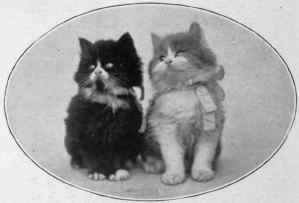
Miss Goddard's Pair Of Kittens (Photo: E. Landor, Ealing.)
We now come to the very fascinating subject of tabbies, and I may as well say at once that any amount of crossing is for the present desirable and even necessary, but it must be done systematically and under a careful and experienced eye. The novice is likely to fail because he does not understand the essential points of a tabby. Let him keep before his mind the fact that if two distinct black stripes run the whole length of the spine and if the chest markings are good there is not likely to be much wrong with his cat's other markings.
In the brown tabby, the markings have become too heavy, they have run together and spread into a heavy black saddle ; while the ground colour has lost warmth and white chins are prevalent. With the "sable" cat, be it understood, I have no fault to find; I can forgive him even his white chin, because he is such a magnificent animal; but he is not a tabby, and should not be shown as such.
In the brown tabby we want dense black markings on a clear golden-brown ground. The black is there right enough, but it wants " breaking up." A cross of strongly marked red tabby is the thing; not a " self - orange," mind you - that would only make things worse - but the best-coloured red, with a dark chin, that can be found. When the markings want intensifying, as may be the case after the red cross, we must mate with a black; but I do not think this will be necessary, as brown tabbies rarely "wash out" as silvers do. It is curious to note that many years ago I bred quantities of beautifully marked silver tabbies and brown tabbies from a brown tabby sire and a sandy, silver tabby dam, both of unknown pedigree. The silvers were clear and pure in colour, with capital black markings, and the browns had good rich colouring. This is a cross I should certainly hesitate to recommend, but there are possibilities concealed therein, and it is worth an occasional experiment with the sole object of rescuing the degenerate tabby markings.
It is a curious fact that while the tabby is supposed to be the common ancestor of all our cats, the tabby markings should be the most difficult point to retain in the pedigree cat.
A brown tabby cat with a good-coloured chin should always be retained to breed from, even if it fails in some other points.
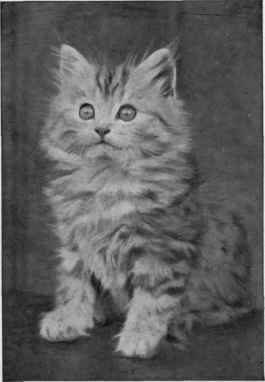
"Lollypop," One Of Lady Marcus Beresford's Silvers. (Photo: E. Landor, Ealing.)
It is, I know, the general opinion that the craze for chinchillas has ruined the silver tabby, but I do not feel convinced that this is so. I am of the opinion that the constant breeding of silver tabby to silver tabby will eventually result in the production of poorly marked cats. Let me give an example : "Felix Mottisford" was a very heavily barred son of "Champion Felix," and "Patz" was also heavily barred and bred from silver tabbies. Two of their kittens were "Silver Midget" and "My Fairy." "Midget" was a prettily marked silver tabby, but much lighter than her parents, and showed a strong tendency to throw unmarked kittens. "Fairy" was certainly a silver tabby, but her markings were entirely on the surface, and as she grew older faded away until she was more shaded than barred. Mated with a blue, she produced four chinchilla kittens; mated with " Lord Southampton," there were two well-marked silver tabbies and two chinchillas (this litter included "Dimity" and "Abbess of Broomholme"); mated with "Silver Lambkin," there was one chinchilla kitten - "Fitz Eustace" - and the rest were silver tabbies ; by "Tuan," a much more marked cat, the kittens were all chinchillas ("Tuan," I may mention, was a distant cousin of "Fairy") ; by "Silver Lustre " there were two chinchillas and two silver tabbies.
I then parted with her, and she afterwards had, by " Silver Chieftain," a litter of silver tabbies and chinchillas, including "Silver Tangle" and "Silver Sprite." After that date I have no record of her doings, but it can be seen that she certainly showed an inclination on her own account towards chinchilla kittens, and this, I take it, was the result of the continued mating together of silver tabby cats. I do not consider any other cross than black is admissible in a silver tabby strain, but the introduction of black blood is necessary from time to time if markings are to be retained. I go so far as to say that a cross of green-eyed black in every third generation would be a wise precaution.
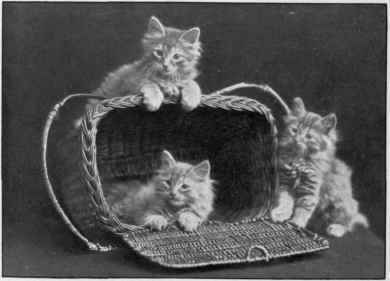
Three Little Americans
The red tabby, the orange, and the tortoise-shell are rather hopelessly mixed up at present. The self-orange (so called) did not exist a few years ago, but of late a premium has been put on absence of marking, and a lot of cats with self-coloured or shaded bodies and striped faces appear in the orange classes and win all the prizes. I have no fault to find with the shade of colour of these cats ; they are a beautiful bright clear orange, but if they are to be self-coloured the face markings must go. Crossing with blue gets over this difficulty, but we immediately lose brightness of colour and get dull yellows and fawns. Tortoise-shell is a safe cross, but the ancestry of the tortoiseshell must be carefully inquired into, and one bred from black and tortoiseshell is best, or we can go direct to the black. Tabby cats or any of a blue or grey colour should be-avoided in this connection.
Clear, pale yellow creams may be bred from oranges and tortoiseshells ; but these must not be confounded with the fawn-coloured cats, often called creams, which are more common and easy to breed. Though creams and fawns occasionally appear in the same litter this is generally the fault of their ancestors, and can be accounted for if the pedigree is known on both sides. As a matter of fact, I have never seen one of these clear yellow creams which was not descended, however remotely, from Mrs. Kinchant's strain. Examples of the colour I mean are "Cupid Bassanio," "Zoroaster," "Dairy Maid," "Mistletoe," and a few of their descendants.
To breed fawn creams is, comparatively, a simple matter, as a cross of blue and orange will almost invariably produce some fawn kittens, especially if the dam is blue. When the dam is orange or tortoise-shell there will often be a number of blue tortoiseshell kittens which are valueless. Some people like them to breed fawn creams from, but I have never found them more useful for this purpose than a correctly coloured tortoiseshell.
Tortoiseshells are entirely neglected by fanciers nowadays, and are only used as a stepping-stone to more fashionable colours. There is no doubt that a tortoiseshell can be got to breed anything ! I knew a queen which bred magnificent blacks, blues, creams, oranges, fawns, and smokes, whether mated to a blue, a cream, or a smoke, and I believe she also threw chinchilla kittens to a chinchilla sire. To breed tortoiseshells for the show pen we must not indulge in any haphazard matings. The fault of the tortoiseshells is, as a rule, that the red and yellow has run all over the black, and instead of having a clear patchwork of red, yellow, and black, we have a blur containing a preponderance of yellow. The obvious remedy is our old friend the black. All the best tortoiseshells are bred from blacks, and a black and a red tabby or orange will generally throw some good tortoiseshells. To produce tortoiseshell-and-whites cross a tortoiseshell with a black-and-white rather than with a white, but avoid red tabby, as a tortoiseshell-and - white cat frequently shows tabby markings for this breeding.
The red tabby has nearly died out among long-haired cats, though it flourishes in the short-haired variety, but by crossing a brown tabby with an orange it might be revived. No doubt there would be a few mis-marked kittens in the litter, but the chances would be in favour of a good red tabby, and the colour could then be preserved by crossing with black and tortoiseshell only.
Of course, it is no use trying experiments in cross-breeding in the hope of obtaining definite results unless we are satisfied as to the pedigree of the cats employed for at least two generations, or all our calculations may be upset. For example, when breeding for chinchillas, if we used a black bred from a brown tabby mother the results would be disastrous.
A point to be carefully noted in crossbreeding is to select a cat with eyes of a colour desired in the breed which he is destined to improve, whether those eyes would be correct in his own family or not. This suggests a use for our rejected green-eyed blues and blacks and our orange-eyed silvers.
My notes, as may be observed, are on the subject of long-haired cats, but they will be found equally applicable to short-hairs.
Hester Cochran.
Continue to:


My Books

