


Orange, Cream, Fawn, And Tortoise-Shell Cat Society. Part 2
Description
This section is from the book "The Book Of The Cat", by Frances Simpson. Also available from Amazon: The Book Of The Cat.
Orange, Cream, Fawn, And Tortoise-Shell Cat Society. Part 2
I do not think orange cats have ever been very popular, and I have remarked at shows that a certain number of people refuse to give anything but a passing contemptuous glance at the classes which contain what they call "those yellow cats."
A very common defect among orange Persian cats is the white or very light chin. Sometimes there is the still more damaging blemish of a white spot on the throat, spreading, perhaps, further down the chest. It is very rare to find an orange that has really a dark under-lip. and chin level in tone with the body colour. The white lip is a bugbear to breeders and exhibitors, for Nature repeats itself, and judges make notes of the defect; and in these up-to-date catty days of specialist clubs and standards of points a cat full of quality failing in one particular is too often a white elephant, if desired for anything more than a pet. I have observed that orange cats will sometimes develop a light or nearly white chin in their old age. I never consider a white spot or tuft of white hairs such a blemish to a cat if these are on the stomach, as compared with the same defect on the throat. Such a spot would not be so likely to be handed down to successive generations; and, of course, a blemish that has to be sought for in an obscure part of the body is not such an eyesore in a self or tabby cat.
I have often observed orange cats with very light hair underneath which has almost approached white ; but such defects are sometimes only temporary, whereas a white spot on the throat or a white chin remains once and for ever.
In the early days of the fancy, orange cats were decidedly more tabby marked than they are in the present day. A noted one of this type was "Cyrus the Elamite," born in 1889, and bred by Mrs. Kinchant, an enthusiastic fancier at that and later periods. In 1893 and 1894 Mr. Heap exhibited a handsome orange, "Prince Charlie," at the Crystal Palace. He also owned another, called "Prince Lyne," of the same breed, the celebrated tortoiseshell "Queen Elizabeth" being the mother of both these cats. "Puff " was exhibited by Mrs.
Spackman in 1894; this orange cat was not much marked, and "Lifeguard" was bred from him. It was about this date that unmarked orange Persians became more fashionable. Among females, "Lifeguard's" sister, "Goldylocks," owned by Mrs. Marriott, was one of the very best queens ever shown. Mrs. Foote, who is still well known in the fancy, had several beautiful orange females, notably "Marigold," "Buttercup," and "Cowslip." With these-cats Mrs. Foote tried to breed unmarked creams and oranges, "Ripon," a noted cream, being the sire. She built up several storeys of her catty castle, but then sold them to Lady Marcus Beresford. "Trilby," litter sister to "Zoroaster," a famous cream, was one of the brightest and deepest coloured orange females - or, indeed, orange cats - that has ever been seen.
Coming down to the present day, I may remark that the number of orange cats placed at stud is very limited. A great loss to the ranks of male orange Persians was " Lifeguard," formerly the property of Lady Marcus Beresford. This cat was almost unmarked, of a beautiful bright shade, and had an unusually round head and short face, with long silky coat. He was purchased by Miss Cartmell, who is well known as an enthusiastic breeder of orange Persians, but who never exhibits. This lady has been very successful in breeding numerous fine female orange cats, and many a winner has been born to blush unseen in the Barham Cattery, near Canterbury.

"Lifeguard." Formerly the Property of Lady Marcus Beresford. (Photo: E. Landor, Ealing.)
Another noted winner and stud cat is "Torrington Sunnysides," of whom a portrait is given. This cat is the property of Mrs.
G. H. Vidal, and has done a lot of winning. His colour is exceptionally good, and he has sired several prize kittens, some of which have been sent out to America and gained distinction over the water. "Torrington Sunny-sides" has a most luxurious house in the spacious garden surrounding Mrs. Vidal's residence at Sydenham. The photograph is by Mr. G. W. Vidal, who dislikes taking orange cats, because the tone is so difficult to reproduce in photography. Mrs. Davies, of Caterham, has owned some good orange cats. Her male "Hamish" was a grand specimen, but was only twice exhibited, when he gained highest honours. He was then purchased by Mrs.
Vidal, and sent out to Mr. Storey in Chicago. A son of "Torrington Sunnysides" has also found a home in a Chicago cattery. "Red Knight " was sent by the writer to Mrs. Colburn, and in an article in the American Field and Fancy mention is thus made of him:- "'Red Knight,' an orange male, with deepest orange eyes, was imported from England. He is a very good type, and has sired some beautiful kittens, notably two by Miss Adams' 'Daffodil,' very fine specimens of pure orange, with cobby bodies, wide heads, tiny ears set far apart, and beautiful coats. They have been fed on 'Force,' and Miss Adams is going to call the male' Sunny Jim.' Another son, seven months old, of the same parentage, is the largest cat ever seen for his age, and if he continues growing will certainly be enormous."
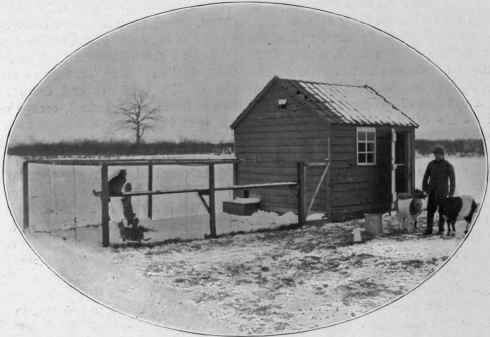
One Of Mrs. Neate's Out-Door Catteries At Wernham
One of Mrs. Vidal's orange kittens, "Puck " by name, is now owned by Mrs. Moxon, of Ilfracombe, from whom I have obtained a photograph for reproduction.
A few notes on orange Persian cats by Mrs. Vidal will be interesting to my readers:"It is difficult to imagine a more gorgeous colour than a really good orange lying full length in the sun. There is, however, rather a prejudice against them, chiefly because some people persist in calling them 'sandy' or 'ed,' both of which names are quite misleading. I have several times had people say to me when visiting my cattery,' I have always thought I did not like sandy cats, but I have never before seen a cat of such a lovely colour as the one you have just shown me.' Six years ago, when I first took up cat rearing, it was rare to see any orange cats at the shows, but now they and the creams form one of the most beautiful classes, and they have a specialist society of their own and an energetic secretary in Miss Mildred Beal.

Curiosity (Photo: Mrs. S. F. Clarke.)
Continue to:


My Books

