


Orange, Cream, Fawn, And Tortoise-Shell Cat Society. Part 3
Description
This section is from the book "The Book Of The Cat", by Frances Simpson. Also available from Amazon: The Book Of The Cat.
Orange, Cream, Fawn, And Tortoise-Shell Cat Society. Part 3
"There are two classes of oranges, one which has the ordinary tabby markings, more or less distinct, and the other which is 'flecked' all over the back in small patches, and which is usually not nearly so bright in colour as the so-called 'tabby' markings. The correct thing is to breed a totally unmarked orange ; and, although many people claim this for their pets, it is very rarely seen. The absence of markings usually means absence of the rich orange colour so much admired. Any white on chin or bib is, of course, a blemish, and for breeding or show purposes such an animal is perfectly useless.
" An orange stud cat is a very useful animal to have in a cattery, for crossing with him will improve many colours, viz. tortoiseshell, brown, grey, and sable tabbies ; while if he is mated to a blue queen the kittens, if orange, are beautiful in colour - brighter, I think, than if two orange cats are mated together. In mating with other colours it is a toss-up what colour will predominate, but the only way to ensure all orange kittens is to mate with orange queens, when, according to my experience with my stud cat ('Torrington Sunny-sides'), the results are all orange. Mated with tortoiseshells the orange kittens are very good ; but mated with blacks the strongest colour carries the day, and the kittens are mostly black or tortoiseshell, seldom orange. Silvers, chinchillas, and smokes should, of course, never be mated with oranges, as the result would be a horrible mixture ! Orange queens were at one time very rare, and even now are not plentiful, being delicate and difficult to rear.
"The time at which the kittens change the colour of their eyes from the baby blue to orange varies a great deal in individual animals, from seven to twelve weeks. When the eyes are very deep blue, they change to bright rich orange or hazel; but if of a pale blue, they change very quickly to a poor yellow, and never get the rich dark orange which the deeper blue get. Therefore rejoice when you see your kittens with deep blue eyes. Some of our kittens have had the most lovely deep blue eyes, and great has been our sorrow as we found the inevitable change coming on. If I could only manage to get some kittens with the permanent blue eyes that the best white cats have, I should indeed be proud; but thinking of the kittens with terrible white chins and under-coats, which would crop up in every litter and would have to be drowned, quite deters me from sending my orange queens to white studs with blue eyes! All who have been accustomed to frequent the show pens will remember Miss M. Beal's splendid old orange queen 'Jael,' who up to the last, although nearly fourteen years old, always took first prize, and was a very good specimen of what an orange queen should be - of a bright rich orange, without any suspicion of light under her chin or chest (the usual weak point), and having the splendid head, short nose, and good cobby shape which all breeders strive for.
Short-haired orange cats are often seen about our towns and villages, and are always called 'sandy,' but are not, I think, held in much account. They are distinct from the so - called' red tabby,' which is a recognised colour in our shows."
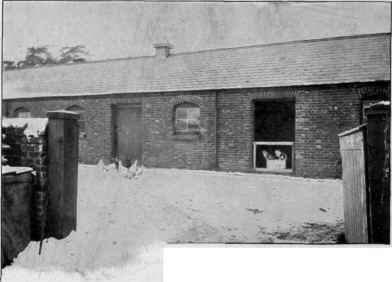
Another View Ok Mrs. Neate's Cat Houses
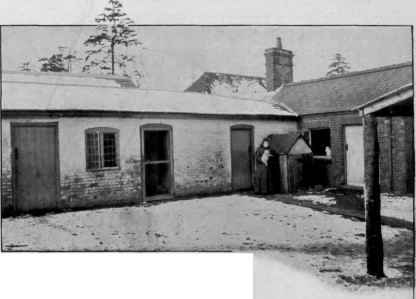
Mrs. Neate's Cat Houses
Among the prize - winning females of the present day I must not forget to notice Mrs. Singleton's "Orange Girl," bred from Miss Beal's noted strain. This cat has had many honours showered upon her during a very short career, and as there must always be a scarcity of queens in this breed, this fine specimen is a valuable possession.
So long as there are two cat clubs and two registers there will be a confused multiplicity of names, and so yet another orange male called "Puck" inhabits the cat world. This handsome fellow is owned by the Hon. Mrs. McLaren Morrison, to whom I had the pleasure of awarding first prize and many specials at the Botanic show held in June, 1902. His vivid colouring and well-shaped limbs and splendid eyes will always make him a conspicuous specimen in the show pen. Alas! his photograph does him but scant justice. Quite a surprise packet appeared at the Crystal Palace show of 1902 by the appearance of a very handsome young male in " William of Orange " exhibited by Mrs. Stillwell, and bred from Dr. Roper's noted black "Johnnie Fawe" and tortoiseshell queen "Dainty Diana." This cat was awarded first and many specials, and was claimed by Lord Decies at catalogue price. As "William" was not a year old when he won his laurels, it may readily be believed that he has a distinguished career before him, and may add another to the long list of winners owned and exhibited by Lady Decies. No orange male cat is better known in the fancy than that splendid fellow " The King's Own," belonging to Mrs. Neate. He has had a most successful career, and may be considered as nearly self-coloured an orange as any yet exhibited.
Mrs. Neate is a devoted admirer of this breed and also a great cat lover, and has recently started an arrangement for boarding cats, and truly I know of no place better adapted for successful cat keeping than the home of Mrs. Francis Neate, at Wernham, near Marlborough ; situated as it is in the very heart of the country, a mile from any other house, her cats can enjoy their liberty with perfect safety.
A large range of brick-built and slated outhouses has been converted into catteries and comfortably fitted. All have wooden floors, wire doors, and large runs attached. A number of portable houses and runs are dotted about the kitchen garden and meadows. An empty cottage serves as an isolation hospital, or place of quarantine for cats returning from shows.
Continue to:


My Books

