


Shaded Silvers. Part 7
Description
This section is from the book "The Book Of The Cat", by Frances Simpson. Also available from Amazon: The Book Of The Cat.
Shaded Silvers. Part 7
"Thus the type once fixed survives, though it be by the aid of the most incongruous connection, such as a brown tabby. Had the latter been the patrician bred from progenitors of her colours, and the chinchilla been the one of doubtful lineage, the result must, of course, have been reversed, and the kittens, in all probability, would have followed the brown tabby strain. If neither parent cat when of distinct varieties can boast a particularly dominant strain, the offspring naturally partakes of the peculiarities of both.

"Silver Blossom." Owned by Mrs. Walker. (Photo: Findlow & Co., High Wycombe.)
"Colour, in chinchillas, is the most important point. It should be of palest silver, lavender tint, and lighter - in fact, practically white - at the roots. There should be no dark blotches or stripes or brown tint on the back or about the nose. A rusty hue is, however, sometimes caused by the action of the sun or wind. As regards bars or stripes on head, these should be as few and light in colour as possible, with a view to breeding them out altogether in the future.
"The coat should be long and thick, of fine, soft texture, much thicker and longer round the neck, forming a decided frill and mane, the latter reaching well down the fore legs. It should also be longer on the hinder part of the thighs, forming culotte, and very bushy on the tail, which should be short and wide. The legs should be slightly feathered, with tufts of hair between the toes. There should also be tufts in the ears, which should be very small and set low.
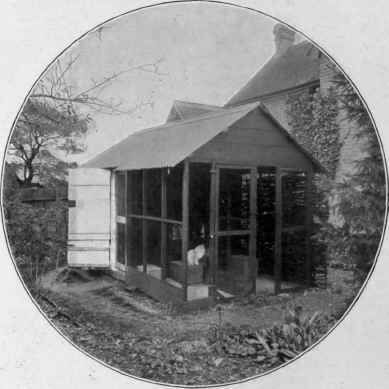
Miss Leake's Summer Cattery (Photo ; Cassell & Company, Limited.)
"The head should be wide at the forehead and short in the muzzle, well filled up below the eyes, giving it a round appearance. The eyes large and luminous, in colour emerald green with black lids. Green and yellow-mixture is permissible, but not so picturesque as the green; yellow in the eyes is not desirable. In shape the chinchilla should have a level back, and be only slightly long in the couplings. The legs should be short, with round paws, the latter well padded. When in full coat the hair should nearly reach the ground and the frill envelop the back of the head, making a very fascinating whole."
The following is the standard of points as drawn up by the Chinchilla Cat Club. It is also used in America as a basis for criticism:
1. Colour Of Coat
Palest silver, lavender tint preferred, nearly white at roots. No dark stripes, blotches, or brown tint. Darker tips to the long hairs give the coat an appearance of being lightly peppered with a darker shade. The whole appearance of the cat to be very pale .. .. .. .. .. 30
2. Coat
Long and thick . . . . 20
3. Texture Of Coat
Fine and soft . . 10
4. Tufts of hair inside and round the ears and between the toes .. .. 10
5. Head
Broad and round; forehead wide, ears small and set low, nose short . . . . .. 25
6. Shape
Back level, not too short; legs short, paws round ; brush short, wide, and carried low .. 20
7. Eyes
Large, luminous, and green in colour (if green mixed with yellow, 5 points only allowed) . . 10
To breeders of silver Persian cats an article by Mrs. Neild will be valuable and instructive. Mrs. Neild has made, so to speak, a speciality of silvers, and owns two noted silver studs - the "Absent-minded Beggar" and "Lord Hampton." There are always some good silver queens, and very frequently some choice kits, disporting themselves in the well-arranged catteries at Hart Hill, Bowdon, where Mrs. Neild has a kennel of Borzois and a cattery of silvers.
This is what Mrs. Neild says regarding the breeding and rearing of silver Persian cats :"Perhaps of the many varieties of Persian cats - and, indeed, they are a goodly number as they now appear on our show catalogues and schedules - the silvers may claim their owners to be the most sporting of cat breeders. Certainly, to breed successfully it is essential that one should possess the not too common virtues of unlimited patience and perseverance. Also experience is necessary.
"A common occurrence among even old hands is to assign a kitten - one of a new litter under inspection, as being of' little good except as a pet' -'to be sold at a small sum to a good home,' and a few weeks later discover this same kitten to be the pick of the litter. In short, the old, old story of the ugly duckling incessantly repeats itself in our catteries, certainly in those devoted to silver cats. Therefore I suspect fanciers who have succeeded (all honour to the few !) and those who mean to succeed in breeding silver Persian cats of possessing a larger stock of patience and of having acquired a larger experience than their brothers and sisters whose love has turned towards the blue, black, or white pussies.
"With these last three one may be tolerably sure - always taking for granted some knowledge - of fairly pure coat colour, and at a very early age the best kittens of the litter may be picked out - those having greatest breadth of skull, smallest ears, etc. But the silver litters are a veritable surprise packet, and remain so for an irritatingly long period. Personally, I have found that those kittens which, when born, have very pale - almost white - unbarred faces and fore legs are ultimately those which grow palest. I take no notice of the colour of the coat on the back, sides, hind legs, or tail, even if striped, as frequently happens, for all these markings generally vanish if - as I before said - the face and fore legs are unbarred. I must, however, own to one kitten who was born jet black. She was by Mrs. Champion's 'Lord Argent' and a shaded silver queen of my own breeding. When a month old I dubbed her a very bad smoke; at three months she was coatless - a most indecent little person, having shed her coat more completely than I had ever seen in cat or kitten.
Continue to:


My Books

