


Shaded Silvers. Part 6
Description
This section is from the book "The Book Of The Cat", by Frances Simpson. Also available from Amazon: The Book Of The Cat.
Shaded Silvers. Part 6
When the challenge cups of the National Cat Club were designed in 1897, it was decided that the beauty and interest attached to them should be enhanced by immortalising on each the most representative cat of the long-haired and short-haired varieties. For the latter the great' Xenophon' was chosen without hesitation. Then came the more difficult task of deciding upon a recipient for the distinction from the long-haired ranks, which claim so much of the beauty and wealth of winnings of the cat world as to render the singling out of one a matter of consideration. To hasten the termination of the discussion Mrs. Stennard Robinson sent for a collection of cat photographs which had been left to her by the late Miss Portman, the well-known'Rara Avis' of the Lady's Pictorial. Amongst these the hon. secretary of the N. C. C. pointed out one - with no name attached - as the most beautiful photograph of the lot. This was recognised by most of the committee as being' Silver Lambkin,' so the honour fell to him.
"By some error at the makers' the longhaired cat was placed on both challenge cups, and it was determined by the club that the superfluous model which had to be removed and replaced by 'Xenophon' should be mounted as a letter-weight and given as a challenge prize for kittens, to be won three times before becoming the property of the winner. After some keen competition, covering about half a dozen shows, Mrs. Martin won it outright in 1899, when it was replaced by the present exactly similar model.
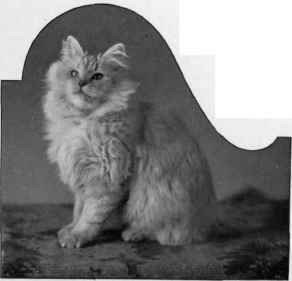
Mrs. Wellbye's Silver "Veronica. " (Photo: E. Landor, Ealing. )
"The endeavour of the Chinchilla Cat Club, of which all the leading breeders and most successful exhibitors are members, is to continue the work that has been done to improve chinchillas, and to produce a new variety the colour of the palest shade of the fur (dyed) known as' blue fox,' or a very light shade of pigeon blue. Without doubt such a result can be obtained by careful selection and -'the little more.' Darwin's words on the subject of selection are attractive to all owners of live stock. He says: 'Improvement is by no means due to crossing different breeds. All the best breeders are strongly opposed to this practice, except sometimes amongst closely allied sub-breeds. And when a cross has been made, the closest selection is far more indispensable even than in ordinary cases. If selection consisted merely in separating some very distinct variety and breeding from it, the principle would be so obvious as to be hardly worth notice ; but the importance consists in the great effect produced by the accumulation in one direction during successive generations of differences absolutely unappreciable by an uneducated eye.
Not one man in a thousand has the accuracy of eye and judgment sufficient to become an eminent breeder. . . . Few would readily believe in the natural capacity and years of practice requisite to become even a skilful pigeon fancier.'
"The Chinchilla Cat Club is also prepared to encourage cats of new colours, which should now be not so very difficult to produce, considering the points that have been brought out in those varieties that were well known, the latter showing that it is possible to breed to a standard if judgment is used in the endeavour to do so. Some of us remember the time when a blue cat, either long- or short-haired (now the largest classes), was a rata avis when Mrs. Lee's 'Meo' was the only Siamese at the Crystal Palace show, smokes an equal oddity, blue eyes in a white cat a comparatively unnoticed point, and cream-coloured cats entirely unknown.
"The colour of the chinchilla has been bred in various ways. In bygone days, when chinchilla cats were flukes or freaks and few and far between, methods which would now be considered somewhat eccentric were resorted to by the first breeders of the colour. The useful tortoiseshell, from which black, red, cream, or tabby cats can be got, was pressed into the service, and, paired with a silver or light blue tabby not too clearly marked, would occasionally, amid the multi-coloured kittens for which tortoiseshells are proverbial, throw a medium chinchilla or light silver tabby, which with careful selection might, a generation or two later, develop into something approaching a good chinchi la.
"But it is, perhaps, more difficult to foretell with cats than any other animal what the result of pairing will be with anything like certainty. This particularly applies to the ordinary English cat, as it is impossible to guess at the mixture of different-coloured creatures which have preceded it, and any of which may influence the progeny of its descendants. A fancier who would produce any particular specimen must, amongst other gifts, be equipped with the patience of biblical celebrities and prepared to wait seven years, as one enthusiast actually did before arriving at the fulfilment of his desires in the shape of a well-marked tabby kitten.
"With pedigree cats, of course, the chances, of unexpected traits reappearing in their progeny are considerably lessened, and, given desirable connections on both sides of some years' standing, the personal attributes of a coming litter may be predicted more or less successfully. One of the loveliest of smokes - the correct black, with white undercoat, without the shadow of a stripe - was from a brown tabby queen, from brown tabby parents, and a chinchilla bred from a chinchilla dam and smoke sire. Again, a brown tabby with white paws, whose appearance did not suggest the bluest of blood, mated with the same chinchilla sire, produced in a litter three chinchillas and two faintly marked silver tabbies, which would nowadays have been styled 'shaded silvers' by followers of the dubious hue. Needless to say, these instances are not given to encourage the idea of breeding chinchillas from brown tabbies, but as illustrations that just as the results of pairing a cat with one of nondescript pedigree cannot be guessed, so in an animal carefully bred for generations so indelibly have the characteristics of the breed or variety been stamped upon it by past ancestors that it is practically impossible for them to become obliterated or submerged.

Southern Cattery, Showing Entrance To Infirmary And Indoor Cattery
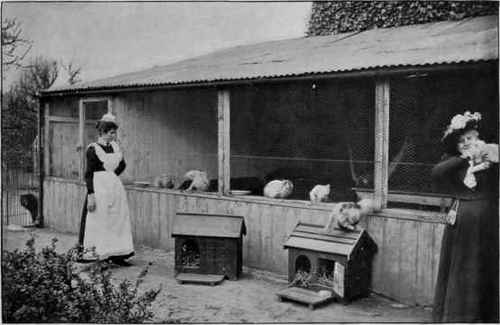
Mrs. Walker Visiting Her Pets. Two Views Of Woodheys Cattery
Continue to:


My Books

