


Chapter XIII. The Thibet Mastiff
Description
This section is from the book "British Dogs: Their Varieties, History, Characteristics, Breeding, Management, And Exhibition", by Hugh Dalziel. Also available from Amazon: British Dogs.
Chapter XIII. The Thibet Mastiff
This breed is comparatively rare in England, and therefore only occasionally met with at our shows, but he is such a magnificent animal that I would gladly see him bred here, as he is really well worth cultivating for his noble appearance, and under the skill and care of English breeders his natural good qualities, grand proportions, and noble bearing would be developed to the utmost.
In their native country they are used as guardians of the flock and the family, and half a dozen of them with "their bristles up '" would certainly present a formidable front to marauders, human or lupine.
In general contour he bears a considerable resemblance to our English mastiff, although, the rough dense coat and black colour is quite a contrast to the rich fawns and fallows of our home breed, with their close-lying short and shining jackets.
The subject of our engraving is a remarkably fine specimen, one of two exhibited by His Royal Highness the Prince of Wales at the Alexandra Palace Show, December, 1875. The pair were exceedingly well matched, and were much admired, Siring, whose portrait we give, being perhaps a shade the better.
In size they are not quite equal to our native mastiffs, although the long coat gives them an advantage in appearance, but both the specimens shown by His Royal Highness were well formed, strong in the back and loins, deep ribbed, with well developed quarters, and standing on stout straight legs with no lack of bone; the coat is about as long as a Newfoundland's and very dense, not sleek and glossy, but rough, without being harsh; the colour is black, inclining to brownish-black on some parts of the body; the tail is large, well furnished with hair, and carried pretty high and with a good swirl - in fact, the term "gawcie," which Burns uses to describe the Scotch colley's tail, pretty accurately applies, but unfortunately I can find no exact equivalent in English. Bushy yet showy comes near it, and the Thibet mastiff carries his stern much higher than the colley - in fact, well over the hips.
The head, wherein the character of the animal is stamped, and where we always look first in considering the type of dog, differs considerably from that of his English namesake, and partakes somewhat of the character of our bloodhounds, although equally distinct from that, and it might fairly be described as a compromise between the two, as it possesses features common to both - the skull is shorter than that of the bloodhound, and not so massive as that of our mastiff; the ears are small, like the latter, but the eyes are deep sunk, like the bloodhound's, and show some haw; there is also a good deal of flew, the lips falling very deep, quite as much so as in an ordinary specimen of a bloodhound, and with this there is the usual concomitant throatiness, although this latter feature is not so noticeable under the thick ruff that surrounds the throat and neck as it is in the smooth-haired hound; the muzzle is a trifle longer than in our mastiffs, and the nose is wide and capacious, showing inherent ability to hunt, although that quality may not be developed, as he is principally used as a guard.
The general appearance of the animal stamps him as a distinct variety, and one of such noble qualities, that I would like to see such encouragement given at our Kennel Club shows to this variety, and to the Russian wolfhound, and a few others, as would stimulate breeders to produce them and bring them forward at our shows in greater numbers.
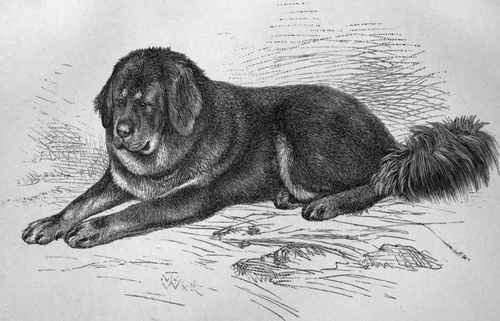
H.R.H. THE PRINCE OF WALES'S THIBET MASTIFF " SIRING." Imported.
Continue to:


My Books

