


The Bedlington Terrier. Part 2
Description
This section is from the book "British Dogs: Their Varieties, History, Characteristics, Breeding, Management, And Exhibition", by Hugh Dalziel. Also available from Amazon: British Dogs.
The Bedlington Terrier. Part 2
At Liverpool, to which show she was sent on, a similar mistake occurred; but the committee of the show becoming aware of the fact, sent Mr. Pickett a special prize. Despite this series of rebuffs, Mr. Pickett forwarded Tyne to the Glasgow show, when the judges pronounced her not to be a Bedlington at all. The Scotsman' of 2nd March, 1872, however, in its notice of the show, remarked that she was by a very long way the best in the class in which she was exhibited. This was a case of doctors differing with a vengeance; and Tyne managed to stultify the Glasgow decision by making a round of brilliant victories at York, Kendal, Bedlington, Blaydon, Seaton Burn, and other district shows, and won twice at Durham - viz., in 1870 and 1871 - finally visiting the great Crystal Palace exhibition of 1872, and taking first prize in her class, which the 'Times,' of 2nd June, 1872, described as the best collection of Bedlingtons ever exhibited at any show. Tear-'em is the hero of the original show at Bedlington in 1870, where, in a class of fifty-two competitors - a number that has never been exceeded since - he was awarded first prize.
Tyneside, a beautiful blue bitch, faultless in shape, coat, and colour, was placed first in a class of twenty-five at Bedlington in 1871; but in the Bedlington show of 1872, this distinguished branch of the family obtained its greatest triumph - Tyne (own sister to Tear-'em) being placed first, with Tear-'em second, and Tyneside third, in a class of twenty-three entries. I have been supplied with a pedigree of Tyneside for six generations back, but the limited space at my disposal prevents my giving it here. It may, however, be stated that she is inbred to a most curious extent, the name of Hutchinson's Tip occurring no less than five times in the course of her pedigree, while on the part of both sire and dam she is descended from such grand dogs as Bagille's Piper, Thompson's Jean, Burn's Twig, Jos. Shevill's Jean, Thompson's Boa Alley Tip, and Bagille's Nimble, etc. The dimensions of Tyneside are as follows: From lugs to tip of nose, 8in.; length of tail, 11½in.; length of lugs, 5in.; breadth (tapering off in a filbert shape), 3in.; height from the claw to the shoulder blade, 14¾in.; weight, 201b.; size round the chest, 19½in.; and fore arm, 7in. So much for the Bedlingtons, and in taking leave of the race I may mention that most of them known to me are terribly inbred, and that the usual consequences often follow; also that many of them exhale an odour which, to say the least of it, is peculiar."
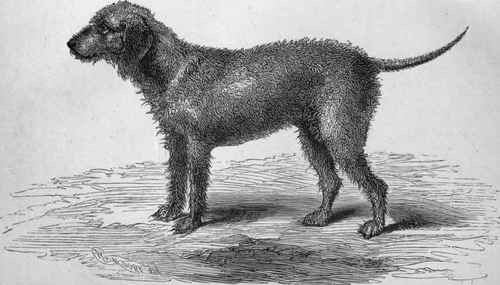
MR, J. CORNFORTH'S BEDLINGTON TERRIER "NEWCASTLE LAD" (K.C.S.B. 6668).
Sire Mr. Liddell's Tip - Dam Mr. Morris"s Sut.
The following quotation from a letter on the subject, by Mr. W. J. Donkin, secretary of the Bedlington Terrier Club, is in some points confirmatory of the above, and throws some additional light on the history of the breed. He says:
"During the first quarter of the present century, Mr. Edward Donkin, of Flotterton - still dear to the old sportsmen of Coquetside by the familiar soubriquet of ' Hunting Ned' - hunted a pack of foxhounds well known in the Rothbury district. At that time he possessed two very celebrated kennel terriers, called Peachum and Pincher. A colony of sporting nailors from Staffordshire then flourished at Bedlington (a village situated about twelve miles north from Newcastle), who were noted for their plucky breed of terriers. But reform was at hand, and the old favourites were obliged to make way for new blood. To Joseph Ainsley, a mason by trade, belongs this honour. He purchased a dog named Peachum from Mr. Cowen, of Rock Law, and the result of a union of this dog with Mr. Christopher Dixon's Phoebe, of Longhorsley, was Piper, belonging to James Anderson, of Rothbury Forest. Piper was a dog of slender build, about 15in. high, and 151b. weight. He was of a liver colour, the hair being a sort of hard woolly lint, his ears were large, hung close to his cheeks, and were slightly feathered at the tip.
In the year 1820, Mr. Howe, of Alnwick, visited a friend at Bedlington, and brought with him a terrier bitch named Phoebe, which he left with Mr. Edward Coates, of the Vicarage. Phoebe belonged to Mr. Andrew Riddle, of Framlington, who subsequently made a present of her to Ainsley; but from the fact of her home being at the Vicarage she was generally known as Coates's Phoebe. Her colour was black, with sort of branded legs, and she had a light-coloured tuft of hair on her head. She was about 13in. high and weighed 141b. In 1825 she was mated with Anderson's Piper, and the fruit of this union was the Bedlington terrier in question, Mr. Ainsley being the first to claim that title for his dog Piper. Of the sagacity and courage of Piper, one of their offspring, a volume might be written.
"The Bedlington terrier is fast, and whether on land or water is equally at home. In appetite these dogs are dainty, and they seldom fatten, but experience has shown them to be wiry, enduring, and in courage equal to the bulldog. They will face almost anything, and some queer stories could be told about them; they will seize a burning paper; and Mr. Thos. Wheatley, of Newcastle, had a dog that carried a red hot poker in its mouth, the mouth after having much the same smell as when putting a new shoe on a horse's foot. The dog mentioned was a very little one, and was greatly in-bred. To their other good qualities may be added their marked intelligence and hostility to vermin of all kinds. They will encounter the otter, fox, or badger with the greatest determination."
The same writer, I may observe, in common with most fanciers of the breed, claims for them a pedigree going back to 1792; but it is quite clear from the above statement that an admixture of terrier blood from Staffordshire was introduced, and the colour of the Alnwick bitch bred from by Ainsley goes to show she was not in that point at least what we now recognise a Bedlington to be. The evidence, written and traditional, is, however, conclusive that a terrier of a distinct type had, prior to that, been recognised as peculiar to the district, and the infnsion of a strain of foreign blood, although it might modify, would probably not greatly alter the original type.
Continue to:


My Books

