


Chapter XVIII. Stable Servants
Description
This section is from the book "Stable Management And Exercise", by M. Horace Hayes. Also available from Amazon: Stable Management And Exercise.
Chapter XVIII. Stable Servants
Varieties and Duties - Wages, Board and Lodging - Commission - Allowances and Tips - Livery and Stable Clothes - Qualifications of Grooms and Coachmen - Veterinary Surgeons and Grooms - Respect due from Stable Servants to their Masters.
Varieties And Duties
Unfortunately for the harmony which ought to exist between master and man, the terms "groom" and "coachman" are ill defined. Hence, before engaging a stable servant, it is in the highest degree advisable to come to a clear understanding with him as to the exact nature of his duties. If a man is engaged, say, from an advertisement, as a "groom," without any further explanation, he will expect to have some help, and he will not feel called upon to do anything outside his own particular sphere. A "coachman " occupies a somewhat better position than an ordinary groom, and would expect to have a groom entirely under him. If the place is a single-handed one, that fact should be conveyed to the groom or coachman before engagement. If the master wants the man to fill up his spare time with work outside the stable, he had best engage him on the understanding that he must be willing to make himself generally useful when required. This extra work may include cleaning boots, brushing clothes, cleaning windows, chopping firewood, bringing in coal to the house, going messages, and lending a hand at any outside unskilled labour. Gardening, waiting at table, and cleaning hunting things could not fairly be included in this list. In a small place, say, with only two or three stablemen, the cleaning of boots is generally taken for granted; but in large establishments, that duty would be performed by an "odd man " or boy. A coachman is of course expected to be able to drive single and a pair, but not four-in-hand, unless he is specially engaged for that work, as well as for the more simple forms of driving.
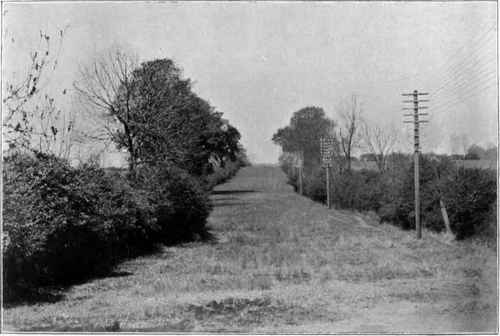
Fig. 62. - WATLING STREET ROAD, On which Dick Turpin and Black Bess made their famous journey. It is now a bridle path.
The most humble kind of stable manager is a pony boy, whose labour in the stable is one of many duties. In large places, an odd man will be occupied almost entirely with outside house work, and will have little or nothing to say to the stable, which, in the opinion of grooms and coachmen, should be kept sacred from outside intrusion. We meet among cooks, gardeners, and officials of all kinds, the same dislike to unprofessional inspection. In small establishments, the odd man will probably divide his time pretty equally between the house, stable, and garden.
The groom-gardener who has at least half of his time for devotion to the stable, may be reasonably expected to look after a horse and trap, or two saddle-horses, the time occupied in the exercise of which might be regarded as equivalent to that spent in driving the dog-cart or gig. Any driving which the groom-gardener would have to do, would naturally be of an unpretentious character, and he would not be expected to wear livery, beyond a top coat and tall hat. A strapper in a hunting stable and a stable helper under a coachman would be on about the same social standing as a groom-gardener. The strapper is not supposed to ride, and the stable-helper not to drive. Either of these men ought to be able to do three horses well, and also to lend a hand at cleaning saddlery, harness and carriages. In a job-master's yard, in which there is usually the stimulus of tips, more work would be expected, say, that of five, or even six horses; but its execution would be of a rough and ready nature. In tram and omnibus yards, a stable-helper will generally have to do ten or a dozen horses in a "lick and a promise" kind of a way.
A single-handed groom or an ordinary groom who is in a subordinate position in a stable, will have a comfortable job in grooming, feeding, watering and exercising two hunters or two polo ponies, which he ought to turn out in first-class style. If he is industrious and has a boy to help him when the ponies are brought on the polo ground for play, he will be able to do three ponies, which he can exercise together by riding one and leading the other two, one on each side. A single-handed or ordinary groom can do all the stable work for three horses which are in work; but he cannot give them a sufficiency of exercise, supposing that he leads only one at a time. The difficulty as to exercise would of course be obviated, if the master or one of his family did all the riding. As a rule, a single-handed groom would not have as much time to devote to the grooming and exercising of his horses, as an ordinary groom; because he would have to do stud groom duties in arranging about fodder, mending of gear, replacement of stable tools, etc. Supposing that a single-handed groom was not expected to ride or drive, and that extreme smartness was not demanded, he ought to be able to look after a two-wheeled trap and harness, as well as three horses. A carriage groom will do about the same work as an ordinary groom, allowing for the time he may be absent from the stable. His duties are to go out with the coachman, sit beside him on the box, perform the work which a footman would otherwise do, clean harness, and strap.
A single-handed coachman would be able to do a carriage and pair in first-class style, if the turn-out was not wanted oftener than every second day. We must here bear in mind that the work on the horses, carriage and harness, and the cleaning of the man's livery, will take about five hours.
A groom or coachman would not esteem a single-handed place as much as one in which he had a man under him. Besides, stable servants as a rule like the society of their fellows, and appreciate a comfortable saddle-room, which is a luxury seldom found in a single-handed situation. Married men, and especially those who are no longer young, often like the independence of a single-handed job.
Continue to:


My Books

