


Chapter VI. Feeding. Economy In The Selection Of Food
Description
This section is from the book "Stable Management And Exercise", by M. Horace Hayes. Also available from Amazon: Stable Management And Exercise.
Chapter VI. Feeding. Economy In The Selection Of Food
canal; but dry forage which is rich in fibre, such as hay and straw, retard its action. Hence, when horses, presumedly idle ones, are given little or no corn, the remainder or the entire of their ration, as the case may be, should not be exclusively composed of hay or of hay and straw, but should consist more or less of green food, which will keep the alimentary canal in good order, and will aid in preventing the accumulation of injurious materials in the system.
Economy In The Selection Of Food
Although oats are the best kind of corn for every class of horse, we may be forced to seek for a substitute from motives of economy. Maize appears to be the only efficient substitute in the case of hard-working horses. Although barley (p. 154) may be given up to 9 or 10 lb. daily, it is not conducive to health if the quantity be much increased beyond that limit. Mr. W. F. Shaw, F.R.C.V.S., who has had great experience in the feeding of tram and cart horses, tells me that "a few years ago, barley, 50 lb. to the bushel, could be purchased at 12s. or 13s. a quarter; while oats, 38 lb. a quarter, cost 14s. or 15s. Barley was then used to adulterate oats very heavily. In some cases a mixture containing a third of barley was sold as oats to small horse-owners. This barley was not even crushed, and yet at that time knackers' yards did not receive more carcases of horses which had died from digestive derangements than at times when oats were cheap. A certain tramway company at that time fed their horses on a daily allowance of 16 lb. of crushed barley mixed with chop. The mortality was considerably increased; but even then the company, I am inclined to think, were in pocket, on account of the saving on the corn bill." Mr. Shaw mentions this as an economic fact, but not as an example to be copied.
The principle upon which commercial horses are at present generally fed, is that the grain which is cheapest, weight for weight, is the one that is selected for use. It is usually thought advisable to increase the feeding value of maize by an addition of about a sixth part of peas or beans. Mr. Shaw, however, states that "in feeding cheaply, even for hard work, beans and peas can be left out of the bill of fare. Although I am fully aware that this is contrary to general usage, and opposed perhaps to the teaching of chemistry, I consider that the high price of these grains prohibits their employment, when trying to feed economically. I found from an experience of several years in feeding a large stud of horses which had to be maintained in condition to perform hard and fast work, that these animals accomplished their task and kept their condition in a satisfactory manner without a single pea or bean being given them." Mr. Shaw considers that bran, even in small quantities, is not an economical food.
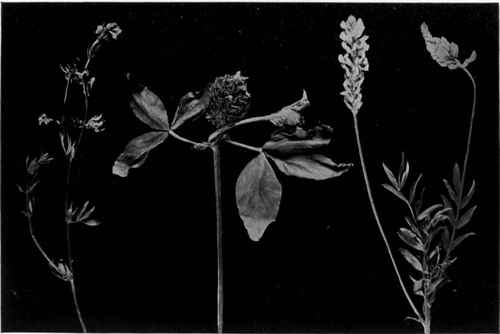
Fig. 9. - a, Bird's Foot Trefoil (Lotus corniculatus); b, Broad Red Clover (Trifolium pratense); c, Sainfoin (onobrychis sativa).
With respect to the nature of the chop, Mr. Shaw tells me that "in the majority of commercial studs the principal constituent of the chop is meadow hay, which by itself would render the chop too soft for obtaining a uniform distribution of the grain throughout the entire mass of the food. A small quantity, say a third, of oat straw placed in the cutter, will enable the hay to be cut shorter, and the resulting chop will be more useful for mixing, and will entail no deteriorating effect on the condition of the horses. Clover, lucerne, and sainfoin are employed for the same purpose to mix with meadow hay. Best clover hay is too expensive for economical feeding, and inferior clover hay, which may be purchased cheaply, is apt to cause serious digestive disturbance from its unduly hard and woody character.
"Dutch hay, Russian hay, American and Canadian timothy, South American lucerne, and Algerian hay are used in this country, when home-grown meadow hay becomes expensive. If foreign hay, either wholly or in part, is employed, care should be exercised in its selection; because serious mortality is often brought about in a stud by the injudicious feeding of such forage, in which case, as a rule, the grain, and not the hay, unjustly gets the blame. A few years ago, great mortality was produced amongst horses in this country by the importation of a large quantity of Algerian hay. As long as the chop is sound, its composition is of little moment, because it is merely the vehicle for facilitating the assimilation of the grain, which is the essential force-producing material.
"During the hay famine which occurred some years since, I witnessed a six months' experiment of giving chop, consisting entirely of straw, to a hundred horses in a large working stud, the remainder being supplied with hay chop, in which there was a small percentage of straw, but no change was made in the grain. During the allotted six months, the hundred experimental horses performed their work quite as well as the hay-fed animals, and at the end of this period were in equally good condition.
"With horses that are inclined to waste their food by throwing it out of the manger, there is economy, without injurious results, in damping the food."
Continue to:


My Books

