


Lucerne
Description
This section is from the book "Stable Management And Exercise", by M. Horace Hayes. Also available from Amazon: Stable Management And Exercise.
Lucerne
Lucerne, which is known as alfalfa in America, is a very valuable food for horses, both green and as hay. It requires dry ground, a warm aspect (preferably in England, ground sloping to the south), and a permeable subsoil rich in lime, which forms a particularly large percentage of the mineral matter in this plant. As the roots descend to a great depth, the absence of lime in the subsoil cannot be efficiently replaced by lining the ground. Ten or twelve feet is not an unusual length for the roots. Bonnet gives an instance of the main root of a plant of lucerne being sixty feet long.
Unfortunately, the necessary conditions of climate and soil for the successful growth of lucerne, cannot always be obtained in England. This fodder thrives best in climates like France, Italy, Spain and the Argentine Republic. It grows well on suitable soil in India, provided that it is frequently watered during the dry weather. Owing to the great depth the roots penetrate, it can bear drought better than any other plant of its kind. Stebler and Schroter state that "if the district has a heavy rainfall, the plant does not thrive at all. It may, in fact, be assumed that lucerne cannot be successfully grown wherever the annual rainfall exceeds 32 or 36 inches, even though the soil is suitable in other respects. Not only is the rain directly injurious, but weeds are favoured and obtain the upper hand." I venture to think that this remark with respect to the quantity of rain which is detrimental to the growth of lucerne, holds good only with reference to temperate climates; for I have found in tropical countries, that this plant thrives only with a frequent and liberal supply of water. In any case, stagnant water is hurtful to it.
In the cultivation of lucerne, which is not an unimportant branch of stable economy, we should bear in mind that the young shoots grow perpendicularly upwards from the rhizome (rootstock), and thus leave spaces which are liable to be occupied by grass and weeds that will more or less choke and impoverish the plants. Hence, in the sowing of lucerne, care should be taken to obtain pure seed and clean soil. The best preparatory crop is roots or potatoes which have been well manured. "After harvesting the preparatory crop, the ground is prepared as thoroughly and as deeply as possible. The subsoil-plough may be used, or two ploughs can be passed through the same furrow, the one to turn the surface soil and the other to stir the subsoil. This preparation of the subsoil is essential, if the land is at all firm. Lucerne is usually sown about the end of April or the beginning of May, when there is no danger of late frost, which acts injuriously upon the young plants. Late sowing also has its risks, as the fly which comes in with the warm weather is equally injurious" (Stebler and Schroter). It is well to sow in drills, so as to facilitate weeding; and Sutton tells us that the seed must not be deeply buried. In the event of manure being required, Stebler and Schroter advise the employment of 40 or 60 lb. of nitrate of soda on each acre, and point out that a dressing of stable dung is not only a waste of manure, but is actually hurtful, because it greatly favours the growth of weeds. Sutton recommends three cwt. of superphosphate per acre. "Its duration varies from 3 to 20 years and depends upon the nature of the soil and climate. In climates where the soil is warm and deep, fields of lucerne from 12 to 15 years are quite common; some fields are in their twentieth or even their twenty-fifth year and still the plants are good. If the conditions are unfavourable, the plants usually die out within a period of 3 years. Cultivation is only profitable when a ley of 5 or 6 years' duration can be relied upon. At the end of the ley, the land is broken up, and a cereal crop follows. As a general rule, it can recur on the same land only after a period of rest equal in duration to the lucerne ley. This interval of time, however depends largely upon the nature of the subsoil; if this is good, the crop may recur sooner" (Stebler and Schroter).
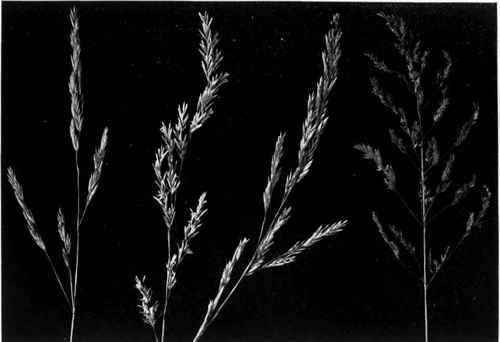
Fig. 7. - a, Red Fescue (Festuca rubru); b, Meadow Fescue (Festuca pratensis) in seed; c, Meadow Fescue not in seed; d, Rough-stalked Meadow Grass (Poa trivialis).
To face page 176.
Lucerne can usually be cut four or five times in the year. In fact, whether it is used green or as hay, it ought not to be allowed to flower; for as Wolff points out, it rapidly loses its nutritive properties after that period, by developing fibre. Besides, if cut when in flower, and especially when in seed, the plants become exhausted, and their life shortened. The best way for stable use, is to cut a little every day, according to requirements. It is advisable to dry it in the sun for an hour or more before giving it, so as to render it more digestible and to make the horse chew it better. For working horses, 3 or 4 lb. of green lucerne will be a fair daily allowance; and for idle horses, 8 or 9 lb.
Exact experiments have shown that hay made from young lucerne, is of higher feeding value than either pasture hay or clover hay (Farm Foods). Such hay, which is probably the best form of lucerne for feeding purposes, will be more or less of a green colour. As the nutritive matter of cut lucerne is very soluble in water, and as the leaves of dry lucerne are particularly brittle; it is essential when making lucerne into hay, to dry it quickly, and to turn it as little as practicable. Care should be taken to give in a clean state to horses, and to remove from it any adhering fungi, which often attack lucerne.
A plot of lucerne forms a very useful adjunct to a stable.
Continue to:


My Books

