


Scales Of Diet
Description
This section is from the book "Stable Management And Exercise", by M. Horace Hayes. Also available from Amazon: Stable Management And Exercise.
Scales Of Diet
In all cases I assume that the horse gets at least 3 1/2 oz. of salt (p. 101) daily in his food, or that he has a lump of rock salt constantly in his manger.
1. Idle Horses
The experiments of Grandeau and Leclerc show that an average horse, when in a state of idleness, can maintain his weight on 17 1/2 lb. of hay, or on 5 lb. of oats and 5 lb. of hay. We all know that an ordinary horse turned out to grass can keep in health on simply the natural herbage of the field; but on such a ration his muscular powers will gradually decrease down to his grazing requirements. Hence, if we want him to maintain his strength, as in the case of a hunter turned out in summer, or a polo pony at grass during winter, we should supplement his open-air food with a moderate quantity of corn, say, about 5 lb. This addition will have no "heating" effect; because the extra nourishment received into the system will become "worked off" by the increased exercise which the animal will take in response to the stimulating action of the corn. This voluntary exercise, supposing the animal to be sound, will be of great benefit in keeping up his condition, which once lost, takes a long time to regain. A horse cannot maintain life on straw as his only food.
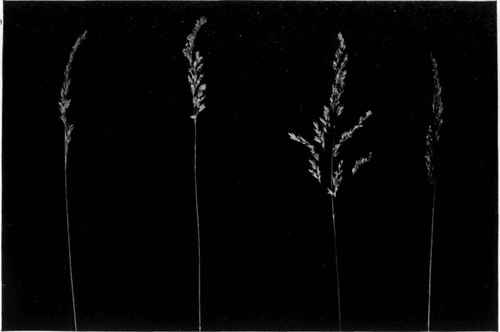
Fig. 10. - a, Sheep's Fescue (Festuca ovina); b, Fine-leaved Sheep's Fescue (Festuca ovina tenufolia); c, Smooth-stalked Meadow Grass (Poa pratensis); d, Hard Fescue (Festuca duriuscula).
To/act page 182.
Healthy horses which take no exercise, such as those on board ship, may get either of the following rations, according as carrots can or cannot be obtained: -
Oats ......... | 3 lb. |
Hay .......................... | 18 " |
Bran ....................... | 5 " |
Linseed ........................... | 3 oz. |
The linseed may be given as a mash or as linseed tea from time to time, or as meal.
Or,
Oats......... | 4 lb. |
Hay . . ...... | 12 " |
Bran ......... | 2 " |
Carrots .................................. | 7 " |
With this ration there is no need to give a mash.
2. Horses In Light Work
Oats....... | 7 lb. |
Hay......... | 16 " |
Bran .............................. | 2 " |
Carrots ................................ | 3 " |
3. Horses In Moderate Work
As examples under this heading we may take cavalry horses during peace time : -
ENGLISH CAVALRY HORSES. | |
Oats .............................. | 10 lb. |
Hay......... | 12 " |
The hay might with advantage be increased to 15 or 16 lb.
GERMAN CAVALRY HORSES. | |
Oats .................................. | 10 lb. |
Hay ........................ | 51/2 " |
Straw ...................... | 7 3/4 " |
U. S. OF AMERICA CAVALRY HORSES. | |
Oats or Maize ........ | 12 lb. |
Hay ......... | 14 " |
FRENCH CAVALRY HORSES. | |
Oats........ | 10 to 11 1/2 lb. |
Hay............................. | 5 1/2 to 7 3/4 " |
Straw ............................. | 7 3/4 to 8 3/4 " |
4. Horses In Full Work
Hunters and light harness horses might get on an average 14 lb. of oats, 12 lb. of hay, 3 lb. of carrots, and 2 lb. of bran. If the work is extra hard, an addition up to 4 lb. to the allowance of oats need not usually be exceeded. With an increase in the quantity of corn, there should be a corresponding diminution in that of hay. Racehorses in full training and others, like London cab horses, which have to do as much labour as can be extracted out of them, should get as much corn as they can eat, the maximum quantity of which may be put down at about 22 lb. As the height of polo ponies is 14 h. 2 in. and under, they will eat about three-quarters as much as hunters; say, 10 or 12 lb. of corn a day.
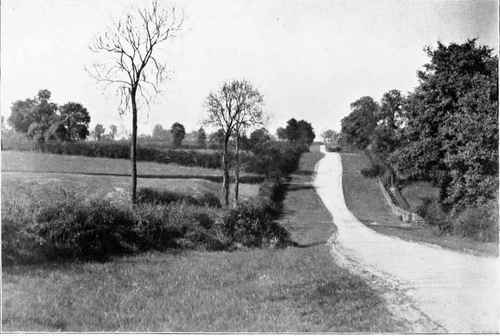
ROAD SUITABLE FOR EXERCISING HUNTERS.
We should bear in mind the law which experience and theory teach us, that the more continuous the work, the more corn will a horse require.
As illustrative feeds for cart, 'bus, tram, boat, and van horses, which have to be regarded, as a rule, from an economic point of view, we may take the following scales of food : -
LONDON ROAD CAR COMPANY'S HORSES. | |
Maize ......... | 16 lb. |
Oats......... | 1 1/2 " |
Peas ....................... | 1 1/2 " |
Hay chop........ | 12 " |
Total...... | 31 lb. |
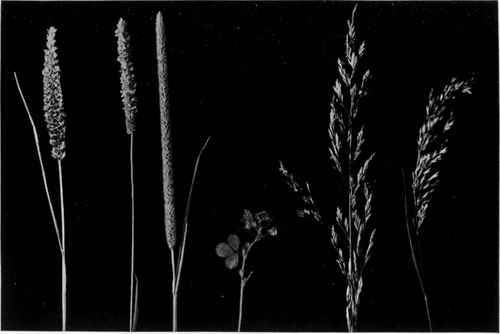
Fig. 11, - a, Crested Dogstail (Cynosurus cristatus); b, Meadow Foxtail (Alopecurus pratensis); c, Timothy (Phleum pratense); d, Suckling Clover (Trifolium minus); e, Tall Fescue (Festuca elatior); f, Yellow Oat Grass (Avena flavescens).
The good condition of these animals, and the large amount of hard work which they go through daily, prove that the above economical though liberal ration serves its purpose in a manner that leaves nothing to be desired. The former daily ration for the horses of this company was: -
Maize ........................ | 11 lb. |
Oats ..................... | 5 " |
Peas or beans ................. | 3 " |
Hay chop ...................... | 12 " |
Total . . . . . | 31 lb. |
The average cost of this food was about 9s. a week.
A heavy cart horse or powerful omnibus animal in full work will generally require about 19 lb. of corn a day. An ordinary tramway or light omnibus horse should not have less than 15 lb. One tramway company gives the following ration with good results: -
Oats...... | 8 1b. |
Maize .............. | 4 " |
Beans .................... | 3 " |
Chop and long hay ........................ | 14 " |
Total | 29 lb. |
This ration would on an average cost fully 10s. a week, owing to the large proportion of oats and beans in it.
A full-sized Shire, Clydesdale, or Suffolk cart horse doing ordinary work in town or country would need not less than 16 lb. of corn, to be made up with hay or hay and straw to at least 30 lb. of fodder. For really hard work, the daily amount of corn should be increased to 19 or 20 lb. A moderately-sized farm animal in hard work might be content with 14 lb. of grain and 13 or 14 lb. of hay.
Continue to:


My Books

