


Construction And Fitting Of Stalls. Part 3
Description
This section is from the book "Stable Management And Exercise", by M. Horace Hayes. Also available from Amazon: Stable Management And Exercise.
Construction And Fitting Of Stalls. Part 3
If the wall of the stall is not made of glazed bricks and expense is no object, the appearance of the stall will be greatly improved and its cleanliness promoted by having the portion of the wall above the manger, say, for a height of 3 ft., covered with porcelain tiles of some suitable colour, such as a light olive green.
Tying-np is the process of securing a horse in a stall in such a way that he will be able to feed, drink, and lie down in more or less comfort, although he cannot quit the spot allotted to him; and is carried out either by one line placed in the centre of the stall, or by two lines, one on each side. In their most common form, these lines, whether single or double, pass through a ring on the manger, and are attached at one end to the headstall, and at the other end to a weight (log or iron ball). This weight acts in preventing the line from getting free, and in lessening the tendency of that part of the rope which is between the manger and the headstall to form a loop, over which a horse might get a leg (in almost all cases, a fore one), with more or less serious consequences. It is evident that, while fulfilling their special purpose, these lines should be durable; should work with freedom and a minimum of noise; should be arranged so as to offer as little chance as possible to the horse to get a leg over them; and should be readily releasable when this accident occurs. Many ingenious attempts to meet these conditions have been made by manufacturers of stable fittings. In the more elaborate tying-up arrangements, a pulley is usually substituted for the ring, so as to diminish friction and noise, which is always undesirable in a stable. Tying-up lines are generally made of rope-chain, or leather. Rope soon begins to fray, chain is noisy, and leather is a tempting substance for a horse to gnaw, but on the whole it is preferable to the other two, except when economy has to be studied, in which case, chain is of course the best, as it is practically indestructible. Some of the more elaborate tying lines have the part which goes over the pulley made of leather, so that it may run freely and make as little noise as possible; and the part next to the horse, of chain, so that he may not injure it with his teeth. It is manifest that the fixed point (or ring) upon which force finally falls when the horse hangs back in his stall and pulls on the tying line, should be attached to some immovable object, such as the wall, and not the manger or other receptacle, which in such a case might get pulled down.
The proper length of a single tying line may be taken as a little less than the height of the animal, (say, 5 feet for a horse 16 hands high), which length will enable him to hold up his head in a natural manner when standing with the tying line more or less perpendicular, and the log just resting on the ground. If a freely working pulley is placed at a distance a little more than half way up that height (say, 2 feet 9 inches off the ground for a 16 hands horse), and if the line is of uniform weight and structure, practically no loop will be formed in the tying line when the horse lowers his head. The desirable prevention of the formation of a loop is here secured by the weight of the log, when the log is off the ground; and by the weight of the front portion of the line acting more perpendicularly and being somewhat heavier than the rear portion, in all cases when the log is on the ground and when the formation of a loop might be possible, if there was undue friction between the pulley and the line. If the height of the pulley be somewhat greater than has been stated, the only inconvenience which the horse will suffer, will be the slight one of having to bear, by means of his headstall, the weight of the log more frequently than he would otherwise have to do, when he moves to one side, hangs back, or puts his head on the ground.
The weight of the log should be sufficient to enable it to readily act in all positions off the ground. Consequently, it should be heavier than the tying line. This difference will naturally have to be greater with a ring and coarse rope, than with a friction roller plate and smooth leather strap. If the weight of the log does not greatly exceed that which is required to enable it to perform its special work, the horse will be in no way incommoded by the log being off the ground, when his head is on the floor.
Some horses have the annoying and hurtful vice of endeavouring to get a fore-leg over a line by which they are tied up. Such old offenders can generally be recognised by the presence of a wound, recent or healed up, at the back of a fore-leg just below the knee. I know no cure for this vice, and the only safe preventive measure I can suggest, is the substitution of a loose box for a stall. Cases of horses getting a fore-leg over a tying line by accident are almost always caused by the line being too long in comparison to the height of the pulley, or by the line failing to run freely through the pulley (or ring).
The plan of tying up a horse with two lines, the respective pulleys of which should not be less than 4 ft. apart, is far preferable to that of tying him up by a single attachment; for by the former, the animal is much less liable to the serious danger of getting a leg over a line than with the latter. Besides, I am strongly of opinion that if a horse gets cast, he will be much more likely to regain his feet unaided, if tied by two lines, than if tied by only one; for with two lines, the line of the side opposite to that on which he is cast, will be more tense than a single line would be, and will on that account be of more assistance to him when he tries to turn over on his side.
When a horse is tied up with two lines, each of them will obviously have to be longer than when a single line is used. Here the proportion between the length of each line, and the height of its pulley off the ground, cannot be fixed, as it will vary according to the distance between the two pulleys.
A rack-chain (Fig. 26) is used in stall or box to confine a horse within narrow limits, in order, for instance, to keep him quiet when being groomed, and to prevent him from feeding or lying down prior to his being taken out for exercise or work. The rack-chain is attached by one end to a ring fixed to the centre of the wall above the manger at a height of about 6 ft. from the ground, is passed through the headstall worn by the horse, and is brought back to the ring in the wall. For purposes of attachment, the ends of the rack-chain may be provided with cross bars or spring hooks; the former being preferable to the latter by reason of their being more simple in action and not being so liable to accidentally injure the horse. To admit of the chain being readily shortened, it may have a ring or two, instead of links, at convenient distances from the ends.
Each of the pillars at the entrance of a stall should be furnished with a ring to give attachment to the pillar reins, which are of cord, leather or chain, and are respectively fixed to the rings of the snaffle, when it is required, as might happen in the case of a saddle horse, to keep the animal in the stall ready to be brought out at any moment. For a stall, pillar reins are practically a necessity; for it is always undesirable to saddle a horse - especially if the stall is narrow and if a side saddle has to be put on - with the animal's head towards the manger. The choice of the material for the pillar reins is a matter of fancy. Steel chain is strongest and lasts a long life time, but does not look well, unless kept bright by constant burnishing. The appearance of a galvanised iron or "never rust" steel chain in a stable suggests the not always pleasant idea of studied economy of labour. White cord, so long as it is kept clean and nicely pipe-clayed, looks "smarter" than leather, which is fairly neat and gives but little trouble to keep clean. Spring hooks are generally used with chain or cord, and billets and buckles with leather pillar reins. When not in use, pillar reins should be looped up out of the way of horses, which have often an unhappy knack of entangling and injuring themselves with loose chains, ropes, and spring hooks, not to mention projecting objects of all sorts. In this respect we cannot be too careful, especially with mares.
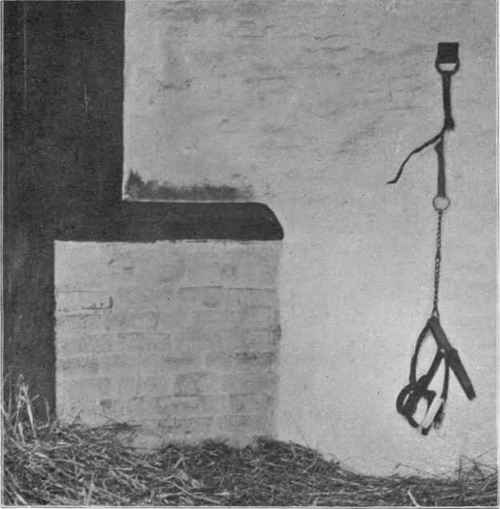
Fig. 26. Rack-chain.
Continue to:


My Books

