


Doors
Description
This section is from the book "Stable Management And Exercise", by M. Horace Hayes. Also available from Amazon: Stable Management And Exercise.
Doors
It is advisable to have the stable door of ample dimensions, say, 6 ft. wide and 8 ft. high, so as to diminish the chance of an accident occurring by a horse knocking himself against the door post, or rearing up and striking his head against the lintel while he is being led through the doorway. As a rule, the immediate consequences of such an accident are less serious than the resulting vice of being "door shy" (if I may use the expression), which frequently follows an injury thus acquired. This annoying trick may be conquered by methods, described in Illustrated Horse-breaking, supposing, of course, that the animal is given no fresh cause to revert to the practice of his former vice. It is evidently impossible to completely blot out from the mind of a horse the pleasing recollection of having successfully "played up." Hence, although we may by good breaking, followed by proper management, keep a "spoiled" horse under control, we cannot regard him as cured; for he will be always ready to return to his old trick or tricks on very slight provocation.
The door-way of a box should not be less than 4 ft. wide. This width may be increased to 6 ft. in the case of a box or hovel for a mare with a foal at foot, in which case the doorpost should have a revolving arrangement; for these mares are apt to shove their youngsters up against the door-post when going in or out of the door-way.
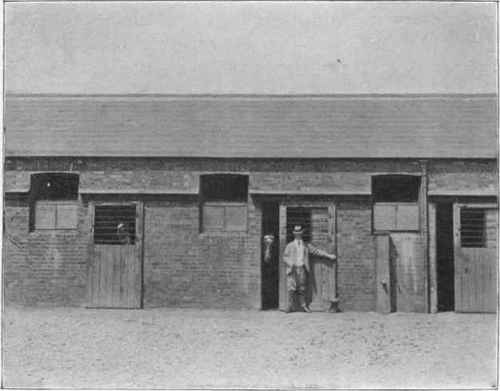
Fig. 24. Stable with Sliding Doors.
A good arrangement for the doors of stables and boxes is for them to slide or traverse on rollers, so that they can be opened or shut by merely pushing them one way or the other (Fig. 24). Even when open, they will then be entirely out of the way, and will not be a possible source of injury, as hanging-doors are when open, to a horse passing through or passing by them. All hanging-doors should be made to open outwards; because then, in case of accident or illness, it would be impossible for a horse or other object inside the stable to bar entrance into the building or box; and care should be taken that no projecting points or sharp edges are furnished by the door or its attachments, so that the animal may not hurt himself on them when going through or passing by the door-way. Also, these doors should be made to fold back and to be secured when they are open, so that they may not remain on the swing. In stables, frequent use is made of the half-door principle, which allows the interior of box or stable to be seen, and which aids ventilation, while, at the same time, ingress or egress can be prevented by keeping the lower half-door shut. The upper portion of the door of a box is usually made of open bars, to facilitate ventilation and also to enable the owner or groom to look into the box without opening it.
In a single line of boxes which has no passage inside it, one outside door may serve for every two boxes (as in Fig. 25) in which the doors of each box are made to revolve on the partition between them. If the upper portion of these inner doors be furnished with open bars, the horses will be able to see each other, and thus will have companionship without being able to smell or tease each other.
Continue to:


My Books

