


Ventilation
Description
This section is from the book "Stable Management And Exercise", by M. Horace Hayes. Also available from Amazon: Stable Management And Exercise.
Ventilation
We may define ventilation as the process of removing foul air and substituting for it pure air in a building.
The subject of ventilation is closely connected with that of drainage; for inefficient drainage often entails a bad state of ventilation. Thus, an amount of ventilation which would be amply sufficient if a stable was kept scrupulously clean, might be much below a healthy standard, if the air was exposed to foul emanations from decomposing organic matter. For practical purposes we may take for granted that the ventilation cannot be good, if the drainage is defective.
We have seen that in a climate as cold as that of England, horses should be shielded from draughts in the stable. The question of obtaining free circulation of air in a building, without draughts, brings us to the definition of a draught. Although we cannot determine with exactness when a draught ends and safe ventilation begins, it will suffice for every-day needs if I say that a draught is a current of air which is appreciable to our sense of feeling under ordinary conditions. Hence, to save our horses from chill, and at the same time to give them a full supply of fresh air, we should arrange the ventilation of the stable in such a manner, that the force of in-coming currents of air is broken and distributed, while the entrance and exit of the air is checked as little as possible. The dangers arising from the retention in the atmosphere of the stable, of volatile and floating impurities (products of decomposition, bacteria, etc.), are too well known to need my dwelling on the necessity of their speedy removal by well regulated ventilation. If the source of these deleterious matters is allowed to remain for a considerable time in the stable, it will be impossible by any system of ventilation to keep the air even approximately pure. Our object, however, will be fully attained, if we are able to preserve the air inside the building at a standard of purity which will be compatible with the preservation of the health of the stabled animals. Although we have no means for rigidly fixing that standard, which varies according to the requirements of individual horses; we may assume that it is attained for all practical requirements when the air inside the building is free from smell, and gives no sensation of "closeness," or of warmth due to the presence of the horses. Any fears on these points will be further allayed, if we find that the place is roomy and lofty, and has free communication with the outside air.
Normal air contains from 0.02 to 0.06 per cent. of carbonic acid. An excess of this gas causes distress, which is shown by accelerated breathing, and diminution in the number of the beats of the heart. Generally speaking, the breathing of impure air induces diseases of the organs of breathing, diminishes vitality, and favours the attack of infective diseases when special bacteria are present.
"Carbonic acid is not poisonous when taken into the stomach, but acts most injuriously when breathed, by offering an obstacle to the escape of carbonic acid gas, by diffusion, from the blood of the venous circulation in the lungs, and its consequent replacement by the oxygen necessary to arterial blood. Any hindrance to this interchange must impede respiration, and such hindrance would of course be afforded by carbonic acid gas present in the air inhaled, in proportion to its quantity. ... It may be safely asserted that it is not advisable to breathe for any length of time in air containing more than 1/1000 th (0.1 per cent.) of its volume of carbonic acid gas. The air of a room contains too much carbonic acid gas, if half a measured ounce of lime-water become turbid when shaken in a half-pint bottle of the air" (Bloxam).
The following are four ways by which ventilation can be naturally obtained : -
1. By the direct action of a current of air from outside, entering by the windows or other openings, and thus imparting movement to the air inside, which by passing out through various forms of escape, allows fresh air to enter. This method of ventilation is utilised when advantage is taken of the direction of prevailing winds, and on board ship, when wind-sails are employed.
2. By the action of a current of outside air indirectly imparting movement in an outward direction to air inside the building, as we may see when wind blows across an open window, open door, top of chimney (Fig. 13), or other opening in the stable.
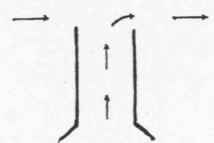
Fig. 13.
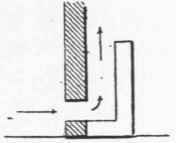
Fig. 14.
3. By convection, that is to say, by the formation of currents of air inside the building due to the heating of the air from the presence of the animals. This air becomes lighter in proportion to its increase of temperature, and consequently rises. The movement thus imparted to the body of air within the stable, tends to cause a portion of it to escape through convenient openings, and thus facilitates the entrance of fresh air from outside. In this process, we must not lose sight of the fact that the carbonic acid given off by the lungs and to a small extent by the skin, is heavier than air, and therefore has a tendency to become accumulated near the floor. Also, horses breathe downwards; hence the advisability of securing ventilation on or near the floor, as well as higher up.
4. By the diffusion of gases, which is the property one gas has of passing into the space occupied by another; supposing that these gases have no mutual chemical action. Consequently, if a stable which was full of foul air, had only one opening (say, a window) in it, and even if the atmosphere both inside and outside was absolutely still, the air in the stable would after a time become comparatively pure; provided of course, that fresh supplies of deleterious gas were not furnished. It is evident that the greater the extent of communication between the stable and the outside air, the more rapidly will diffusion take place.
Continue to:


My Books

