


Ventilation. Continued
Description
This section is from the book "Stable Management And Exercise", by M. Horace Hayes. Also available from Amazon: Stable Management And Exercise.
Ventilation. Continued
The foregoing principles of ventilation may be applied in the following ways : -
A. By ventilation on or close to the level of the floor obtained by means of "air bricks," gratings or other narrow openings. These air passages should be small enough to prevent the entrance into the stable of undesirable visitors, such as mice, and are specially applicable to outside walls which are at the head of boxes or stalls, or to doors. In order to prevent a draught coming on the horses from these air passages, we may utilise the principle of the "Tobin tube" (Fig. 14) to give a vertical direction to the current of incoming or outgoing air. We may obtain under a door the same form of ventilation by cutting off, say, an inch from the bottom of the door and attaching a plank to the inside of the door, so as to cover the gap thus made and to allow a space of about an inch between the door and the plank (Fig. 15). A plan which would be equally efficacious, and which would not disfigure the appearance of the door so much, would be to apply the plank in the same manner, but a little higher up, and instead of cutting away the bottom of the door, to bore one or more rows of holes in the door (Fig. 16). This method of ventila-lation is similar to that which was proposed many years ago by Dr. Parkes for ventilating dwelling rooms by ordinary "guillotine" windows. The lower half of the window is raised 2 in. or 3 in., a block of wood of the same width as the window is placed in the vacant space, and the lower half of the window is allowed to rest on it so as to give vertical ventilation between the upper and lower halves (Fig. 17).
B. By windows, which should be a little above the heads of the horses, so as to obviate the danger of a draught, and also to prevent the animals reaching them. When the windows are separated from the horses by a passage, they may be placed the horses, so as to obviate the danger of a draught, and also to prevent the animals reaching them. When the windows are separated from the horses by a passage, they may be placed lower down. It is well to have these windows constructed so that they may give an upward direction to incoming currents of air, and that while freely admitting air, they will keep out rain and snow. These duties are fully carried out by Shering-ham's air inlet, the lower part of which revolves on hinges, while the sides are blocked in such a way as to prevent air passing by them. The windows I like best for a stable are those of the louvre pattern, with two or more panes of glass at intervals, say 1/2 in. between them, so that even when these windows are shut they will admit air, and will also give it an upward direction (Fig. 18). They are of course equally useful in giving exit to air leaving the stable. I thoroughly believe in the correctness of Admiral Rous's remark that "The windows of a stable ought never to be shut by night or day. In cold weather, add to the clothing, but never deprive them of the first great source of vitality - fresh air."
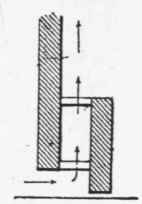
Fig. 15.
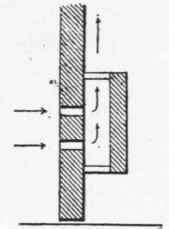
Fig. 16.
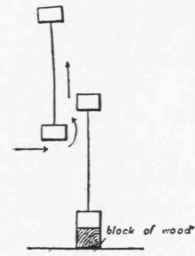
Fig. 17.
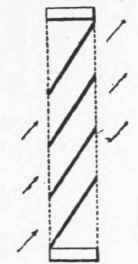
Fig. 18.
C. By roof ventilation, which may be obtained between the roof and walls; at the top of the roof; or by windows in the roof.
D. By ventilating shafts, which may come out on the side of the roof or on the top of the roof. In the market there are various ventilators for these shafts. Ventilating shafts, as a rule, are needed only when there is an upper storey, against the wall of which they may be placed for economy of room.
The requirements of the case will decide the question as to the most suitable methods of ventilation.
Inlets And Outlets For Air
We are unable by any system of natural ventilation to restrict either the entrance or exit of air to particular openings in a building. Thus, if we have an open door on one side and an open window on the other side, we cannot, without employing artificial means for giving a "lead" to the air, make an invariable inlet of the door, and an invariable outlet of the window; or vice versa. Although the fact that the wind generally blows in a direction more or less parallel to the surface of the ground, gives rise as a rule to an upward draught in the case of a chimney or vertical ventilating shaft; either of these passages may often serve as an inlet for air, or even as an inlet and an outlet at the same time. It is evident that when this double function is in action, there is a certain amount of impediment to movement offered by the influence of the opposing currents of air on each other. Hence we find that the action of a ventilating shaft is improved by separating it into two divisions, each of which can act as an outlet or an inlet, independently of the other (Figs. 19, 20, 21 and 22). In McKinnell's method (Fig. 23), the separation is effected by using two concentric shafts (one within the other); the inner one being made to project above the outer one, so as to render it an outlet as much as possible.
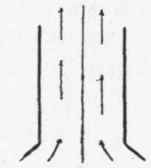
Fig. 19.
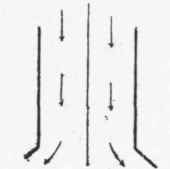
Fig. 20.
One of the best examples of an artificial lead to an outlet for air is afforded by an ordinary fire in a room, in which the chimney is maintained as an outlet by the fire causing the production of heated and consequently light gases, which while escaping upwards, are followed by a current of air that takes their place. In this, as in other forms of convection of heat, we find that for the outlet to work well, there must be free admission of air by an inlet; for if we close up all the windows and doors and thus prevent as much as possible any air entering the room, the fire will not "draw" properly. Even a chimney with a fire in the grate will not always act as an outlet; for sometimes a downward current of air will be set up by the air outside. The principle of the fire and chimney can occasionally be used in stables to give a lead in an outward direction to the air in ventilating shafts, by placing a lamp or small fireplace in them, with all due precautions. On board ship, when horses are carried on the lower deck or "between decks," it is often necessary to give an artificial lead to the circulation of air by either pumping down fresh air or withdrawing foul air by means of an engine. A similar procedure, by means of a small motor, would be useful in many stables which contain a large number of animals in proportion to their cubic contents, and which are placed in confined positions.
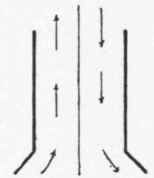
Fig. 21.
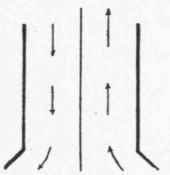
Fig. 22.
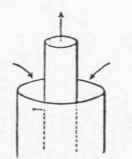
Fig. 23.
Continue to:


My Books

