


Chapter 4. The Riders Position When Jumping
Description
This section is from the book "Training Young Horses To Jump", by Geoffrey Brooke. Also available from Amazon: Training Young Horses To Jump.
Chapter 4. The Riders Position When Jumping
Before going farther it is necessary to discuss the rider's seat. For the man who hopes to make young horses successfully there are two considerations affecting the seat over a fence.
1. Assistance to the horse, and
2. The rider's own balance.
Let us try to picture a good horseman putting a young horse over a fence at a canter. Most young horses require to be steadied on coming up to a fence.
Our rider will bring him up at a collected canter; by not allowing the horse to extend himself now he just keeps him back on his hocks. Two to three lengths from the fence the rider lowers his hands, giving the horse a freer rein but of course keeping contact with his mouth. This enables the horse to slightly lower his head the more easily to judge his distance and, if necessary, lengthen his stride. He gives the horse the so-called office to jump in accordance with its temperament. Experience alone can teach us the best method to employ
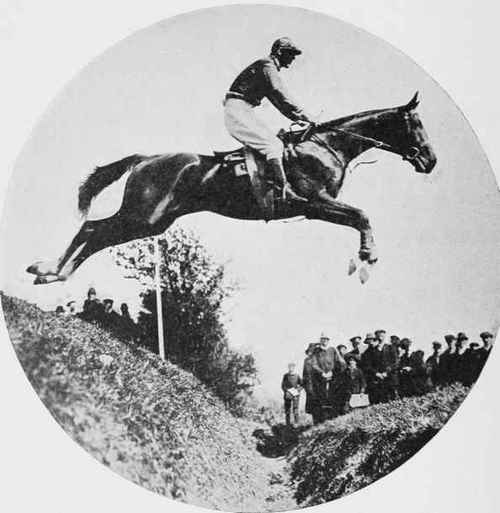
Fig. 12 - A fine bold fencer. Note the propulsion that has been given by the hind-limbs and the extension of the horse's head and neck. The rider's weight is practically over the horse's centre of gravity. The rider is in a position to lean his weight back or remain in the same position as circumstances may require with each horse. - Copyright Illustrations Bureau
Young horses generally want a little driving the last length, so the rider will close his legs the stride before the take-off and again deliberately at the take-off stride.
Some horses require to be driven well into their bridles right up to the time they take off. Others merely require the rider to sit still and give them their heads. Thus the so-called "giving the office" varies with different horses.
The rider should be leaning slightly forward coming up to the fence, i.e. the ordinary position at the gallop. The weight is thus off the back of the saddle and carried at a fixed point (roughly about the dees of the stirrup leathers). The rider should be holding the greater part of his weight on his thighs and knees, thus permitting the lower part of his leg to be free to drive on his horse if necessary. This is most important.
If the lower part of the riders leg is stiff it is lost as a means of propulsion to a young horse.
If the riders leg is kept forward and stiff, there are several disadvantages, especially if the rider is a long-legged man.
Firstly, on landing the greater part of the rider's weight is borne on the stirrup, which is forward of the centre of gravity, and consequently comes too much on the horse's forehand landing.
Secondly, if the horse makes a bad mistake the rider may be thrown violently forward and, the pivot from the stirrup being longer than from the knee, the violence with which the rider's body is thrown forward is increased (with the leg stuck out straight) and he has less chance of recovery. In the case of a short-legged jockey these points are of small account.
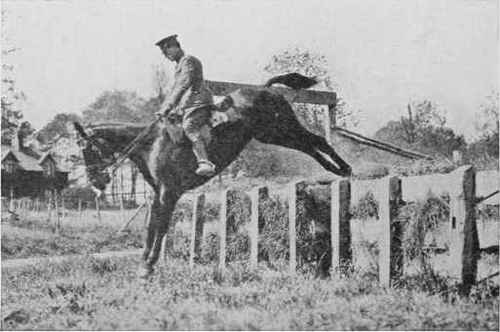
Fig. 13 - Good position of the rider in no way exaggerated. The position of the weight appears to be constant, which must help the horse - W. A. Rouch Copyright
Thirdly, it is impossible for the rider to bring his weight forward when required if the lower part of the leg is kept forward and the knee stiff.

Fig. 14 - This picture shows the horse in the act of propelling the body from the ground. The effort is borne from the loins downwards. Notice the straightening of the hock and pasterns and the final propulsion given by the toes. Here again the horse is assisted by the rider's weight being brought forward. - By permission of Capt. Paul Rodzanko
As the horse raises his forehand our rider inclines his body forward with the movement of his horse, because he wishes to assist his horse. Any horse that has been schooled slowly can raise his forehand to a very considerable height. Note the ease with which all horses can rear up in front to a great height, but it is a much greater effort to raise their hindquarters up to a similar height. As the hindquarters are raised the weight is still thus kept off the back part of the saddle to assist the horse, whose chief effort is to propel himself upwards with his hind-limbs, when the forehand is still in the air.* As the hind-limbs are coming up and the horse is in mid-air, he is preparing and balancing himself to land.
* In the gallop, on the other hand, the chief effort is borne by the leading fore-leg. As is shown in the diagram, the body rotates over the foot with the limb rigid all the way down to the fetlock. Finally, by a muscular bracing of the leg the body is propelled forwards to position (1) when all the legs are off the ground. If the weight of the rider is not forward the horse's effort is accentuated, and the hind-legs also are hampered in their action of primary propulsion, since they gain impetus by coming as far forward as possible.
The Action Of The Riders Hands When Jumping
Consequently he will now wish to extend his head for this purpose. Unless he is a horse that continuously holds his head out, the rider must be prepared to give him more rein as he is landing.
It is easier for him to do this if he is now not sitting back. In fact, it is not necessary for him to sit back till the horse is actually landing. Raising his weight off the back part of the saddle prevents the rider from feeling any concussion from the horse's efforts, should he have jumped awkwardly, and consequently he will not jerk his horse on the mouth-this is most important when schooling a youngster.

The above diagrams show how the greatest effort of the horse is borne on the leading fore-leg. Vide figures 6, 6a, 7, 1 and 2. In jumping the chief effort is borne by the hind-limbs and hocks. In either case the farther back the weight is put on the horse, the greater is the exertion required of him.
As the horse is landing the rider can easily lean his body back; or if he thinks his horse will drop his hind-legs in a ditch, he can still keep his weight forward to assist his horse. In either case his weight will not go beyond the horse's centre of gravity.
The hands should be kept low the whole time and the horse should not be pulled up abruptly on landing, for fear he should mistake it for punishment.
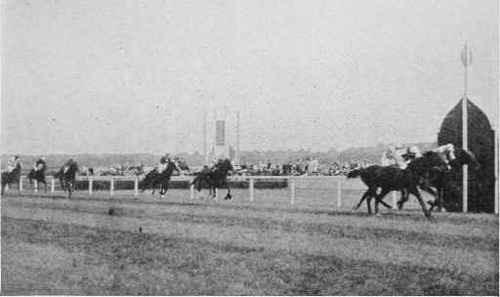
Fig. 15 - Fugleman and Manaton dead-heat for the Newbury Cup 1907. It is interesting to compare the positions of the horses with the diagrams of the horse galloping. It is now realized that the horse is assisted in his gallop by carrying the weight of the rider forward as seen in the picture. The reason for this is obvious if one examines the locomotive action of the horse in diagram 5,6, 6a, 7. With the modern seat it appears that horses are less under control than was previously the case. - W. A. Rouen Copyright
It is advisable not to ride too long when schooling, as the seat is strengthened by riding rather on the short side. The stirrups, if used correctly, are a means of strengthening the seat. If the heel is kept down and the sole of the foot turned very slightly outwards it will be found that any weight on the stirrups will only assist to force the knees closer to the saddle. This argument may appear difficult to follow, but if, on the other hand, the soles of the feet are turned in towards the horse, and weight is put on the stirrups, it will be found that the knees are mechanically forced away from the saddle.
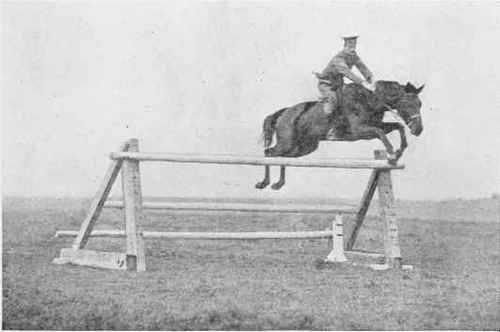
Fig. 16. This horse requires a lot of head; the rider is letting his hands go forward to give him sufficient rein. Possibly he might have ridden with a longer rein. - W. A. Rouch Copyright
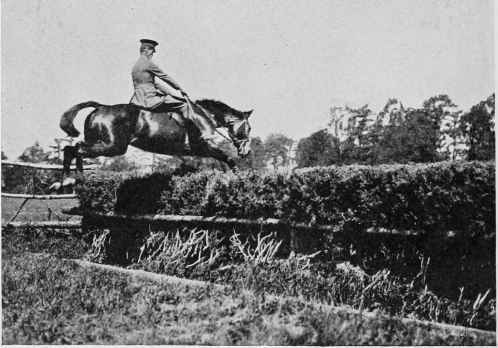
Fig. 17 - A free fencer jumping at the gallop, and from the impetus thus gained there is no great necessity to help the horse by keeping the rider's weight forward on the saddle. - W. A. Rouch Copyright
Continue to:


My Books

