


Horses That Are Unable To Attain Their Correct Balance When Jumping
Description
This section is from the book "Training Young Horses To Jump", by Geoffrey Brooke. Also available from Amazon: Training Young Horses To Jump.
Horses That Are Unable To Attain Their Correct Balance When Jumping
The slower the pace (either at a trot or canter) at which he comes up to the fence, the more easy it will be to keep his hocks under him. Similarly, reining back puts a horse on his hocks before presenting him at the fence. Jumping slowly downhill will also teach him to keep his hocks under him when taking off at a fence. A series of small obstacles from one to three feet high at seven yards apart is useful for bringing horses back on their hocks and tends to check them of the habit of landing with too much of their weight on their forehand.
Standing Martingales Safe To School In, But Not Recommended For Hunting
Not infrequently on the other hand one comes across a young horse that jumps with his head up and his weight too far back. Such a horse will often land on his hind-legs first; he cannot extend himself well, and will consequently leave his hind-legs in the ditches out hunting. The best treatment in this case is to school the horse for several days, or as long as is required, in a snaffle, and when a double bridle is resumed it must not be too severe and the curb chain must be fairly loose. It may sometimes even be necessary to school with a standing martingale on the nose-band to keep the horse's head down.


Fig. 9 and 10 - These pictures show the necessity for a free head when the horse is actually jumping. The horse's balance in each case is wrong as the weight is not brought sufficiently far forward. In each case note the obvious effort on the part of the horse. If the head was lowered he could more easily raise his hindquarters and then extend his fore-limbs when landing. This is a frequent failing with light-mouthed horses, but less common with horses that are heavy on the hand.
The rider must also assist the horse to lower his head and get his weight forward. He can do this by giving the horse complete liberty of rein w hen he is jumping, and at the same time keeping his own weight forward off the horse's loins. The horse relieved of the weight behind will learn to bring his hindquarters higher, and his head being free he will learn to extend it instead of lifting it up. He will thus soon attain his true balance over the fences and consequently land correctly.
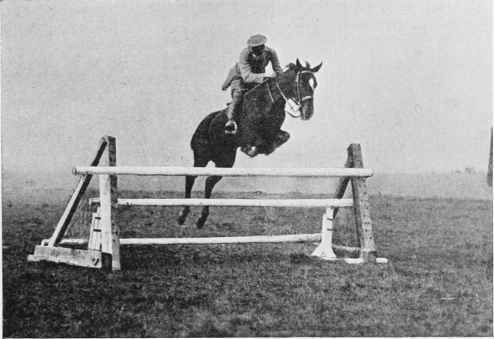
Fig. 11 - The rider's seat is exaggerated in the endeavour to teach the horse to get his weight forward. His attempt is apparently successful, though the hind-limbs appear to drag behind.
Running Martingales
Running martingales assist in bringing a horse under control. They should not be too tight to interfere with his freedom. With a double bridle the martingale should generally be attached by the rings to the bit reins, and should have no bearing on the rein when the head is placed correctly.
The Value Of Up And Down Hill Work
Work uphill puts muscle on behind the saddle, but much galloping uphill tends to shorten a horse's stride. On the other hand, if a horse is occasionally well-extended down a gentle slope, he will learn how to make full use of his shoulders.
Continue to:


My Books

