


529. - To Find The Side Of A Buttressed Octagon
Description
This section is from the book "The American House Carpenter", by R. G. Hatfield. Also available from Amazon: The American House Carpenter.
529. - To Find The Side Of A Buttressed Octagon
Let ABCDE (Fig. 382) represent one quarter of an octagon structure, having a buttress HFGJ at each angle. The distance MH, between the buttresses, being given, as also FG, the width of a buttress; to find H C or C J, in order to obtain B C, the side of the octagon. Let B C, a side of the octagon, be represented by b; or D C by 1/2 b. Let MH = a; or J D = 1/2 a; and J C = x. Then we have -
JD+ JC=CD,
1/2 a + x = 1/2b,
a + 2 x = b.
For FG put p; or L G = K J = 1/2p.
Now E D is the radius of an inscribed circle and, as per equation (140.), equals
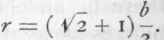
Also, E C is the radius of a circumscribed circle, and, as per equation (141.), equals
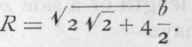
The two triangles, CJK and CEB, are homologous; for the angles at C are common and the angles at K and D are right angles. Having thus two angles of one equal respectively to the two angles of the other, therefore (Art. 345) the remaining angles must be equal. Hence, the sides of the triangles are proportionate, or -
Ed: Ec:: Jk: Cj
r: R:: 1/2 p: x = 1/2 p R/r. The value of the side, as above, is -
b = a + 2 x = a + p R/r.
And taking the value of R and r, as above, we have -
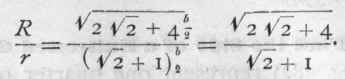
Substituting this for - , we have -
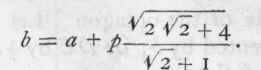
The numerical coefficient of p reduces to 1.0823923 or 1.0824, nearly.
Therefore we have -
b = a + 1 .0824 p. (207.)
Or: The side of a buttressed octagon equals the distance between the buttresses plus 1 . 0824 times the width of the face of the buttress.
For example: let there be an octagon building, which measures between the buttresses, as at MH, 18 feet, and the face of the buttresses, as FG, equals 3 feet; what, in such a building, is the length of a side B C? For this, using equation (207.), we have -
b = 18 + 1.0824 x 3 = 18 + 3.2472 as 21 .2472.
Or: The side of the octagon B C equals 21 feet and nearly 3 inches.
530. - Within A Given Circle To Inscribe Any Regular Polygon
Let abc 2 (Figs. 383, 384, and 385) be given circles. Draw the diameter a c; upon this erect an equilateral triangle aec, according to Art. 525; divide ac into as many equal parts as the polygon is to have sides, as at 1, 2, 3, 4, etc.; from e, through each even number, as 2, 4, 6, etc., draw lines cutting the circle in the points 2, 4, etc.; from these points and at right angles to a c draw lines to the opposite part of the circle; this will give the remaining points for the polygon, as b, f, etc.
In forming a hexagon, the sides of the triangle erected upon ac (as at Fig. 384) mark the points b and f. This method of locating the angles of a polygon is an approximation sufficiently near for many purposes; it is based upon the like principle with the method of obtaining a right line nearly equal to a circle (Art. 524). The method shown at Art. 531 is accurate.
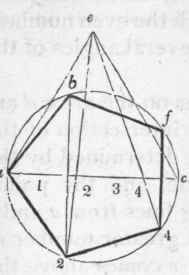
Fig. 383.
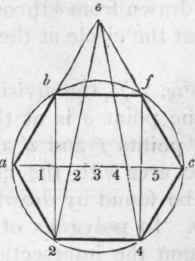
Fig. 384.
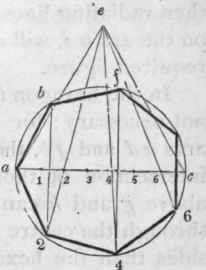
Fig. 385.
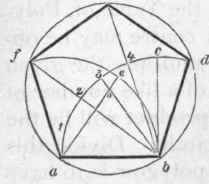
Fig. 386,
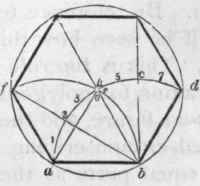
Fig. 387.
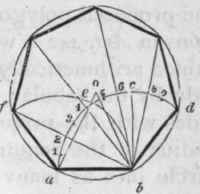
Fig. 388
Continue to:


My Books

