


554. - To Draw An Oval In The Proportion Seven By Nine
Description
This section is from the book "The American House Carpenter", by R. G. Hatfield. Also available from Amazon: The American House Carpenter.
554. - To Draw An Oval In The Proportion Seven By Nine
Let cd (Fig. 412) be the given conjugate axis. Bisect c d in o, and through o draw ab at right angles to cd; bisect co in e; upon o, with oe for radius, describe the circle efgh; from e, through h and f, draw ej and ei; also, from g, through h and f, draw gk and gl; upon g, with gc for radius, describe the arc kl; upon e, with ed for radius, describe the arc j i; upon h and f, with h k for radius, describe the arcs j k and li; this will complete the figure.
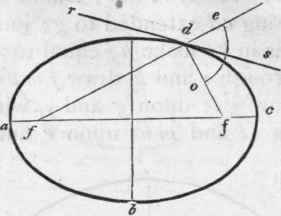
Fig. 413.
This is an approximation to an ellipsis; and perhaps no method can be found by which a well-shaped oval can be drawn with greater facility. By a little variation in the process, ovals of different proportions may be obtained. If quarter of the transverse axis is taken for the radius of the circle efgh, one will be drawn in the proportion five by seven.

Fig. 414.
555. - To Draw A Tangent To An Ellipsis
Let abed (Fig. 413) be the given ellipsis, and d the point of contact. Find the foci (Art. 548) f and f, and from them, through d, draw fe and fd; bisect the angle (Art. 506) edo with the line sr; then sr will be the tangent required.
556. - An Ellipsis With A Tangent Given, To Detect The Point Of Contact
Let agbf (Fig. 414) be the given ellipsis and tangent. Through the centre e draw a b parallel to the tangent; anywhere between e and f draw cd parallel to ab; bisect cd in o; through o and e draw fg; then g will be the point of contact required.
557. - A Diameter Of An Ellipsis Given, To Find Its Conjugate
Let ab (Fig. 414) be the given diameter. Find the line fg by the last problem; then fg will be the diameter required.
558. - Any Diameter And Its Conjugate Being Given, To Ascertain The Two Axes, And Thence To Describe The Ellipsis
Let a b and c d (Fig. 415) be the given diameters, conjugate to one another. Through c draw c f parallel to a b; from c draw cg at right angles to ef; make cg equal to ah or hb; join g and h; upon g, with gc for radius, describe the arc ikcj; upon h, with the same radius, describe the arc ln; through the intersections l and n draw no, cutting the tangent ef in o; upon o, with o g for radius, describe the semi-circle e igf; join e and g, also g and f, cutting the arc icj in k and t; from r, through k, draw e m, also from f, through h, draw fp; from k and t draw kr and ts parallel to gh cutting em in r, and fp in s; make hm equal to hr, and hp equal to hs; then rm and sp will be the axes required, by which the ellipsis may be drawn in the usual way.

Fig. 415.
Continue to:


My Books

