


559. - To Describe An Ellipsis, Whose Axes Shall Be Proportionate To The Axes Of A Larger Or Smaller Given One
Description
This section is from the book "The American House Carpenter", by R. G. Hatfield. Also available from Amazon: The American House Carpenter.
559. - To Describe An Ellipsis, Whose Axes Shall Be Proportionate To The Axes Of A Larger Or Smaller Given One
Let a c b d (Fig. 416) be the given ellipsis and axes, and ij the transverse axis of a proposed smaller one. Join a and c; from i draw ie parallel to ac; make of equal to oe; then ef will be the conjugate axis required, and will bear the same proportion to ij as cd does to ab. (See Art. 541.)
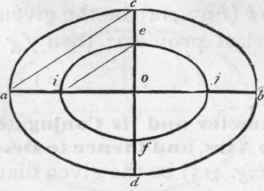
Fig. 416.
560. - To Describe A Parabola By Intersection Of Lines
Let ml (Fig. 417) be the axis and height (see Fig. 404) and dd a double ordinate and base of the proposed parabola. Through f draw a a parallel to dd; through d and d draw da and da parallel to ml; divide ad and dm, each into a like number of equal parts; from each point of division in dm draw the lines 11, 22, etc., parallel to ml; from each point of division in da draw lines to l; then a curve traced through the points of intersection o, o, and o, will be that of a parabola.
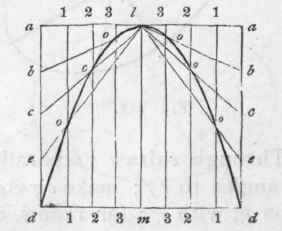
Fig. 417.
To Describe An Hyperbola
Another method. Let m l (Fig. 418) be the axis and height, and dd the base. Extend ml and make la equal to ml; join a and d, and a and d; divide ad and ad, each into a like number of equal parts, as at 1, 2, 3, etc.; join 1 and 1, 2 and 2, etc., and the parabola will be completed. (See Arts. 460 to 472.)
561. - To Describe An Hyperbola By Intersection Of Lines
Let ro (Fig. 419) be the height,pp the base, and n r the transverse axis. (See Fig. 404.) Through r draw a a parallel to p p; from p draw ap parallel to ro; divide ap and po, each into a like number of equal parts; from each of the points of division in the base, draw lines to; from each of the points of division in ap, draw lines to r; then a curve traced through the points of intersection o, o, etc., will be that of an hyperbola.

Fig. 418.
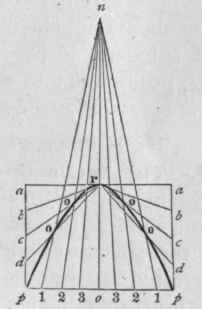
Fig. 419.
The parabola and hyperbola afford handsome curves for various mouldings. (See Figs. 191 to 205; 222 to 224; 241 and 242; also note to Art. 318.)
Continue to:


My Books

