


Single Floors
Description
This section is from the book "Notes On Building Construction", by Henry Fidler. Also available from Amazon: Notes on building construction.
Single Floors
In single floors the "common " or "bridging joists" span the whole distance from wall to wall, and rest upon the wall plates or templates only.
Advantages
With a given quantity of timber single floors are the strongest, cheapest, and simplest; they distribute their weight and load very equally over the walls upon which they rest, and hold the sides of the building together.
Disadvantages
The disadvantages of single floors are -
1. When they are used for a span of more than 12 or 15 feet1 the bridging joists (unless of considerable size) are liable to bend or "sag," and thus to crack the ceiling (if any) below.
2. They require a good deal of "trimming" to avoid resting the ends of the joists on flues, fireplaces, etc. (see p. 132).
3. The joists bear equally on all parts of the walls, on piers and openings Fig. 273.

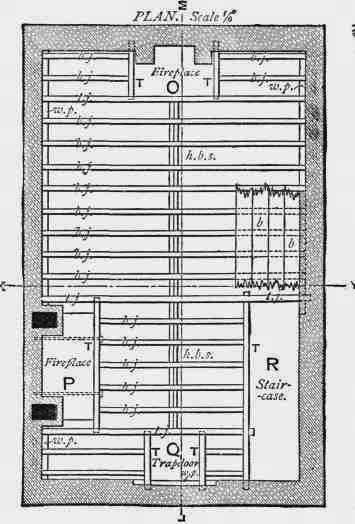
Fig. 272, alike, and thus the jars upon the floor are communicated to the wall even at its weak points.

Fig. 274.
1 Tredgold says that to ensure stiff ceilings the bearing of single floors should not exceed 12 feet, but they are frequently made with a bearing of 18 feet or even more. 18 feet is a safe and usual limit for domestic work.
4. They occasion the use of wall plates, which often have to be fixed in the wall (Fig. 286), and are then objectionable.
5. They facilitate the passage of sound from the room below.
This last defect can be remedied or removed by "pugging" (see p. 132), and also by keeping nearly all the bridging joists clear of the ceiling, so as to have as few conductors for the sound as possible (see Fig. 288). This latter is, however, an expensive arrangement, as it renders ceiling joists necessary.
In ground floors (see Fig 275) where there is a space below and no ceiling, intermediate walls ("dwarf" or "sleeper" walls) or piers are built to support the joists at intervals.
Upper Floor
Figs. 272, 273, 274 give a plan and sections of a single floor. In this case there are no ceiling joists, the laths being nailed to the under side of the bridging joists, which are all of the same depth.
Plan And Sections Of A Single Floor With Trimmed Openings
Fig. 272 is arranged so as to show various forms of trimming - at O the floor is trimmed parallel to the joists to keep clear of a fireplace, at P it is trimmed across the joists for another fireplace, at Q it is trimmed to form an opening for a trapdoor, and at R for a staircase. Herring-bone strutting is lettered h.b.s.; only a small portion of the floor boards are shown, at b, in order that the joists and trimmers below may be visible in the plan.
Fig. 288, p. 131, is the section of part of a single floor with ceiling joists, which are supported by the deep joists at the ends of the figure. Only one joist in every four or five is thus connected with the ceiling joists, in order to obtain a more rigid ceiling, and also that the points at which the sound can be conducted through the floor may be as few as possible.
Single Floor - Ground Floor
Fig. 275 is the section of part of a single floor constructed just above the ground. The concrete under the floor itself is to prevent unwholesome exhalations from being drawn up from the subsoil into the room above. The damp courses are to prevent the damp from rising into the walls.
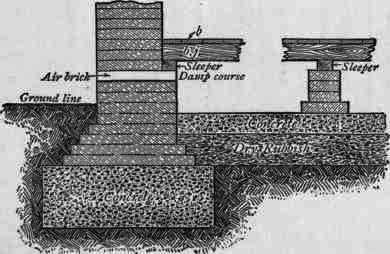
Fig. 275.
No trimming is required for fireplaces on the ground floor as the hearthstone is supported by dwarf brick walls called Fender Walls.
Continue to:


My Books

