


Building Conditions. Part 4
Description
This section is from the book "Cyclopedia Of Architecture, Carpentry, And Building", by James C. et al. Also available from Amazon: Cyclopedia Of Architecture, Carpentry And Building.
Building Conditions. Part 4
30 said party of the second part shall fail in the due performance of the
31 entire work to be performed under this contract, by and at the time
32 herein mentioned or referred to, the said party of the second part shall
33 pay unto the party of the first part, as and for liquidated damages, and
34 not as a penalty, the sum of.......................dollars for each and
35 every day the said party of the second part shall be in default, which
1 said sum of................. dollars per day, in view of the difficulty
2 of estimating such damages with exactness, is hereby expressly fixed,
3 estimated, computed, determined, and agreed upon as the damages
4 which will be suffered by the party of the first part by reason of such
5 default, and it is understood and agreed by the parties to this contract
6 that the liquidated damages hereinbefore mentioned are in lieu of the
7 actual damages arising from such breach of this contract; which said
8 sum the said party of the first part shall have the right to deduct from
9 any moneys in its hands otherwise due, or to become due, to the said
10 party of the second part, or to sue for and recover compensation or
11 damages for the nonperformance of this contract at the time or times
12 herein stipulated or provided for.
Note. - The question of actual damages is always a very difficult one to settle, and generally involves a lawsuit; therefore the contract states the amount of liquidated damages, or the amount settled and fixed in advance by both parties to be paid by the Contractor in case of default. While this amount is rarely less than $20.00 a day, with an average of about $40.00, the Secretary of the Treasury is empowered by Congress to remit so much as will reduce such sum to one that in his judgment is right; and as a matter of fact, it is usual to assess only such an amount as will cover the actual expense of maintaining a Superintendent on the ground, and any items of rent, etc., and additional inspections for which the Department has actually to pay on account of the failure to complete within contract time.
14 save the United States, its officers, agents, servants, and employees,
15 harmless from and against all and every demand, or demands, of any
16 nature or kind, for, or on account of, the use of any patented invention,
17 article, or appliance, included in the materials hereby agreed to be
18 furnished under this contract.
20 that the said party of the second part will, without expense to the United
21 States, comply with all the municipal building ordinances and regula-
22 tions, in so far as the same are binding upon the United States, and obtain
23 all required licenses and permits, and be responsible for all damages to
24 person or property which may occur in connection with the prosecution
25 of the work; that all work called for by the drawings and specifications,
26 though every item be not particularly shown on the first or mentioned
27 in the second, shall be executed and performed as though such work were
28 particularly shown and mentioned in each, respectively, unless other-
29 wise specifically provided; that all materials and work furnished shall be
30 subject to the approval of the said Supervising Architect; and that said
31 party of the second part shall be responsible for the proper care and relative to the plumbing was complied with. The official had a perfect right to refuse the permit as the sewer was in the street; but after the Department had decided not to turn on the water, and to leave all plumbing fixtures unusable, the official soon found it better policy to allow the connection. This policy is always followed by the Government, as the practice of the Supervising Architect's office in all matters of this sort is the best, and is generally far better than that followed by many municipal laws.
32 protection of all materials delivered and work performed by said party
33 of the second part until the completion and final acceptance of same.
Note. - Municipal laws are binding on the Government to a very limited extent, and only outside of the lot line; the land, when bought by the Government, not only becomes its property, but it is, by such sale, ceded back to the United States, so that the land occupied by the public building is no longer a portion of the State, and the State or City has no more authority over it than it has over the District of Columbia.
Cases sometimes occur when some city official attempts to show authority, as in one case where a permit to enter the sewer was denied until some minor useless demand
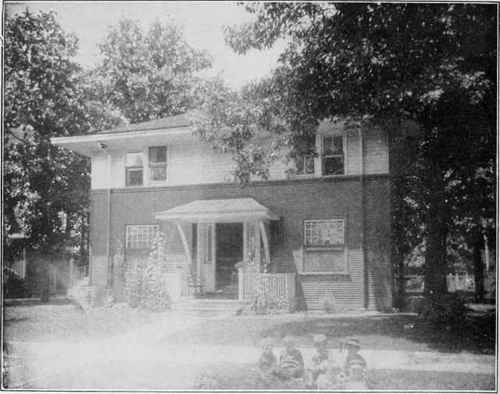
COTTAGE AT NORTH EVANSTON, ILL.
R. C. Spencer, Jr., Architect, Chicago, Ill.
Frame House; First-Story Walls, Narrow Clapboards Painted a Dull Red; Second-Story, Wide Clapboards Painted White. Built in 1896. Cost, about $2,000.

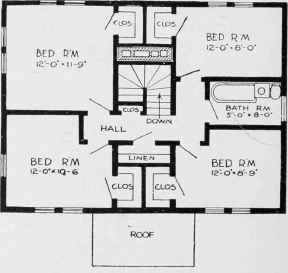
FIRST AND SECOND STORY PLANS OF COTTAGE SHOWN ABOVE.
Credit is due '-The House Beautiful" Magazine, Owner of the Copyright, for the Use of this Picture.
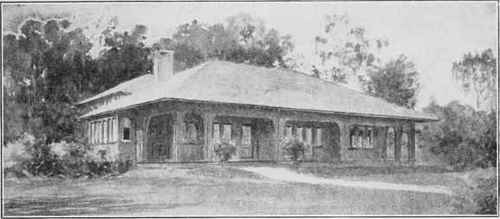
FLORIDA BUNGALOW.
R. C. Spencer, Jr., Architect, Chicago, Ill.
Outside Walls Rough Shiplap, Stained.

GROUND-FLOOR AND SECOND-STORY PLANS FOR FLORIDA BUNGALOW.
Credit is Due " The House Beautiful" Magazine, Owner of the Copyright, for the Use of this Picture.
Inside the lot lines, municipal and state authority do not exist, except for minor police regulations.
Continue to:


My Books

