


Bond In Brickwork: English Bond. Part 4
Description
This section is from the book "Modern Buildings, Their Planning, Construction And Equipment Vol1", by G. A. T. Middleton. Also available from Amazon: Modern Buildings.
Bond In Brickwork: English Bond. Part 4
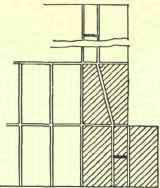
Fig. 91.
The simple modifications in the case of walls of an odd number of half-bricks in thickness should be noted.


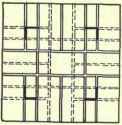
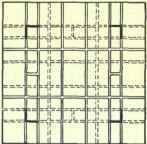
Fig. 92.
Rectangular Piers
These are practically formed like stopped ends placed end to end, as in Fig. 92.
Right-Angle Junctions Of Cross Walls
When a cross wall meets a main wall at right angles the bond is produced as shown in Fig. 93. One course of the cross wall overlaps the main wall by 4 1/2 inches, a sufficient number of headers of the main wall being omitted to receive it. A queen-closer is inserted 2 1/2 inches from the face of the main wall to give the necessary lap in the cross wall, and the wall is continued from this closer in the ordinary manner. The next course of the cross wall is simply butted against the face of main wall.
In the case of thick walls it is considered by many that a stronger junction is made if the one course of the cross wall projects within the main wall more than 4 1/2 inches, as shown in the lowest drawing in Fig. 93.
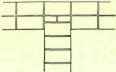
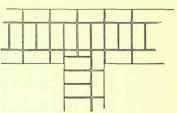
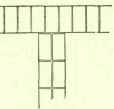
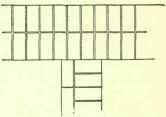
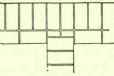
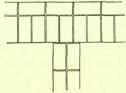
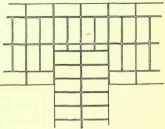
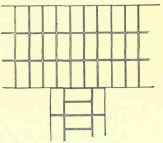
Fig. 93. Right Angle Junctions or Cross Walls in English Bono.
Cross Walls At Various Angles
When the cross walls meet the main walls obliquely it only requires a slight modification of the above method to secure good bonding. The headers where one course of the cross wall penetrates the main wall must be as large as possible, and pieces of brick cut to various shapes as the case requires must be inserted in place of the queen-closers in right-angle junctions, which pieces must be as large as possible, and at the same time not large enough to lessen the amount by which the cross wall overlaps the main wall. A few of these oblique junctions are shown in Fig. 94.
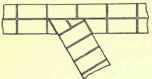
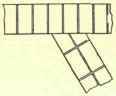
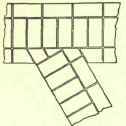
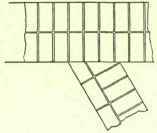
Fig. 94.
Zed Junctions of Walls - Perhaps the simplest way to remember how to bond zed angles is to take them as three different cases.
1. Where the distance AB in Figs. 95, 96, and 97 = a multiple of half a brick plus a quarter of a brick.
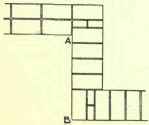
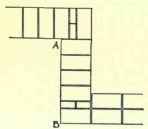
Fig. 95.
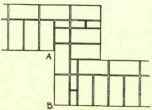
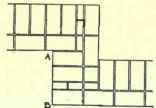
Fig. 96.
2. Where the distance AB as in Figs. 98 and 99 = a multiple of half a brick.
3. Where the distance AB as in Figs. 100 and 101= a multiple of half a brick plus a distance which lies between a quarter and half of a brick, or which is less than a quarter-brick.
Case 1 is shown in Figs. 95 and 97, in which the distances AB are [(5 x4 1/2) + 2 1/4] inches, and in Fig. 96 in which AB is equal to [(3 x 4 1/2) + 2 1/4] inches. In this case start to build the angles and prolong the small piece of wall between them and it will be found that it closes naturally. It will facilitate committing this to memory to notice that the directions of the closer at the angles form a right angle.
Case 2 is shown in Figs. 98 and 99, in which the distances AB are respectively 2x4 1/2 inches and 6 x 4 1/2 inches respectively. In this case an arrangement of bricks can be obtained giving a good bond, and it may be noted that the directions of the queen-closers are parallel to one another.
Case 3 is shown in Figs. 100 and 101, in which the distances AB are [(4 x 4 1/2) + 3 1/2] inches and [(7 x 4 1/2) + 1 1/2] inches respectively. This case presents most difficulty, and the bonding always needs to be specially devised, for after building up the angles and continuing the joining wall from these angles it is found that a gap of 4 inches in Fig. 101 remains in the middle to be filled up. This is done by inserting a brick cut to 4 inches in width in the course whose plan is shown on top in Fig. 101, while in the next course the bricks C, D, and E have to be cut to breakjoint with the courses above and below.
Continue to:


My Books

