


To Draw An Inclined Line, Given In Position And Magnitude. Continued
Description
This section is from the "The elements of drawing & the elements of perspective" book, by J. M. Dent & Sons. Also see Amazon: The Elements Of Drawing & The Elements Of Perspective.
To Draw An Inclined Line, Given In Position And Magnitude. Continued
Now if the line A B in this diagram represented the length of the line A B in reality (as A B does in Figs. 10. and 11.), we should only have to proceed to modify Corollary III. of Problem II. to this new construction. We shall see presently that A B does not represent the actual length of the inclined line A B in nature, nevertheless we shall first proceed as if it did, and modify our result afterwards.
In Fig. 77. draw a d parallel to A B, cutting B T in d.
Therefore a d is the sight-magnitude of A B, as a R is of A B in Fig. 11.
Remove again from the figure all lines except P V, v T, P T, a b, a d, and the measuring-line.
Set off on the measuring-line a m equal to a d.
Draw P Q parallel to a m, and through b draw m Q, cutting P Q in Q.
Then, by the proof already given in pages 230. and 303.,
P Q = P T,

Fig. 78.
Therefore if P is the vanishing-point of an inclined line A B, and Q P is a horizontal line drawn through it, make P Q equal to P T, and a m on the measuring-line equal to the sight-magnitude of the line A B in the diagram, and the line joining m Q will cut a p in b.
We have now, therefore, to consider what relation the length of the line A B in this diagram, Fig. 77., has to the length of the line A B in reality.
Now the line A E in Fig. 77. represents the length of A E in reality.
But the angle A E B, Fig. 77., and the corresponding angle in all the constructions of the earlier problems, is in reality a right angle, though in the diagram necessarily represented as obtuse.
Therefore, if from E we draw E C, as in Fig. 79., at right angles to A E, make E c = E B, and join A c, A c will be the real length of the line A B.
Now, therefore, if instead of a m in Fig. 78., we take the real length of A B, that real length will be to a m as A C to A B in Fig. 79.
And then, if the line drawn to the measuring-line P Q is still to cut a P in 6, it is evident that the line P Q must be shortened in the same ratio that a m was shortened: and the true dividing-point will be Q' in Fig. 80., fixed so that Q' P shall be to Q P as a m is to a m; a m representing the real length of A B.
But a ni is therefore to a m as A C is to A B in Fig. 79.
Therefore P q' must be to P Q as A c is to A B.
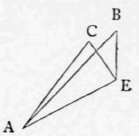
Fig. 79.

Fig. 80.
But P Q equals P T (Fig. 78.); and P v is to V T (in Fig. 78.) as B E is to A E (Fig. 79.).
Hence we have only to substitute P v for E C, and v T for A E, in Fig. 79. and the resulting diagonal A C will be the required length of P Q'.
It will be seen that the construction given in the text (Fig. 46.) is the simplest means of obtaining this magnitude, for v D in Fig. 46. (or v M in Fig. 15.) = v T by construction in Problem IV. It should, however, be observed, that the distance p D or p x, in Fig. 46., may belaid on the sight-line of the inclined plane itself, if the measuring-line be drawn parallel to that sight-line. And thus any form may be drawn on an inclined plane as conveniently as on a horizontal one, with the single exception of the radiation of the verticals, which have a vanishing-point, as shown in Problem XX.
Continue to:


My Books

