


Chapter XXXV. Lesson XXVI. Etching Statuettes
Description
This section is from the book "Complete Self-Instructing Library Of Practical Photography", by J. B. Schriever. Also available from Amazon: Complete Self-Instructing Library Of Practical Photography.
Chapter XXXV. Lesson XXVI. Etching Statuettes
520. Departing from the regular commercial retouching work, it is possible to produce some very pleasing and artistic effects which are always appreciated by the picture-loving public. For special work, and particularly along advertising lines, the retoucher will be called upon to work up negatives and prints, securing effects differing vitally from the original. The clever use of the etcher and pencil will enable the photographer to produce almost any desired results along such lines.
521. The First Step
The First Step. The first step in producing such results is the pose and lighting of the subject. Of course, you must determine in advance just what you desire to produce, and with the idea of what is wanted thoroughly fixed in your mind, then proceed first to pose your subject, taking care that you have the proper lighting. If the lighting is not carefully handled considerable difficulty will be experienced in properly regulating the effects of the light and producing the desired results. In Illustration No. 35 we show a group of three statuette portraits. The little subjects used for this illustration, as you will observe, appear to be of almost perfect form.
522. In Fig. 1, a statuette entitled, "The First Sorrow," illustrated by a child weeping over a broken doll, we have a very characteristic pose, and the lighting of the subject gives it still more life. The drapery surrounding the little form is nothing more or less than a strip of light chiffon. In order to give boldness to this picture and have
it stand out in relief, the entire background was etched away, and even a portion of the drapery removed, and to make this last appear soft and in folds, slight shadows were etched therein.
523. The outlining of the statuette is, perhaps, the most difficult part of the work and with figures such as those represented in this illustration, this is the most important feature, for there is every danger of ruining the shape of the figure. So, in outlining a figure of this kind, you begin first by etching a line all the way around the figure, and very close to it, but not encroaching on the figure itself. The etching of this outline is done with the point of the etcher.
524. The Second Step
The Second Step. After the outline is etched, then the remainder of the background is shaved away with the flat side of the blade of the etching knife and the entire film is removed, scraping through to the glass, thus giving a black background. With this accomplished, using the curved side of the blade, the edges of the outline in the film are gradually blended into the figure, thus supplying roundness thereto in place of harshness. You will observe in the head of Fig. 1, that the outline has not been blended, between the head and the outline the space being still visible, thus leaving a rather ragged edge to the head. The remainder of the body being nicely blended, is quite an improvement over this portion.
525. There are opportunities, as before stated, for improving the shape of the figure, for portions may be added or imperfect parts removed. In this little subject close inspection will show you that the calf of the leg has been added to, giving this member better proportions. In Fig. 2, the sitting subject, the outlining of the figure is completely blended, and to look at the picture you would never know that any etching had been done to produce the black background. The little wings etched onto the shoulders were produced with opaque applied to the negative, the surplus spread of opaque being scraped away with the etching knife, leaving the shape of the wings.
526. In Fig. 3, the little subject entitled, "The First Flight," is a very interesting study, the outlining having been done in the same way as before, but the bird and bird's nest were added to the portrait after the negative was made. The child was posed looking at her right hand, which is open; in the left hand she held a rubber ball, which was afterward transformed into a bird's nest. In making the bird's nest the top of the ball was etched away and with a soft BB pencil a sort of fuzziness worked into its place, giving it the appearance of straw and leaves, while the bird in the hand was etched from the light background which previously prevailed before the background was all cut away. You will observe that the extended arm has been somewhat altered (made larger). Had we followed the outline of the arm it would not have appeared in proportion to the remaining figure (as you can see from the illustration), and yet the alteration made would not be detected unless one's attention were called to it.
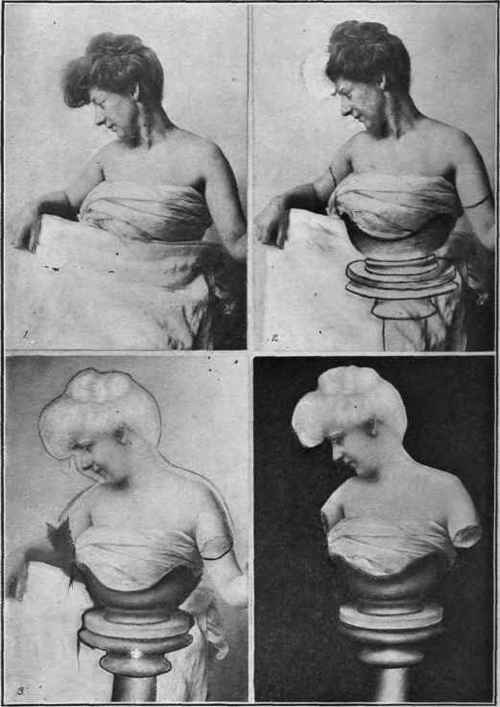
Illustration No. 36. Advanced Etching - Statuary from Life.
See Paragraph 527.
Continue to:


My Books

