


Chapter Ten. Puppetry
Description
This section is from the book "Arts And Crafts In The Elementary School", by Joan Dean. Also available from Amazon: Arts And Crafts In The Elementary School.
Chapter Ten. Puppetry
There are a number of crafts which are closely related to the three-dimensional work described in the last chapter. One of these is puppetry. This craft has become very popular in recent years and so far as Primary schools are concerned, I feel the popularity is well deserved. Not only is puppetry a craft in which most children delight; it is an excellent foundation for work in other crafts. It includes needlework, woodwork, modelling, drawing and painting, as well as providing practice in skills such as cutting out and sticking things. It offers splendid incentives for writing, for speech training, for reading, and it can be used as a teaching method for almost every subject in the timetable. From the craft point of view, it has also the advantage of offering opportunities for children of every degree of skill. There are kinds of puppets which Infants can make well, and kinds which tax the skill of mature craftsmen.
Probably the simplest form of puppet is the cut-out head or figure mounted on a stick. These can be dressed by sticking or draping scraps of material over them and they make a good beginning for work in puppetry, for they can easily be made and used in one lesson. A development of these is the cut-out figure with one movable arm or leg. The arm or leg is cut out separately and jointed to the body with a brass paper clip. A wire or bicycle spoke for moving the limb is then passed through it and fixed. Cut-out puppets can be dressed in all kinds of ways. Dresses can be cut out and sewn, or they can, more simply, be made by sticking. Hair can be made from raffia, wood shavings, horsehair, cotton wool, paper shavings from chocolates and biscuits, old woollen material, and many other things. This is yet another opportunity for children to become aware of the relationships of different materials, to discuss the way in which a rough texture often looks well with a smooth one, the way a strong pattern is enhanced by a plain material. Puppets should always be looked at from a distance and preferably in a strong light. It will be found that simple treatments, such as those suggested for the hair, are often much more effective than careful realistic ones.

Cut-out puppet with movable leg.

Match-box puppet

Puppet glove
Puppet heads can also be made from cigarette and match boxes. The box is first covered with plain paper. A tube, made of thin card, is rolled to the size of the first finger, and fixed inside the box, from which the centre sliding part has been removed. This tube makes the puppet's neck. One end of it should be left protruding. A face is then painted on the box, and hair, made from any suitable materials, is stuck into position. A simple glove is now made and sewn, following the pattern in the diagram. It is turned inside out and sewn to the neck of the puppet head. This glove is common to most glove puppets and forms a base on to which more complicated puppet costumes can be built.
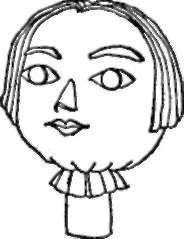
Stuffed head of puppet.
Another way of making heads is by gathering and stuffing a circle of material on to a tube of card, which represents the neck of the puppet. If this head is firmly stuffed and given a coat of size or thin glue, scraps of leather or cloth can be stuck on to represent features, and other materials to represent hair, and the whole can be painted.
More lifelike, but more demanding in skill and patience, is the modelling of heads from papier mache. One way of doing this is to work in solid papier mache, modelling on to a piece of stick or a bottle neck. It is generally best to wind a number of strips of newspaper round the stick first, sticking them into position. This gives the work a start, and allows it to dry rather more quickly. The papier mache should be made as described in the last chapter. When these heads are dry—and this may take a week or more—they can be painted and the puppet finished in the way described earlier. Sequins or small buttons often make effective eyes for this sort of puppet. The sticks on which the heads were built can remain if a rather formal character is required, or they can be taken out and replaced with cardboard tubes.

Head modelled on a stick. This was made for a rather severe and formal character, so the stick was left in place.

Puppet with neck made from a cardboard tube. This puppet was made to play a less formal character, so the stick was taken out and replaced by a cardboard tube.
Continue to:


My Books

