


Clay Modelling And Pottery. Part 7
Description
This section is from the book "Arts And Crafts In The Elementary School", by Joan Dean. Also available from Amazon: Arts And Crafts In The Elementary School.
Clay Modelling And Pottery. Part 7
4. Slip can also be trailed to form patterns directly on to a pot or tile. These, once again, should be bold, and all fine detail should be avoided. Some good examples of slip-trailed plates can be seen in the work of Thomas Toft and his contemporaries, and children attempting this kind of work would benefit from looking at pictures of some of these.
5. Another bold kind of slip decoration can be carried out by using wax resist or by masking out part of the pot and painting slip over the rest of it. If wax is used, it should be melted and applied with a brush—melted candles are quite satisfactory for this purpose. The slip will crawl away from the wax, leaving a textured edge. The wax itself will disappear in the firing, and the area may be glazed.
6. Stencilling. Stencils and edge stencils may be used in conjunction with slip or paint to form decoration in a number of ways.
There are also a number of kinds of decoration which can be carried out when a piece of work is at the "biscuit" stage, i.e. after the first firing. These are:
1. Painted decoration in underglaze paint. This can take a number of forms. Paint can be used to form a repeating pattern. It can be used with stencils or edge stencils. It can be printed on to the pot with a small block of some kind. It will often be found, however, that it is the simplest decorations which are the most effective. Patterns formed from simple stripes and spots often look very well.
2. Wax resist and masking. These processes can be used before glazing, in just the same way as they can be used with slip.
3. Majolica or Faience or Delft. This is a method of painting on top of a tin glaze (a transparent glaze with about 10 per cent of tin oxide added). The glaze is applied first and the design painted over the top. The paint will need to be wet and laid on quickly with a large soft brush. When the pot is fired the design will appear in colour on a white background.
There are a number of basic processes in pottery, which may need explanation. If work is to be fired, it is usually necessary to "wedge" the clay before using it, so that there are no pockets of air trapped inside it. When it first arrives very little wedging will be necessary, but when it is being used for the second and third time it becomes an important process. The simplest way of doing this, and one which children will love doing, it to take a large piece of clay and slam it down on a bench a number of times. If you cut it through the centre with a piece of wire, you will be able to see any air pockets, and wedging should continue until there are no more.
When work is finished and completely dry it is ready for the biscuit firing. When it is dry a dust will come off to the touch and the clay will be much lighter in colour than when wet. Work packed in a biscuit kiln may touch, or one piece may be placed inside another so that all the possible space is used. You must avoid trapping air, however, and avoid placing work so that it could lose shape in firing (e.g. placing a round piece of ware on its side). Leave a space in the front of the kiln for cones, remembering that these will bend and so will need space. Put three cones in each kiln, one which will go over at a temperature slightly lower than the one you want, one for the temperature you want, and one at a higher temperature. In this way you will have warning when you are approaching the temperature, and if you should go above your intended temperature, you will have some idea of the range of temperatures you have reached. Raise the temperature of a biscuit kiln slowly, so that any further drying out can take place. Personally I like to leave the kiln at a low temperature overnight and then raise the temperature quickly in the morning. When your temperature has been reached you will need to allow quite a long time for cooling before you can open the kiln. Slow cooling is less important after a biscuit firing than after glaze firing, but in any case you will have to wait a long time before the ware is cool enough to handle. Allow at least as many hours as it took to reach maximum temperature from cold.
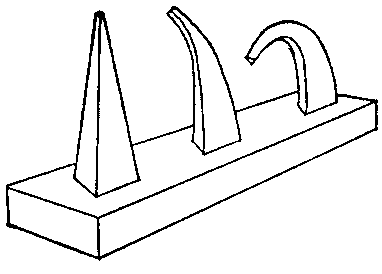
Cones for testing temperature.
Continue to:


My Books

