


V. Envelope Problems
Description
This section is from the book "Paper and Cardboard Construction", by G. F. Buxton, F. L. Curran. Also available from Amazon: Paper and cardboard construction.
V. Envelope Problems
Envelopes and paper bags are typical problems for paper construction and are varied enough in shape to suit the abilities of pupils of different ages. The making of envelopes is of importance industrially, altho, of course, automatic machinery takes the place of most of the hand processes. Yet there is enough similarity between the hand and the machine process to make the type of construction evident. Careful "laying out", cutting, folding, and gluing are necessary for successful work and must be insisted upon at all times.
To keep up the interest in the making of envelopes, several forms are introduced, and the uses of the finished envelopes are different. Mailing envelopes are made in many shapes and sizes and from different materials. Filing envelopes are made in different proportions to fit particular uses, and increasing in difficulty as different school grades are reached. Paper bags are included with the envelope problems as they are of the same general character.
Many uses for the envelopes and bags will suggest themselves, and different constructions may be made as other needs appear. It is hoped that teachers will find in these outlines constant hints for new ways to attack the problems in paper and cardboard work, but it is also expected that a reasonable number will always have a definite line of problems to present to pupils, and will not hesitate to give such directions as will make the work clear to the pupil. More freedom may well be allowed in the uses of the envelopes as made, than in the methods of making them. As suggested for the card problems, there is a good deal of illustrative material which should be saved for future reference, and which if mounted or saved in envelope files would be convenient of access as needed. Certain of the envelope files will be found convenient for newspaper clippings, and others for magazine illustrations.
The arrangement of envelope problems by grades is as follows:
141 Envelope folder (Thin tag board or heavy cover paper).
142 Square envelope (Book paper or cover paper).
143 Pocket for clippings (Thin tag board).
241 Paper bag (Thin cover paper or manila wrapping-paper).
242 Mailing envelope (Bond paper or flat writing-paper).
243 Long mailing envelope (Bond paper).
341 Photo filing envelope (Light or medium tag board).
342 Long filing envelope (Medium tag board).
343 Large filing envelope (Medium or heavy tag board).
Fourth Grade
441 Paper bag with folds (Thin cover paper).
442 Flat envelope file (Medium tag board, binders' cloth, cloth board, marble paper).
443 Book envelope file (Medium tag board, cloth board, binders' cloth, marble paper).
141. Envelope Folder.
Thin tag board or heavy cover paper, 1 piece, 6"x9".
Paste.
Rule, pencil, scissors.
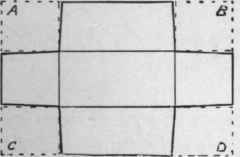
Folder Cut To Size.
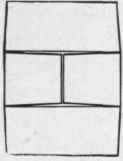
Partly Folded.
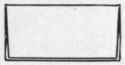
Finished.
Directions: a. Place the sheet of paper with the long edges in a horizontal position.
b. Fold left edge nearly to center of sheet and crease.
c. Fold right edge nearly to center of sheet and crease.
d. Open to original position.
e. Fold bottom edge up nearly two-thirds of the distance to the top edge and crease.
f. Fold top edge down nearly to folded edge at bottom, crease and open.
g. Cut away corners as indicated in drawing at A, B, C, D.
These cuts may be made at an angle as shown in drawing, or they may be made on folded lines. h. Refold all parts.
Note: - Different shaped folders should be made if time permits. It may be well to apply paste for a space about one-half inch in width along the inside edge of bottom lap and press firmly in place to make a regular envelope in place of the envelope folder.
142. Square Envelope.
Book paper or cover paper, I piece, 9"x 12". Paste.
Rule, pencil, scissors. Directions: a. Fold one short edge to one long edge and crease on diagonal fold.
b. With paper in this position cut away the three-inch strip.
This leaves the paper 9" square.
c. Fold the other diagonal.
d. Fold A to B, and C to D, as shown in first drawing.
e. Fold bottom up, - E to F, as shown in second drawing.
f. Fold top down, - I to J, as shown in third drawing. , g. Open top part back to original position, and with rule draw pencil line from K to L, and M to L. h. Open all folds and cut away portions G and H. i Fold in sides and paste at D.
Envelope Problems j. Apply paste at edges of bottom fold and press into place.
Note: - Step "h" may be omitted to simplify the work and the paper left square but the folds will be more clumsy.

Steps In Making Square Envelope.
143. Pocket for Clippings.
Thin tag board, 1 piece, 9"x 12". Paste. Scissors. Directions: a. Cut sheet to 9"x 9" as directed in 142, "a" and "b".
b. Fold other diagonal.
c. Fold in the four corners about one-half inch past the center of the sheet, and in the following order, - A, B, C, D, as shown in drawing.
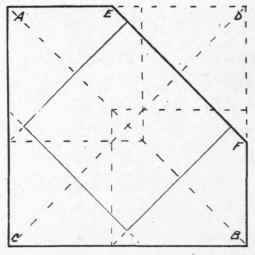
Pocket Cut To Size.
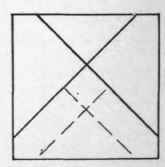
Pocket Folded d. Unfold top part, D.
e. Cut on fold E F.
f. Paste as in 142.
241. Paper Bag.
Thin cover paper or manila wrapping-paper, 1 piece,
9"x 12". Paste. Rule, pencil, scissors.
Directions: a. Place the sheet of cover paper with the long edges in a horizontal position.
Continue to:


My Books

