


Transferring Design To A Saucer
Description
This section is from the book "Cassell's Cyclopaedia Of Mechanics", by Paul N. Hasluck. Also available from Amazon: Cassell's Cyclopaedia Of Mechanics.
Transferring Design To A Saucer
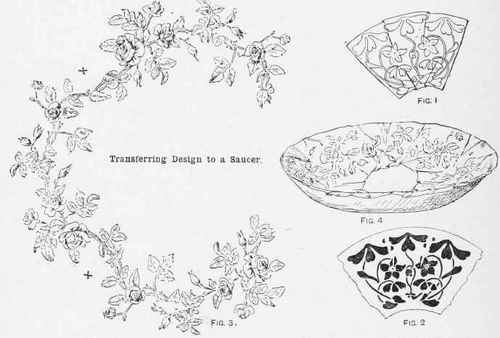
If it is wished merely to fit the design to the concave face of the saucer, to be painted over by hand afterwards, fold up the drawing which it is desired to transfer as shown at Fig. 1 in such a manner as to fit the curved surface, and adapt the drawing to these folds. Fig. 2 shows the drawing arranged to suit the folds. Manufacturers, however, adopt a different method. Fig. 3 shows the pattern repeated three times round the circle. It will be noticed that the design does not entirely fill the circle, but that a small blank space has been left. In the necessary folding of the drawing to fit a circular concave surface the diameter of the circle on which the design is drawn must be considerably larger than that of the saucer - that is to say, in a saucer of 6-in. diameter, it will be necessary to draw the design on, say, a 7i-in. circle. The spaces marked + + + in Fig. 3 are left vacant, so that there may be as little distortion as possible when transferring the printed pattern on to the saucer. Fig. 1 shows the appearance of the paper containing the design when stuck on the saucer. The following is the process employed in producing these designs. When a design has been drawn, the engraver cuts it out on a copper plate, making the incisions deeper where a darker shade is required. On to this engraved plate paint is rubbed to fill the lines, all superfluous colour being carefully cleaned off. A sheet of thin tissue paper is laid over the plate and pressed into it by means of an iron roller covered by three or four wrappings of felt. The print is then cut out with scissors, laid round the saucer, and worked into place with a dabber made of rolled flannel. The transfer is left on the saucer, which is in the "biscuit," or half-fired, state, for half an hour or so, when the paper is washed off, leaving the design on the saucer. In the colours composing the design there is a certain amount of oil, which stains the biscuit ware; this oil has to be burned off before the glaze is applied. This is done by placing the ware in a heated kiln. When the oily matter has been expelled, the saucer is dipped into the liquid glaze, winch is a solution of borax glass containing lead salts and silica.
The saucer will be dry in about five minutes, when it looks as if it had been whitewashed, the design being completely obliterated. The saucer is now put in an earthenware sagger, or crucible, and heated to a white heat for sixteen hours in the kiln, during which period the glaze has fused and turned into a transparent glass through which the design is visible. The saucer is now finished.
Continue to:


My Books

