


Barometer. Part 3
Description
This section is from the book "The Engineer's And Mechanic's Encyclopaedia", by Luke Hebert. Also available from Amazon: Engineer's And Mechanic's Encyclopaedia.
Barometer. Part 3
On the other hand, if the atmospheric pressure decrease, the surface at c will rise, and, with the assistance of the counterpoise w force up the iron ball, and, by this means, turn the pulley and index in an opposite direction. There are two sources of error in this instrument, that render it inferior to the simple vertical barometer. These are, the pressure of the iron ball on the surface of the mercury, which necessarily increases the height of the shorter column, and the friction of the pulley. It is impossible entirely to annihilate these causes of error, and hence, for philosophical purposes, the straight barometer is preferred.
Fig. 3.
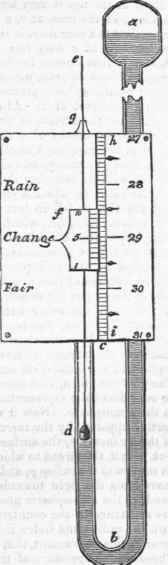
Fig. 4.

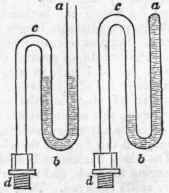
The Syphon Barometer is an instrument used to ascertain the pressure of air in the partially exhausted receiver of an air-pump. It consists of a tube bent as in the accompanying engraving, Fig. 6. Each leg may be about 4 inches in length, and one a b completely filled with purified mercury. When the instrument is connected with the air-pump by means of the screw at d, and the air partly exhausted, the mercury in the leg a b will begin to fall, and, consequently, rise in the branch c b; every inch, therefore, that it falls in a b, must be reckoned equal to two inches in the straight barometer. This instrument does not begin to act till the air is reduced to about 1/7 of its original density; but this is no inconvenience, as its indications are seldom required the exhaustion is nearly complete. If the leg a b be lengthened, and left open at the top, as in Fig. 7, this barometer becomes a useful appendage to the steam engine, in ascertaining the pressure of steam within the boiler. When it is attached to the boiler by the screw d, and the air or steam in the boiler has the same elasticity as the external air, the mercury stands at the same height in both legs; but as soon as the steam increases in elasticity, the mercury will be depressed in the leg c b, and rise in a b, and the difference between the two levels will be proportional to the difference between the external and internal pressure.
If the common barometer stands at 30 inches, and the difference of level between the two surfaces is 6 inches, the elasticity of the steam will be 1/30 or 1/5 greater than the pressure or elasticity of the atmosphere.
Fig. 5.

Fig, 6.
There are other forms of the barometer, but their comparative unimportance renders it unnecessary to describe them here. We shall, therefore, proceed to consider the most important purposes to which this instrument is applied.
The most immediate use of the barometer, for scientific purposes, is the ascertainment of the amount and variation of atmospheric pressure. The fluctuations in the pressure being observed in connexion with changes in the state of the weather, a general correspondence is supposed to prevail between these effects. The instrument has, from this circumstance, been called a weather glass. Rules have been attempted to be established, by which the approaching state of the weather may be predicted from the height of the mercury, and the words rain, fair, changeable, etc. are engraved on the scales of common barometers. These marks are, however, entitled to no attention, since it is the changes that occur in the height, and not the absolute height, that indicates approaching changes in the weather. The variation in the altitude of the barometer in a given place, together with the corresponding changes of the weather, have been regularly recorded for a considerable time; and it is by an exact comparison of these results that general rules are to be found.
At present, the best rules are liable to some uncertainty at times. Those which have been considered least liable to error are the following: 1. Generally, the rising of the mercury indicates fair weather; its fall shows the approach of foul weather. 2. In sultry weather the fall of the mercury indicates coming thunder. In winter, a rise indicates frost. In frost, its fall indicates thaw, and its rise indicates snow. 3. Whatever change of weather suddenly follows a change in the barometer, may be expected to last but a short time. Thus, if fair weather follow immediately the rise of the mercury, there will be very little of it; and in the same way, if foul weather follow the fall of the mercury, it will last but a short time. 4. If fair weather continue for several days, during which the mercury continually falls, a long succession of foul weather will probably ensue; and again, if foul weather continue for several days, while the mercury continually rises, a long succession of fair weather will probably succeed. 5. A fluctuating and unsettled state in the mercurial column indicates changeable weather.
The other important purpose to which the barometer is applied, is the measurement of altitudes.
If the atmosphere were a liquid of nearly equal density, like water, the measurement of heights by the barometer would be the simplest process imaginable: for we should have then only to make one experiment to ascertain how much the mer cury would fall, in rising to the height of 100 feet for example, and then the fall for 200 or 300 feet would, of course, be double or triple the former one. But the density of air is well known to decrease as we ascend from the earth, so that at the height of 31/2 miles, it is only one half its density on the surface of the earth. From this it must be evident that if the mercury fall one-tenth of an inch in rising through the height of 100 feet, we must rise through a greater height to cause a fall of another tenth. The height of the surface of the atmosphere above that of the earth is considered to be about 50 miles; and we have already observed, that at the height of 31/2 miles the density is reduced to one-half. Hence we should find, by ascending to the height of 31/2 miles in the atmosphere, the mercury would stand at one-half the height of another barometer at the surface of the earth.
If, however, the decrease of density were affected by the height alone, the determination of altitudes would be comparatively easy, as a simple formula may be given, which would immediately show the relation between the height and density.
The circumstance that u interferes with barometric observations, is temperature, which affects them in two ways. 1. Increase of temperature expands the mercury in the barometer, and thereby causes the column to be longer than at lower temperatures. 2. The air itself becomes expanded by heat; and hence the column becomes lengthened without any increase in its absolute weight. It might be thought that these effects were too trivial to influence sensibly the results of our observations; but it must be remembered, that as we ascend from the earth, the temperature of the air rapidly decreases, so that at a certain height, dependent on the latitude of the place, a freezing temperature constantly prevails. Putting aside the effect of change of temperature, the simplest rule for determining heights is as follows:- Observe the height of the mercury at the bottom and top of the altitude to be ascertained; take the logarithms of these heights, and multiply their difference by 10,000, the product is the answer in fathoms.
Then suppose the mercury at the foot of a mountain to stand at 29,5 inches, and at its summit 26.4 inches, the calculation would be as follows: -
Lower barometer. . . | 29.5 | log. | .469822 | |
Upper ditto ................. | 26.4 | log. | .421604 | |
Difference | .048218 | |||
10000 | ||||
482,180,000 | Fathoms, | |||
or, | 2893 feet, | |||
which is the altitude, supposing the temperature to be at 31° Fahr. If the temperature differ from this, it must be observed at the upper and lower station, and a mean of the two taken, by adding them together, and dividing the sum by 2. If the mean thus obtained exceed 31°, the altitude before obtained must be increased 1/435 for every degree of difference between them, and vice versa. If we wish to correct the other error arising from the expansion or contraction of the mercury in the barometer, we must observe the temperature of the mercury at the upper and lower station; then the altitude of the lower one must be increased, or the higher one diminished, 1/1600 part for each degree of difference between their temperatures. To those who are unaccustomed to the use of logarithms, the following rule may be preferred: - Take the sum and difference of the upper and lower barometric heights, and divide one by the other; multiply the quotient by 55000, and it will then answer in feet for a temperature of 55°.
Suppose, as before, the height at the lower station to be 29.5, and at the upper, 26.4 then
29.5 - 26.4
------------- = 0554
29.5 + 26.4 And .0554 X 5500 = 3047 feet. This result, it will be seen, exceeds the other by 154 feet; it is not so exact, but, in many cases, it may serve to furnish a tolerable approximation, when logarithmic tables are not at hand. The corrections for temperature may be applied as in the other formula.
Continue to:


My Books

