


Drill
Description
This section is from the book "The Engineer's And Mechanic's Encyclopaedia", by Luke Hebert. Also available from Amazon: Engineer's And Mechanic's Encyclopaedia.
Drill
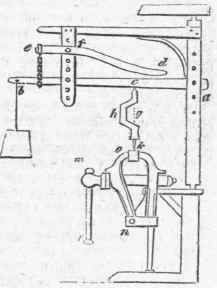
An instrument for boring holes in metals and other hard substances. It usually consists of a straight piece of steel, one end of which is formed into an angular point, and the other into a blunted round point, for inserting into a hole in a steel breast-plate, which is worn by the workman whilst operating with the instrument, in order that he may steadily press the point into the work, while he, at the same time, turns it backwards and forwards by means of a bow and cord, the latter being passed around a small pulley fixed about the middle of the drill. Sometimes drills are fixed to braces or stocks for the purpose of drilling. For boring large holes in metal, smiths and engineers employ a very convenient arrangement of levers for applying pressure to the drill, which is called a press-drill, and is delineated in the subjoined cut. a b is a lever of the second class, whose fulcrum is at a; the weight being applied at b, its efficacy is transmitted to the point c, in a ratio proportioned to the relative distances between b c and e a.
As the pressure upon the drill often requires relieving, a lever de is added, whose fulcrum is at f.
The extremity of the shorter arm is connected to the lever a b by any convenient method; and when the workman wishes to release the brace g, he applies his power to the extremity of the longer arm by pulling down at d, which raises the shorter arm, and with it the lever a b, consequently the brace g is at liberty to be removed. In order that the work may be firmly fixed, it is usual to screw it fast between the chaps of a vice, as shown at o l m n in the cut.
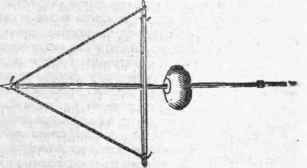
The annexed cut represents an extremely simple and ingenious contrivance for drilling holes, used by the smiths in Ceylon. It is about two feet and a half high; the cord attached to the cross sticks is made of slips of hide twisted. The round weight to give momentum is of compact neiss, neatly cut. Any kind of borer can be fixed to the extremity of the wooden rock The instalment is worked on the principle of torsion. The hole in the cross arms or handle, through which the spindle of the drill passes, is sufficiently large to admit of it being slided easily up and down the spindle. Upon turning the cross a few times round the spindle, the cords become twisted in a corresponding degree round its upper part, and upon pulling the cross downwards, the cords in untwisting impart a rotatory motion to the spindle, which, by the impetus which the weight upon it acquires, is continued after the cords have become straight; and the cross being then slided up the spindle, the cords become twisted round it in a contrary direction; and by again depressing the cross, the spindle revolves the reverse way.
Drill, in Gardening and Agriculture, a small trench made in the ground, for sowing in it the seeds of vegetables.
Continue to:


My Books

