


Matin's Furnace For Smelting Iron With Anthracite Coal
Description
This section is from the book "The Engineer's And Mechanic's Encyclopaedia", by Luke Hebert. Also available from Amazon: Engineer's And Mechanic's Encyclopaedia.
Matin's Furnace For Smelting Iron With Anthracite Coal
Mr. Joshua Malin, of Lebanon, in Pennsylvania, has described his furnace for this purpose in the Franklin Journal. It is very similar to our common blast furnaces, the crucibles and hearth alone differing materially. Mr. Malin's crucible, instead of being square is round; anthracite coal being so much more dense than coke or charcoal, its weight causes it to descend in the corners or angles of a square hearth, where, being screened from the intense blast which is required, and carrying with it a portion of the unmelted ore, it mixes with, and chills a quantity of the fused ore and metal, which stops the operation of the furnace.
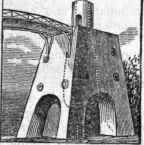
For the smelting by means of anthracite; ""Mr. Malm states, that the Wast must be introduced under a pressure of at least two and a half pounds to the circular inch; and the quantity required for a common sized furnace will not be less than 28,000 cubic feet per minute, or 7 cubic feet per minute for every circular inch in the area of the hearth at the tuyere. The hearth of the furnace in which Mr. Malin made his experiments, was only 11 inches in diameter at the tuyeres, the blast being introduced as represented in the subjoined plan. Mr. Malin had the diameter increased to 14 inches, and found that the blast which he had at his command would not enable him to go beyond that point, as, when he attempted it, the scoriae and metal chilled, and formed a tube from the tuyere a part of the way across the hearth. Fig. 1 exhibits a vertical section, and Fig. 2 an horizontal section drawn to a scale of an eighth of an inch to the foot; the letters of reference in each figure that are the same indicate corresponding parts, a is the crucible, being a part of what is commonly called the hearth of the furnace; b are the boshes, or that part where the metal passes from the solid to the fluid state as it descends; c is the bottom stone of the hearth, bedded in sand, and supporting the crucible and boshes; d is the dam-stone; e e the blast pipes; f f inner walls of the furnace of fire-brick, around which is a space from 4 to 6 inches wide, filled with soft sand-stone; h tymp-plate; i i lintels of cast-iron to support the inner walls over the tuyere and tymp-arches; k k tuyere arches; f part where the metal flows out; m tymp arch; n the tymp-stone, forming a part of the crucible, and supporting a part of the boshes.
Fig. 1.

Fig. 2.

The prejudices in America against the use of anthracite were as strong as they are here; but there, they are now being rapidly dissipated by an irrepressible spirit of enterprise, guided by scientific intelligence; whilst we, out of reverence to the ignorance of our forefathers, adhere to and cherish them. In America anthracite was at first introduced into the parlour grates, where, having gained a triumph, it descended into the kitchens, in spite of the vehement protestations of the ministers of the victualling department; having, however, here demonstrated its superiority over all other kinds of fuel, it next presents itself to the notice of steam-furnace men and the iron masters; these, however asserted that there was something in its very nature which, in their occupations, forbade its use; and they were so obdurate, Dr. Jones informs us, that " you might as well have attempted to convince them that it was fit to be made into candles, as that it might be employed for their purposes if their furnaces were suitably constructed, and the fuel properly managed." "It appears likely, however," our scientific historian continues, "that it will soon assert its claims to superior excellence in these applications also, and triumph over the prejudices of the managers of furnaces, as it has over those of the householder, the cook, and the blacksmith."
Continue to:


My Books

