


Questions 35
Description
This section is from the book "Applied Science For Metal Workers", by William H. Dooley. Also available from Amazon: Applied Science For Metal Workers.
Questions 35
1. Explain the different steps in finishing and machining castings.
2. How are the castings made to exact size?
3. What is high-speed steel? Why is it very useful in the machinists' trade?
4. What is chipping and filing?
5. What is the meaning of "benchwork" in the machine-shop?
6. Is it necessary to use mathematical instruments in doing machine-work? Why?
7. Describe a micrometer. How is it used? Does the heat of the hand affect it?
8. Name some machine tools built on the principle of rotary motion; reciprocating motion.
9. Which is the most economical tool, so far as the energy put into it and the useful work it will do is concerned?
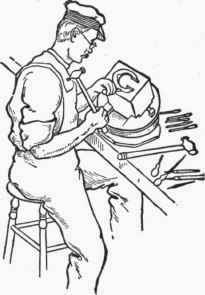
FIG. 204. - Die-sinking.
10. Upon what does the cutting capacity of a machine depend?
11. Define the following expressions: "cutting feed of a tool," "depth of cut," "cutting speed."
12. Is it possible to cut all metals at the same rate of speed? Explain.
13. Why is it necessary to have different speeds on a machine tool? How are different speeds obtained?
14. What is a lathe? Explain the difference in action and uses of different lathes.
15. What is meant by the expression "size of a lathe"? Why is it important?
16. What is a simple lathe? Compound lathe?
17. What is a lathe tool?
18. Describe a machinist's vise.
19. What is a screw machine? Explain its action.
20. What is a drilling machine? Explain its action.
21. What is a shaper? What is a planer? How do they differ in use and action?
22. What is a key-way machine?
23. Explain the Purpose of a milling machine. Describe its action.
24. What is a grinding tool?
25. Describe the different kinds of power hammers.
26. Explain the use and action of a vernier.
27. What is a screw pitch gauge? Thickness gauge?
28. What is the difference between a general machinist tool-maker and die-sinker? Name some of the principles of science that a general machinist should know in order to understand and do his work intelligently.
Continue to:


My Books

