


Ornamental Silver Work
Description
This section is from the book "Elementary Metal Work", by Charles Godfrey Leland. Also available from Amazon: Elementary Metal Work.
Ornamental Silver Work
There are many very pretty silver ornaments which any lady might wear, and yet are extremely easy for any girl or boy to make, and require very few implements. I have seen in Nubia very neat objects of the kind actually hammered from coins with only a nail and a stone, and among the Red Indians of America a hammer, a pair of scissors, and a flat-iron, suffice to make a great variety of decorations. Of these latter, known as Nispeman'l, I possess more than a pound in weight.
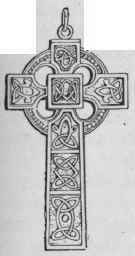
Fig. 106. Scottish Cross : engraved Silver.
The metal for this work is generally obtained by hammering silver coins flat; but the amateur may begin with real or German silver, which is sold in sheet form of different degrees of thickness, some silver wire, and for advanced work some silver solder. The first and easiest thing to make is a shawl-brooch. Take a sixpence or a shilling, lay it on the anvil (as before said, the Indians use a flat-iron reversed), and with a small hammer gradually and carefully beat the coin into a saucer shape. Fig. 107, a, b. If neatly done, it will be quite smooth. Do not make it too thin or it will bend too easily, and not wear well. When this is done, take a file and make a hole of from half an inch to three-quarters of an inch diameter in the centre. With a round cutting punch and a blow of the hammer this round centre may be cut out, and the bit thus removed may serve as a pendant.
This done, bore a small hole in the edge of the brooch, pass a strong pin through it, bend the dull end into a ring to hold it, and the brooch is finished. Fig. 107, c, d. It may be observed that any small jeweller will solder a pin - which will be better than the bent one - for sixpence, and that a steel pin is better than one of silver. To use the brooch, pull the shawl through the hole, put the pin through it, and the shawl, as it pulls, holds the pin down. It is not uncommon in Scotland for people to make penny pieces into brooches by the simple process of filing a round hole in the rim, and, without hammering, adjusting a pin to it.
These brooches maybe ornamented by etching with nitric acid, and the lines nielloed with ammonia and sulphur as before described (p. 54), or they may be hammered in repousse. Fig. 108. I possess a broad silver brooch which I once dug out of an old Indian grave. On it is a figure of a bear, which had been neatly pointed in with a dot-wheel. A dot-wheel is a little implement which is used by shoemakers, and which may be bought for ninepence. Fig. 85. A silver chain is very easily made. Take the bit of wire, turn its end once round the round-nosed plier, then hold the ring in the flat plier, turn the other into an S. Of course the ends meet, like a figure 8. Then cut a second bit, repeat the process, link one into the other, and so on.
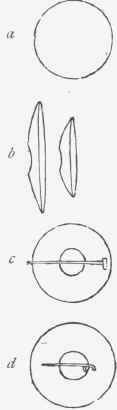
Fig. 107. A Silver Brooch.
Two strands of silver wire may be twisted, or three may be braided into a cord, which may be made into a necklet or bracelet, according to its length. When two are twisted a loop may be made at one end, and the two bent into a hook at the other to catch the loop. Where there are three braided, one of the wires must be secured by soldering or winding its end round the other two. It is advisable to make such necklets and bracelets first in bell-wire before venturing on silver.
When the silver wire is very thick, a single piece curled once or twice round the wrist, and simply cut off, makes a neat bangle. To this pendants may be affixed or hung.
A simple flat band of sheet silver, worn round the wrist, and lapping over at the ends, can be cut by anybody with a. pair of shears or even strong scissors, and it makes a very attractive ornament. When nielloed with ever so little skill it is very pretty. With the round or ball punch bosses may be worked on these flat bangles, and the outside ornamented by chasing, acid-etching, or repousse. '
An endless variety of beautiful ornaments for pendants is made by the simple process of cutting out from sheet silver, with a pair of scissors, any kind of figures suitable. Even the ancient Etruscans, who surpassed the first artists of modern times in a perfect knowledge of the art of jewellery, took a great pleasure in this simple, easy method of making pendants, by merely cutting out and stamping thin gold and silver metal, and it is found side by side with the exquisite powdered gold articles, which, according to Castellani, no one can now imitate. And if there was not now prevalent in the world a vulgar belief that excess of expense, labour, and finish constitutes "beauty" in jewellery, we should now see ladies wearing ornaments made by themselves according to their own original tastes and designs. Fig. 105.
Continue to:


My Books

