


Nails And Nailed Strips
Description
This section is from the book "Elementary Metal Work", by Charles Godfrey Leland. Also available from Amazon: Elementary Metal Work.
Nails And Nailed Strips
T was extensively recognized in ancient metal work that shining points of light were of themselves very attractive, and therefore bosses were so freely used in armour, and even imitated in round coloured spots on cloth. Hence the frequency of grapes and other round fruit in old repousse or embossed sheet brass work.
This is the leading feature in the work I now describe. This beautiful and very easy style of ornamentation has been very little practised since the Middle Ages, although some very fine specimens of it were executed and exhibited at the International Exhibition a few years ago in London. It consists simply of round-headed or boss nails of iron, brass, copper, or silver, of which many varieties of all sizes may be purchased from dealers in metal-ware. These nails are simply arranged in rows so as to make patterns, and are driven into boxes or chests.
Boss nails can be very freely employed in strip and sheet metal work, and, indeed, I may say, all kinds of metal work may be freely combined and intermingled.
Harness makers and others have a great variety of elegant ornaments, coats of arms and crests, attached to nails, which can be used for decorating surfaces. I have in my possession a very old flat carved Florentine powder-horn, which has been made very attractive by having fastened to it a stag's head in brass, which was manifestly at first attached to some carriage harness.
For this purpose of ornamenting caskets, cabinets, etc., the Japanese cast a great variety of pretty little objects, which you can find attached to boxes, etc., at a very low price in most Japanese shops.
African savages often make a curious decoration for sword-handles by driving small brass-headed nails or tacks closely together so as to quite conceal the wood. Some of the Red Indian tribes of North America also ornament their whip-handles, hatchets, knives, etc., very curiously with brass-headed tacks.
What is known as Bent Iron, Ribbon, or Strip Work, when attached to wood, is called by Germans "Venetian Nail Work," it being a combination of the two kinds of work, that is, of bent iron rosettes nailed at intervals on the panel. This is not properly nail work in itself of the old English kind, but rather the art of making, firstly, highly ornamented heads of nails in bent iron, repousse, etching, and casting; and secondly of forming ornaments such as rosettes or bosses, which were nailed on at regular intervals. There is perhaps no kind of decorative work in which such admirable and striking effects can be obtained with so little labour as in this, as it consists of ornaments which are for the most part very easily made.
There is a combination of strip and nail work which was often executed in the Middle Ages, which consists entirely of straight lines, all the angles being made by riveting. This is chiefly applied to flat surfaces, as, for instance, doors of cabinets or boxes. To attach it to a surface, nails are here and there driven through the rivet-holes. The whole method of making it is shown by the illustration, Fig. 114.
A very pretty application of flat metal, brass or iron, is to take a box or chest, and nail strips round it, using round-headed nails for rivets. This was extremely common at one time. Fig. 115.
Flat strips are sometimes interwoven like matting, and when inclosed in a frame may be used as a diaper ground,1 on which to rivet flat sheet metal in cut-out patterns. This forms a kind of metal woven fabric. It is pretty when arranged diagonally in the frame.
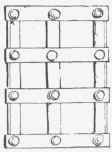
Fig. 114.
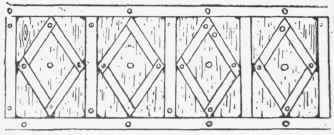
Fig. 115. Box Front.
Arab or Moorish patterns in straight lines, geometrically arranged, which are made from the simplest square crossed with a triangle, up to the most elaborately complicated and elegant combinations, are all adapted to flat strip iron work. The 1 A diaper ground is one in which the whole is covered with one small pattern frequently repeated. It may be a mere dot, or a little circle like a small o, a flower, a diamond, or a more developed ornament. On such a ground large ornaments may be placed at intervals.
student who can draw or construct, may find full directions how to make such Moorish patterns in my little work on Design.
Nail, knob, or boss work of any kind is specially suited, not only to chests and caskets, because it is suggestive of strength and firmness, but for the same reason to panels of doors, to squares placed above doors and windows to improve their effect, and in many cases and places to furniture. On a small scale it was much employed by the monks in bookbinding, not merely for ornament, but to attach leather to boards, and in many cases to protect the painted or jewelled surface of the cover, when laid flat, from friction.
Where no great relief is desired, ornaments may be cut from flat metal into disks, circles, . flowers, rosettes, or figures, and attached by flat-headed nails to the surface. Fig. 116. Here the nail is properly a mere aid, but as such it plays an important part in metal work, especially when it is a central convex shining point. Thus the attaching of clasps and ornamental covers to books, sidepieces, or ornaments anywhere by means of projecting points, belongs properly to nail work.
It may be observed that nail work ranges from dots the size of a pin's head up to circles, disks, or knobs of any size, also that it includes all kinds of small applied ornaments which are held by a nail of which they are the heads. Therefore (as in bead work sunk in wood) by making lines of nail-heads we can execute any designs or patterns in lines which we please. Fig. 117.

Fig. 116. Pattern for Nail Work.
I should mention that square-headed nails can be bought with which work in lines is very effective.
When the ground or wood is light coloured, the effect of nail work, especially for brass, is much improved by painting the pattern in black bands. This method is particularly striking where elaborate patterns or picture-making is desired. It was very much in vogue in old Scandinavian ornament, and was profusely imitated in stone-carving. There is a curious survival of old Norse and Middle Age nail work on black bands to be seen on many old trunks, in which strips of black or red leather formed the band. The effect is improved by making the band a little broader than the diameter of the nail head.

Fig. 117. Complicated Pattern in Nail Work.
If we have, for instance, a box of walnut wood, very good effects may be produced by taking thin disks of walnut wood with bevelled edges larger than the diameter of the metal knob, and driving the nail into the centre. Fig. 118.
The simplest form of nail work consists of driving short pins, or pins which have been shortened by clipping off with scissors, into a panel in lines. Very pretty designs can be thus made with a little ingenuity.
Continue to:


My Books

