


Figure Work In Strip Or Ribbon
Description
This section is from the book "Elementary Metal Work", by Charles Godfrey Leland. Also available from Amazon: Elementary Metal Work.
Figure Work In Strip Or Ribbon
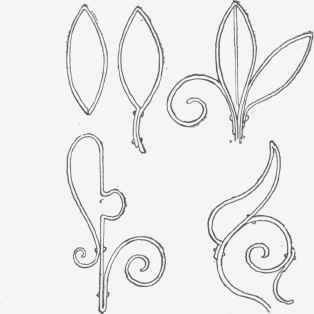
Fig. 36. Simple Plant Forms for Figure Work.
Italian bent iron-work is limited as regards ornament chiefly to circles, S curves, and spirals, nor does it often go beyond a repetition of the simplest geometrical forms, or leaves, in which it is closely followed by all English writers and teachers of the art. This is quite needless, for with a little care, any simple figure, such as a bird, an animal, or ornamental spray or crocket, may be made even without a fret-sawed mould, by bending with the round pliers and pinching. However elegant and elaborate the best Italian work may be, it soon produces a sense of wearisome monotony when seen in quantities.
The old German art of the same kind abounded in figures and grotesque forms of all kinds, which were more difficult both to design and execute, yet which had a far greater variety and interest than the former.
And there are many figures which, as the reader may see by the designs, are almost as easy as common curves, and which even a child could form, Fig. 36.
The easiest way to do this is to draw the figure, be it of a bird or animal or a face, etc., on paper, and fret-saw it out of a thin piece of wood. Then take the strip, which should be preferably of thick sheet iron, because the thicker it is, the more firmly will it retain its form. Bend this to the wooden mould or form, till you have got the outline exact. In most cases the strip should be drilled here and there and fastened to the wood with tacks, to keep it in form. Then make up or fill the surrounding space with curves, and when all is riveted the central figure will be firmly in place. Then remove the wood.

Fig. 37. Hinged Bracket.
It is needless to say that the simplest outline figures are best suited to this work, not only because they are the easiest, but because they are the most effective. It is not advisable for the most skilful and ingenious artists to attempt to make "pictures" in metal, but simple forms combined with Italian curve-work are, when skilfully chosen, the most attractive phase of the art.
The effect is improved when the figure is of brass, German silver, or copper, and the surroundings of iron. Gothic ornament, such as abounds on churches, will be found extremely rich in suggestions for such figure work in iron, because, not withstanding its complexity, the outlines are almost invariably very simple.
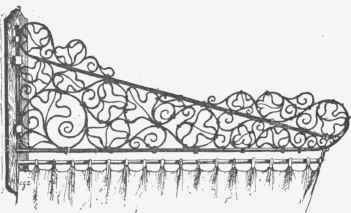
Fig. 38. Bracket for Door Curtain.
To make this quite clear I would say that any pattern whatever in a Gothic glass window, enclosing the glass, can be executed in bent metal or strip-work, as a matter of course, because such outlining was very often strip-work, when not a leaden frame, which was even harder to make into varied forms (see Fig. 45, p. 32), And with patience and practice the pupil will find it just as easy to mould strips into leaves, human figures, or animals, as to bend wire to his will. The process is analogous to preparing the walls or compartments for cloisonne work, in which the most delicate and minute patterns are made by arranging strips of metal (see Figs. 39-42).

Fig. 39. Mirror Frame.

Fig. 40. Photograph Frame.
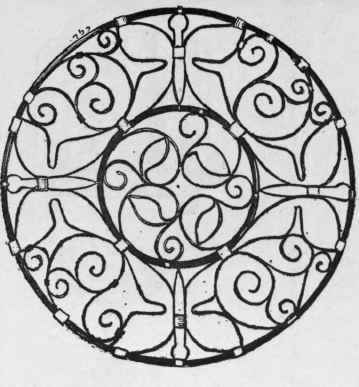
Fig 41. Circular Panel or Frame (without the Centre).
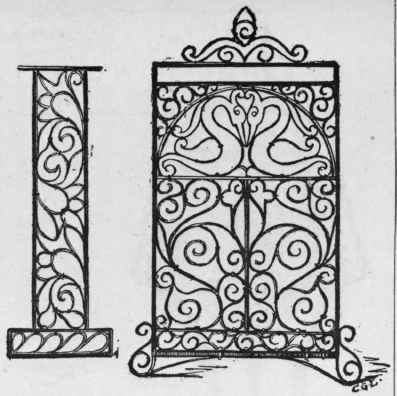
Fig. 42. Book Rest and Support.
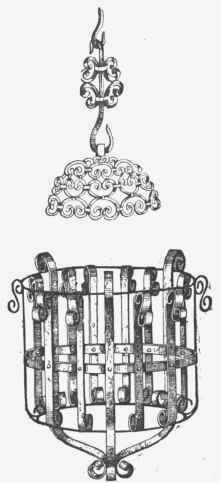
Fig. 43. Holder for Oil Lamp.

Pattern for Three Chains.
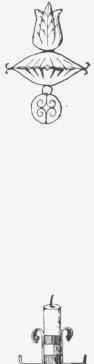
Sockets, for Candle.
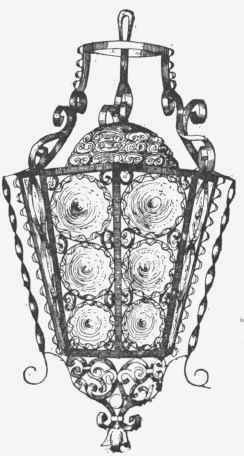
Fig. 44. Six-sided Hall Lantern.
Continue to:


My Books

