


Lesson III. Bent Iron-Work
Description
This section is from the book "Elementary Metal Work", by Charles Godfrey Leland. Also available from Amazon: Elementary Metal Work.
Lesson III. Bent Iron-Work
The second stage of bent iron-work is to apply or fasten the strips in ornamental form to frames. These are iron rods of different thickness, varying it may be from the tenth or eighth of an inch in diameter, to half an inch. As they are more difficult to manage than the strip work, many ladies buy them ready made, or have them made, which is a very easy matter for any blacksmith, nor does such work honestly cost much. But with an anvil and a small fire, or even, for lightest work, a gaslight, any lady can make any frame which she may require with a very little practice. What is beyond ordinary strength must of course be left to a smith, but a vast amount of very beautiful work can be effected even by children.
To make a frame, first buy a sufficiently long piece of nail rod, or square iron rod, rather less in diameter than a common lead pencil or penholder. The smaller it is the easier will it be to manipulate, and the pupil can rapidly advance to larger sizes and heavier work. This rod or mere thick wire may for a great deal of work also be round. Bend this, by heating the places where it is to be turned, into a square. Very flexible iron can be bent without heating, by means of carefully curving and hammering. When this is done, drill two holes through the ends which meet, and rivet them. Then you will have a square frame, Fig. 30.
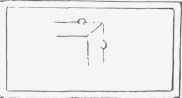
Fig. 30.
As a glass will probably be placed in this, there are two ways to effect it. One is to take a strip of flexible iron, and bend it into a V shape, or at a right angle all its length, Fig. 31. Any tinsmith will do this for you, by means of a little machine made for the purpose, one of which you can buy. But this turning the edge is also easily effected by putting one half the strip into the vice, and hammering the other half (of course lengthways) to a right angle. Make four of these V strips, corresponding in length to the inside of your frame, or even in short bits. Drill holes and rivet them in. This will hold the glass.
Another way is to take a strip of iron, or narrow ribbon, and bend it in an undulating or wave-pattern, Fig. 32. Unless the strip be of very soft iron it had better be heated, but in most cases careful hammering and wielding the pliers will suffice. This can be fastened to the frame either by riveting or binding with little strips or clamps, hammered round frame and border.

Fig. 31.
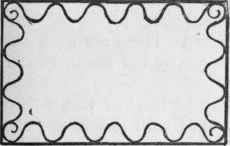
Fig. 32.
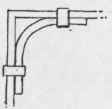
Fig. 33.
The easiest but least ornamental method is simply to drill eight holes into the inside of the frame and to drive into them iron or wooden pegs, leaving enough projecting to hold the glass. Again, you can bend a narrow strip, not quite so thick as the frame (that is, leaving the space of the thickness of the glass), and curve the corners, fastening the whole with rivets or clamps, as shown in Fig. 33, for corners alone.
Having made the frame and secured the glass, the next step is to make decorations of strips, as taught in Lesson I., and to apply or fasten them on.
As strip iron-work is extremely cheap, it would be well for all who can afford it, especially teachers of schools, to purchase, and keep for models, a few specimens of it. With these, or with designs or photographs, and the instruction already given, all the commoner kinds of frame and strip-work can be easily executed. And I here lay stress on the fact that it should be practised until the pupil is quite perfect in it, before proceeding to more advanced work.

Fig. 34.
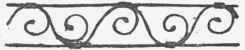
Fig. 35.
It is not more difficult after practice in making S's and C's to form letters which may be placed as initials in a centre, or made into inscriptions to fill borders. These are most striking when made of strips of brass, copper, or red metal, to contrast with the iron, Fig. 34.
When the work is done it may be blacked with "Day and Martin," or painted black, or worked with bronze powder and acid, or japanned in the usual way, or most effectively finished by heating it and dipping it into oil. Drop-black, ground in turpentine, with an addition of one-eighth bulk of japanner's gold size to bind it, is also recommended.
Continue to:


My Books

