


Anvils
Description
This section is from the book "Elementary Metal Work", by Charles Godfrey Leland. Also available from Amazon: Elementary Metal Work.
Anvils
For small work, an iron weight of from one to three pounds, with one side smoothed by any smith, and set in a wooden block, makes a very good anvil.
When an anvil cannot be obtained a flat-iron reversed is a very good substitute. I learned this many years ago from the Red Indians of New Brunswick, who used them for hammering out coins wherewith to make brooches and other ornaments.
A pair of strong metal shears, from seven to nine inches in length, for cutting thin sheet metal. The larger kinds are set firmly on the side of the work-bench, and are worked by means of a handle, as may be seem in tinsmiths' shops. For beginners the hand-shears will be sufficient. Fig. 4.
A pair of very strong scissors of best steel, also for cutting thin metal. The use of these may at first hurt the fingers, but with a little practice one can cut out thin soft iron or tin or brass into any shape with great ease, and without pain.
Cold chisels, or well-tempered cutters, used with a hammer for cutting out forms from sheet metal too hard for the shears.
Cutting pliers, for cutting wire and snipping off ends of metal.
Flat nippers, pincers or long-nosed pliers. Large and small round-nosed (or "pipe") pliers. Three or four sizes. Fig. 5. Common pincers. Two sizes. A metal drill for holes. These may be had from two to ten shillings; adjustable points of different sizes cost about one penny each.
Punches or bradaivls for making holes for rivets. One variety of punch for thin soft metal cuts out a round piece. A good steel nail may be used (round).
Rimer, in handle, for enlarging holes. Files. Flat, half-round or bastard, and rat-tailed or round. A small square block of iron into which holes are drilled, and others in which these hollows are of different sizes, saucer-scooped, and gradually deeper (to be fastened in the vice).
A centre-bit with three or four circular (or barrel) cutters, for cutting out large round holes.
A screw-wrench for nuts and bolts. Iron, steel, and tin rivets. A small forge or a fire when possible. A work bench or strong table.
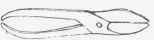
Fig. 4. Shears.
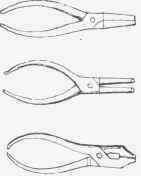
Fig. 5. Pliers.

Fig-. 6. Punch.
Wire. Ductile bell-wire, iron, brass, or copper.
A very important article is a round bar of wood firmly set in the work bench or wall. It should be from nine inches to a foot in its projection. It is useful for rivetting and rounding curves. The pointed and rounded end of a large anvil is also adapted to such work.
There is an instrument used to cut open tins of fruit, caviare, etc., which takes out a round piece from the size of a crown-piece to one of four inches diameter. This will be found very useful in broad work.
Apparatus for soldering.
A solid block of wood for rivetting and other special work.
Templet rods and pins. These are tapering rods or sticks, round which the strip is bent to make spirals, etc.
The pupil of limited means need not be alarmed at the number of tools here enumerated, nor their expense. For a beginner one pair of flat pliers or pincers, and one of the long-nosed, with table or block, a hammer, bradawl, and snip or shears, will suffice to produce very beautiful work. It is much better not to have too many implements at first, and to learn to thoroughly master what one has, and to know how to make the utmost of them. This leads to ingenuity and inventiveness, and to developing something which is even better than artistic skill.
Materials and Instruction.1 - Strip or band metal, or ribbon iron, consists, as its name indicates, of strips of thin sheet of varied thickness. Iron has sometimes been made as thin as Instruction in all kinds of metal-work - specially artistic - as well as tools and materials, may be had of Mr. Karl Krall (Barkentin and Krall, 291, Regent Street, metal-worker for the Ecclesiological Society). Also lessons at the Home Arts and Industries Association, Albert Hall. Tools and materials of best quality are also to be had of John J. Holtzapffel and Co., 64, Charing Cross, any note paper. It is usually made in widths of 1/8 of an inch (used chiefly for bands, clips, or ties to connect the work), 3/16 in. and 3/8 in. Strip or ribbon iron is sold at greatly varying prices, from 10d. to 3s. a pound, not by any means in relation to the value, but to the price which it is supposed it will bring. If the pupil is provided with a stout pair of shears, he can buy thin sheet iron for about 3d. or 4d. a pound, and cut it up himself into strips, or have it done as cheaply by any blacksmith or tinsmith. For practice, and even for a great deal of work, old tin cans may be utilized.
It may be here observed, that whatever can be made in iron, may with equal success be attempted in brass, copper, and especially in "red metal," and two or three other compounds of very great ductility. Tin-plate is also of course adaptable, it being only iron dipped into tin. I have seen a great deal of beautiful repousse work made from thin sheet pewter, coloured to imitate brass and copper. It is of course very weak, but serves admirably for ornament when placed out of reach.
Bent iron work is said to be the easiest of all the arts in metal, and so it is - after one difficulty has been mastered. This is simply to bend and curve the strips smoothly, so that there shall be an even surface without irregularities or kinks, so as to have the whole "smooth as wax." This is the first step. To do this, the pupil must positively not begin by trying to produce a finished article, but practise forming the curves with pieces of strip till he can make and smooth them perfectly. If this is done, step by step, from first making a mere ring, then one curve after another, as will be described, and then twisting strips, what would otherwise be very difficult (as it is generally hurried over in a brief description) will be found easy enough. And it may be here observed, that if this is thoroughly learned in cold bent strip work, it is perfectly easy to do the same in heated metal.
Continue to:


My Books

