


Of Setting Glass, Mother-Of-Pearl, Etc
Description
This section is from the book "Elementary Metal Work", by Charles Godfrey Leland. Also available from Amazon: Elementary Metal Work.
Of Setting Glass, Mother-Of-Pearl, Etc
The ordinary Venetian work seldom goes beyond setting disks or circles of coloured glass or square panes in lanterns, but as soft strips can be easily bent to any common curve or geometrical form, such as an oval or ellipse, circle, diamond, etc., it will be seen that there is a vast field for beautiful ornament of this kind, that is to say, for mosaic, in which the "stones" or "cubes" are to be divided by strip iron.
Coloured glass is specially adapted for lanterns. It is easily enough shaped with the diamond or a shilling American steel glass cutter. It is also possible to trim flat glass into good enough shape for such work by taking a strong pair of scissors and cutting the glass quite wider water. With a little practice one can attain to great skill in this. If necessary, the glass can be made neat and smooth on the edges by grinding it on a common grindstone with water. It can also be worked with a sharp file, which cuts better if dipped now and then in spirits of turpentine.
Frames made in compartments may be filled in with pieces of mother-of-pearl, with a very beautiful result; with bone, which can be bought sawed into thin tablets, and which is easily dyed of any colour; with variegated wood, all of which can be fret-sawed to any shape; and, finally, with pieces of porcelain or crockery, made from waste or broken plates, by breaking into shape, filing, and grinding. We can also employ fireclay, moulded in the strip-pattern. These pieces, when dry, can be easily fired even at home, but it may be cheaply done at any pottery; then paint them with porcelain colours, and have them fired again. Another very beautiful and brilliant effect may be obtained by pounding coloured glass in a mortar - some may be pulverized fine, but that which is coarsely powdered is the most brilliant fill the compartments with Portland cement and colour the surface with the glass powder.
The reader must remember, that to produce these compartments the strips must generally cross one another in the manner which has been already described (page 18). In this manner we can very easily form a panel of diamonds or squares, and in fact execute in strip iron any outline design whatever.
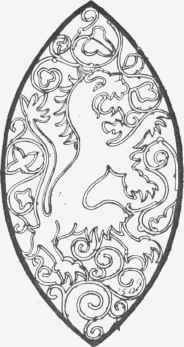
Fig. 45. Design of Glass Panel.
Continue to:


My Books

