


Venetian Work
Description
This section is from the book "Elementary Metal Work", by Charles Godfrey Leland. Also available from Amazon: Elementary Metal Work.
Venetian Work
To work repousse on a jar, pot, or vase, etc., fill the vessel with "pitch " or cement, and then let it cool and harden. To remove it, heat it again.
If the pupil will be contented to begin by simply working a hemispherical figure like half an orange, and then perhaps a pear, by itself, and so on through a dozen easy models, with great care, without hurrying to produce something remarkable, he will really need no teaching whatever. But it is so usual for even elementary books to set forth difficult show-pieces even for a first lesson, and almost all beginners are so ambitious to display what seems to the ignorant to be a masterpiece as a first effort, that it would seem to be almost useless to insist on this. But as I have said, and all sensible writers on repousse agree with me, it is really and truly only by observing closely the manner in which relief or depression follows one's moulding or manipulating, and by thinking and trying, that one learns to repousse anything, and not by being told or shown how; and it therefore follows inevitably that if the pupil would begin by very easy efforts, and thoroughly mastered everything as he went along, on the "acquiring strength by going" principle, he would have little or no need of a teacher.
After the pupil has thoroughly learned the rudiments of an art, it is almost useless to describe the advanced processes and great difficulties, for the simple reason that they are rarely, if ever, read by anybody; for these are always more easily acquired in the studio or workshop from seeing others working, or by divining them from models and works of art. Yet it is precisely these difficult things to which the authors of "elementary" books of instruction devote most time, as if they were either anxious to show how much they know, or were apprehensive of being considered ignorant, while the rudiments, in which nine-tenths of all education lies, are slurred over. And for this reason I beg all who follow this book to execute easy repousse, especially on pitch, with careful slowness, and if they do, they may be sure that I have clearly shown them enough to produce great or good work, if they are ever destined to do it.
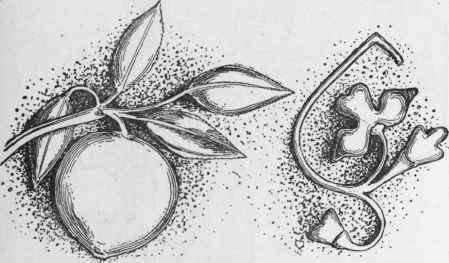
Fig. 94.
I beg the pupil to pay special attention to this fact following: Hammering in high relief on pitch is effectively the same thing as modelling in clay or wax, the difference being only this, that metal and different tools are employed. Now it is in repousse exactly the same as in modelling - the most apparently difficult curving, moulding, and turning, are nothing but the work of the first lessons repeated perhaps many times. Thus if you can repousse so simple a thing as a pear or a curved leaf, Fig. 94, and will have the patience to execute it with great care, several times, before proceeding to more ambitious work, - that is to say, make it till you can do so from memory, with perfect confidence and ease, - you will not only find that most large pieces involve quite the same work over and over again, but also that you have saved yourself months of work by perfectly mastering the first steps. In Decorative or Minor Arts - design apart - careful mastery of the rudiments is equivalent to genius.
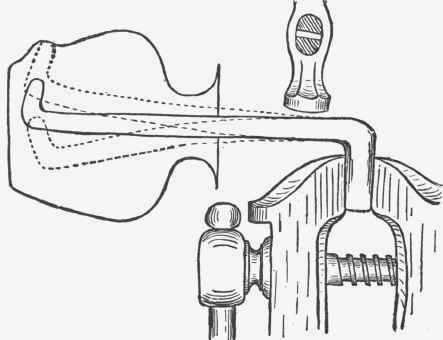
Fig. 95. Snarling.
There are very few people who reflect when they see a beautiful design that it is probably only a simple pattern doubled or quadrupled, with perhaps some trivial alterations, or that the most bewildering and complicated designs may be made by any child, by the simple process of cutting out two easy patterns in lines and laying one on the other. And I have found many very well-educated people who were astonished to learn that a wall-paper whose design was to them quite a mystery, consisted of nothing but a single ornament repeated and connected by a vine, the construction of which is to the last degree simple and mechanical, and which anybody can learn to make in five minutes. This is precisely the case with higher repousse, of which it may be very truly said that all its difficulties lie in the preliminary details.
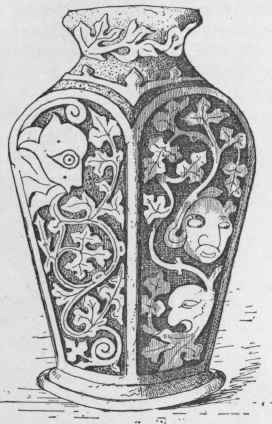
Fig. 96.
Snarling. This is a very curious element in embossing metal. The reader is probably aware that the very moderate tap of a hammer on metal produces at least a slight indentation, and that if repeated, on the " continually dropping " principle, a very large cavity can soon be produced. On this principle a long curved bar of peculiar shape, held in a vice, and frequently struck with a hammer, will keep vibrating, and if its vibrating end strikes all the time on sheet metal, it will of course bend it. Now as it is impossible for us to hammer, let us say, inside a narrow-necked copper vase, and beat out the side into a given form, this is most ingeniously and very easily done by snarling, that is, by introducing the end of the iron into the vase, so that it touches the spot required, and hammering on it. To do this the vase or bottle or cream-jug is placed on the chaser's bowl, and this on the cushion to steady it. Snarling irons are both light and heavy, and they are not confined to working inside vessels. When the vibration is given by a treadle or by the aid of a second person, it is easily applicable to a great deal of work, and is saving of much muscular exertion to the artist. Begin by snarling on a bit of waste brass or tin, and you will at once learn the method of working.
Snarling involves the same principle as spinning, and both that of making pottery on a wheel; that is to say, we avail ourselves of the principle of producing by means of a machine a greater amount of force, or more frequently repeated blows, or a more persistent and effective pressure, than we could do by the hand alone. Vide Fig. 95.
Continue to:


My Books

