


Repousse On Pitch
Description
This section is from the book "Elementary Metal Work", by Charles Godfrey Leland. Also available from Amazon: Elementary Metal Work.
Repousse On Pitch
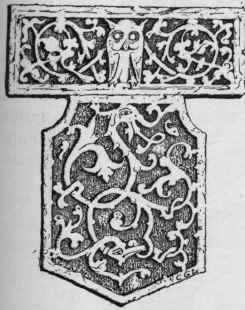
o get the highest relief in sheet-metal work we must of course push the pattern out from the back, and not drive the back in from the face. To do this the sheet must be laid on some substance which will oppose a moderate resistance, and yield a little to every blow, but not give way all at once. The substance best fitted for such a resistant consists of a cement made of about onehalf Burgundy pitch, and one half of brickdust, or of brickdust and plaster mixed. In some cases where we need a body which is more yielding, this is tempered with a little linseed oil and rosin. Pitch and dust harden too much in cold weather, therefore, and especially in America, where there are almost Russian winters and tropical summers, the composition of the cement is a very important matter. Dealers in tools for chasing and sheet-metal work generally sell a carefully prepared cement in cakes, which saves the great trouble of heating and mixing.

Fig. 89. Repousse, High Relief. From the Baptistery, Florence.
For repousse on cement, or, as it is generally called from its chief ingredient, "pitch," there are needed, in addition to the tools already described as used for embossing on wood, certain others. It will be at once seen, from the cost of these and their bulk and relative difficulty of management, why it was that when the easier process was made known, or hammering on wood, it became so popular; and if repousse on pitch has also become of late popular the fact is due to the impulse given by the humbler art.
The tools referred to are as follows.
A chasing hammer, and one of a heavier kind.
Beaters. These are stamps of different sizes, and with more or less rounded, flat, or oval heads. They are intended to beat hollows into the metal. Fig. 90.
A tin or iron cup to hold the beaters, tracers, and matts.
One good mallet.
A spatula or metallic spreader.
A pair of strong compasses and a square.

Fig. 90.
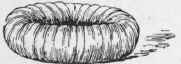
Fig. 91.
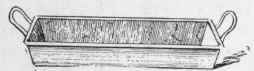
Fig. 92.
A cushion to hold the work. Fig. 91.
A strong bench.
A pitch block, i.e. a stone slab, one inch thick.
A chaser's bowl.
A pitch pan. A common frying-pan will answer for this. Fig. 92.
A bottle for pitch.
A stove, or fire.
A small iron stool for the stove.
The pitch is laid on a bed, which varies according to the shape and size of the work. It may be a block of stone, or a flat pan, a piece of plank with raised sides, or a wooden bowl. It is some times applied in small quantities to special surfaces, for the purpose of working small objects; and again, cups, goblets, and hollow vessels, are generally filled with melted cement, and when this is hard they are worked on the outside face.
Having melted the cement in a pot or boiler, dip it out with a ladle, and pour it into the pan or on the stone, gradually, till it is, let us say, an inch deep. Before it is too hard, lay the brass plate with the design already drawn on it, and bring enough cement or "pitch" over the edges to hold it firmly when cooled. This is done with the fingers, which are dipped in water to prevent the pitch from sticking to them. A spatula, or flat knife, is often used in treating the pitch. The pan is most convenient for beginners, as it can be filled and kept till needed. All that is necessary is to re-warm it, or else warm the brass and press it on, when the cement, as it cools, will hold it fast.
Now take a ball-headed tool, and with the mallet gradually beat in the brass into the cement, before it is quite cool. Do not attempt in this, any more than in working on wood, to get to the full relief all at once anywhere. Beat it at first shallow with a large tool in the large hollows, and then do the same with a smaller tool in the lesser parts, and so on, moulding or sculpturing, as it were, in a hollow. If you are very careful and patient, it is probable that you may make a good piece of work at the first trial.
All directions in print as to how to handle or manipulate the tools to give a form are only bewildering, and quite as useless as attempting to tell how one should model in clay. If the beginner has already a model or cast, or beaten work exactly like what he is trying to produce, it will, however, save him a great deal of uncertainty and trouble; so much indeed, that this may be regarded as really indispensable where there is no skilled teacher to direct his work.
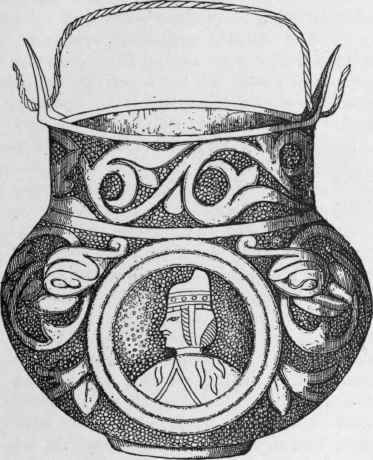
Fig. 93. Copper Scaldino to contain Burning Charcoal.
When the work appears to be finished, the pitch can be warmed, the work taken out and washed clean with petroleum, and then, if it appears to be imperfect, repeat the process. If it seems to be all right, then, filling it well with cement, lay it reversed on the pitch, and when hard work it on the face. In this stage the outlines are renewed or sharpened, and the matting or roughening the ground to give a dark relief to the shining pattern is executed.
Continue to:


My Books

