


Flat Sheet Metal Work. Shearing, Chiselling, Fret-Sawing, And Pressing
Description
This section is from the book "Elementary Metal Work", by Charles Godfrey Leland. Also available from Amazon: Elementary Metal Work.
Flat Sheet Metal Work. Shearing, Chiselling, Fret-Sawing, And Pressing
Istinct from, but closely allied with strip metal work, is sheet metal work. This is very beautiful and also easy work when soft and thin sheet metal is used. It entered largely into old German designs, especially in Nuremberg work. When sheet iron or brass is very thin it may be cut with strong scissors almost as easily as cardboard. When there are small openings into which the scissors will not pass, lay the sheet on the anvil and cut them out with a narrow cold chisel, using a hammer; or else, opening a small hole with a drill or nail, use a file. When the sheet is too thick for the scissors, use shears; and when these fail, then you can either cut out the whole pattern with the cold chisel and hammer, or else, taking a fret-saw, treat it like a sheet of wood. Brass or soft iron from one-eighth of an inch in thickness to half an inch can be thus sawed into patterns, but I assume that in all the work of the pupil he will rarely have occasion for sheet metal of such thickness. When the cutting out is completed, the whole may be finished with a file. Figs. 46, 47.
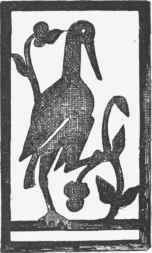
Fig. 46. Small Panel. Cut Metal.

Fig. 47. Fret-sawed Sheet Metal.
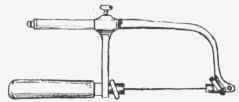
Fig. 48. Fret-Saw.
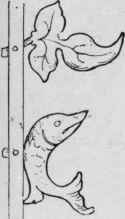
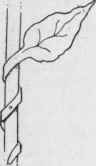
Thin sheet metal can be easily cut with a common fret-saw, such as is used for wood, but for thicker metal work a saw with a thinner blade and narrower frame is employed; these are cheap, with one frame a dozen saws are generally supplied, the whole may be had at all prices, from a shilling to a pound. Fig. 48. Of course, a hole is first made in the metal with a drill or round file, the saw passed through it, then fastened, and the cutting is executed by working the saw up and down.1 Whatever can be cut in wood or paper can be done in sheet metal, even to the most incredible fineness. Figures of men or of animals, heads in profile, birds, butterflies, flowers, grotesques, arabesques, or, in short, anything in outline cut from sheet metal can be freely combined with the strip, band, or ribbon work, already described. One way to adapt these figures to the strip or ribbon work - that is, to attach them to it - is to drill holes in the strip, leave a projecting bit on the edge of the figure, pass the projection through the hole, and clinch or rivet it with a blow on the other side, flattening it sideways. Fig. 49 A.
A
B
Fig. 49.
In other cases a leaf may be riveted in the ordinary way to the end of a strip which has been previously heated and turned round; or a turn may be made in the neck of the leaf, etc., which is then riveted to the strip. Fig. 49 B.
The surface of sheet metal work may be decorated in different 1 Arturo Fumel, Via San Paolo, No. 7, Milan, publishes a very extensive and cheap album of patterns for this work in wood, giving nearly 300 for threepence.
way: (1) by repousse, or working on it with hammer and tracer and stamps, which will be described in another section of this book; (2) by engraving by hand, which may be sufficiently well learned for mere line work in a few days ; only two or three gravers of hard steel are needed for this (Fig. 50). The lines are cut by projecting the point and pushing it forward, not by scratching towards the operator. The art is not difficult to acquire, and when learned, is applicable to wood-engraving, ornamenting the surface of metals, shells, and other substances ; (3) by etching, or engraving with acid. To effect this the iron or other metal is covered with a thin coating of wax, care being taken to make a little wall of wax all round the work - or else with varnish - then with a "point," or a pin or needle in a holder, scratch the design in the coating so as to expose the metal; this done, pour on it a mixture of about one-third nitric or sulphuric acid to two-thirds of water, and with a feather remove the little rows of bubbles which will at once begin to form. After ten minutes, pour out the acid and water into a cup, dip the plate into water before handling it, then remove the wax, or wash away the varnish with turpentine, and you will find the design eaten into the metal; the wax may be quite taken away by heating it. If there are any imperfections in the etching renew the process.
When the sheet of iron is tolerably thick it may be beautifully ornamented as follows. Cut with the graver grooved lines, deep enough to receive gold or silver, brass, German silver, or copper wire, lay the wire in the groove and hammer it in. This will generally hold fast, but the process to be perfect requires that the metal be heated and fluxed with borax.
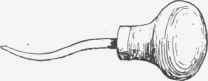
Fig. 50. Graver.

Fig. 51. Inlaid Metal Work.

Fig. 52. Book Cover. Fret-sawed Metal on a Thin Panel.

Fig. 53. Old Swiss Sawed Iron Work. (1537.)
Etching or engraving by hand, or with acid, may also be gilded either with gold-leaf and size, or else with gold (or bronze) powder and gum-water; this latter may be protected with a coat of retouching varnish. Even avery little gilding, tastefully applied, on black iron work greatly improves its appearance. We can, with a file, or better still with a graver, run or cut a line along the centre of a strip of iron; this is made easy by slipping over the strip a sliding flat ring, in which there is a hole to receive the cutter, Fig. 54. We then introduce the point of the cutter or graver, and, bearing on, push it along; fill the groove thus cut with gilding or gold-powder paint.

Fig. 54.
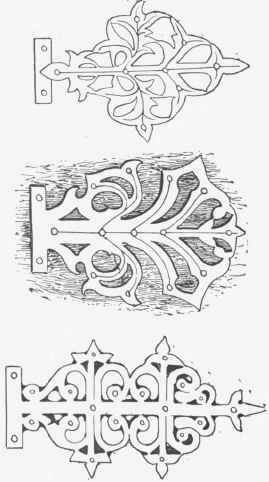
Fig. 55. Hinge-Plates.
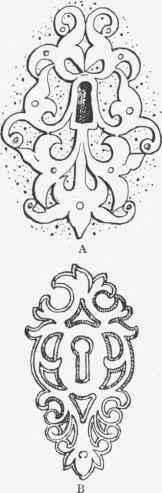
Fig. 56. Brass Scutcheons.
Beautiful effects may be produced in sheet metal by cutting out a pattern and then placing a larger sheet of another metal behind it; then rivet or tack the two on the ground, taking care that no ends turn up. This is applicable to picture frames, cabinet doors, or any plane wall surfaces.
Very beautiful inlaid sheet metal work is made as follows.
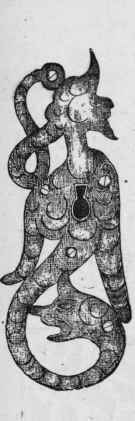
Fig. 57.
Nuremberg Work, 15th Century. Basle Museum.

Fig. 58.
Cut out the pattern from thin metal, and lay it on a panel of wood, which should of course be hard and well seasoned. The metal may then be thoroughly pressed into the wood by means of any kind of screw press, or even with a roller. When thoroughly imbedded, take it out, coat the back with the strongest Turkish or mastic cement, and if the latter be well made it will hold the metal to the wood; should it "spring" in any places it may be riveted. Another way to imbed the metal is to lay it on the wood, draw the outline with a sharp needle, cut the wood out with great care, cement or rivet the work, and rub the cement well into all cavities or edge cracks.
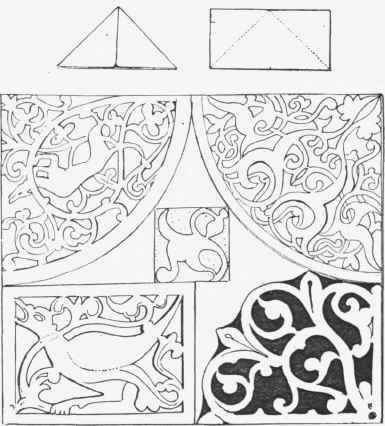
Fig. 59. Corners for Books.
. A very beautiful decoration for any box or chest or door is made by cutting out either true or false hinges from thin sheet metal and screwing them on. A false hinge is only the ornament applied to the edge of the hinge on which the lid turns. See Fig. 55. The same patterns may be used for book clasps.
A scutcheon is a keyhole plate used to protect the edges of the keyhole. Figs. 56-58. In both Nuremberg and Italian work these scutcheons were often very broad, as were the hinges, and sometimes very grotesque. A very effective enrichment is obtained by having two or more pierced plates laid one over the other and riveted together as a whole. In this case the lower plate will be pierced so as to leave a little margin all round the pattern above it (see Fig. 56 b), or if the top plate is pierced, leaving rather large openings, a different scroll, diaper or trellis pattern of smaller scale, may be placed underneath it. In many old examples this "double tracery" work is underlaid with velvet, leather, or cloth, not showing at the outside edges. The most ordinary wooden panel, door or shutter may be made beautiful or attractive, at very little expense, by means of such adornment. Flat strip work may be thus applied. Slighter work of the same kind may be used for making shields to protect the corners of books. Fig. 59.
Stencil Cutting, which is a special form of flat sheet metal work will be found described later in the volume.
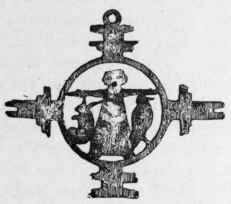
Fig. 60. Cross of Sawed Metal.
Continue to:


My Books

