


Moulded Sheet Metal Work
Description
This section is from the book "Elementary Metal Work", by Charles Godfrey Leland. Also available from Amazon: Elementary Metal Work.
Moulded Sheet Metal Work
Heet brass and copper, especially red metal, and also thin malleable iron when it can be obtained, can all be shaped as easily as damp leather, in fact, more easily, because they retain any form or indentation more firmly. The processes for making leaves and flowers are indeed essentially the same with those of the old-fashioned leather or wax work, so that anybody who is familiar with one, could immediately work successfully in the other. For thick and ordinary sheet iron, which is harder and more brittle, smithing, or heating and shaping by hammering on the anvil is necessary, of this I do not propose to write, but would say that to those who have thoroughly mastered all the lessons here given - which, it must be admitted, are extremely easy even for children, if gradually and carefully learned - ordinary forging or hammering heated metal will be found even easier, and there is also in it a certain fascination or pleasure which is indescribable. I was very much astonished when I first learned how easy it is to forge a knife, dagger, or sword, especially when the pupil has some previous knowledge of design, modelling, or wood-carving.
Therefore I earnestly urge the pupil, when it is possible, to practise, even if it be but for a short time, making leaves and flowers of sheet wax, paper, or damped leather, because this very easy work is an admirable preparation for sheet metal, especially for children, who find no difficulty in learning the former, and in going from it to the latter, but who find the metal at first difficult.
To make a leaf in thin sheet metal, after having moulded one in wax or leather, requires no knowledge or practice beyond being told to hold one end with the flat pliers, and give it shape with the round-nosed or pipe pincers. If the stem or vine be a wire, then let the stalk terminate in a strip which may be wound around the wire. To prevent it slipping, flatten the wire slightly in one place, and hammer the wrapper to it, or else rivet through the flattening. Fig. 62, p, q, r, t, etc.
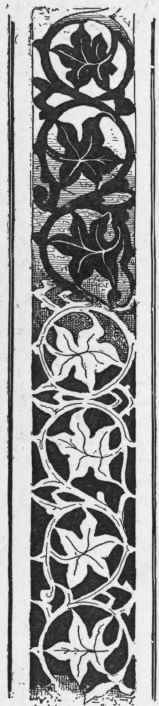
Fig. 61. Border or Frame.
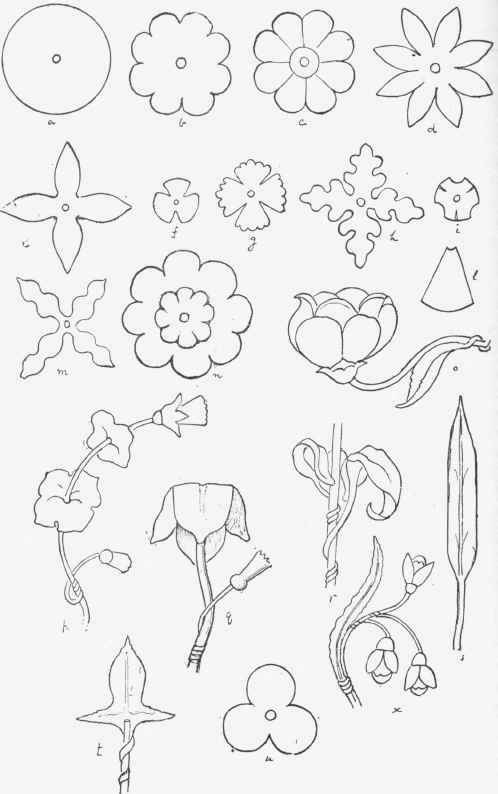
Fig. 62. Patterns for Metal Flowers, etc.
A piece of soft sheet metal may be easily moulded into any form of leaf, scooped or goffered, fluted or waved, by means of the pliers, round-nosed or flat, the ball-punch, or the hammer. This work may be performed on the anvil, on a piece of soft pine plank, or on a bed of the cement used in repousse, according to the curve required. It is quite useless to describe in detail how every kind of depression, or hollow, or boss is to be made, since all such detailed descriptions are more confusing to youthful beginners than helpful, and even young children require no instruction to imitate the bend of a leaf in wax or paper. I have taught classes in such arts for years, and have always found that if the pupils will only begin with very easy imitations of models or designs, and, taking an interest and working industriously, thoroughly master the rudiments, they always find their way onwards, step by step. All that they require is to know exactly what they are expected to do, and to see the objects, models, or pictures, of what they are to make, and if these are not beyond their power or intelligence, they will make them, and, while so doing, learn something for more advanced work. This is well shown in this modelling of leaves and in bending metal, in which any intelligent pupil - the tools, metal, and model being given - is sure to find his way to do good work. This is the only way to make a good artizan or artist, that is, to make the learner think and stimulate his inventive power. He is the best teacher who does this.
The mid-rib or lines on the leaf are very easily indicated with a tracer, like a screw-driver, the use and command of which can be acquired in an hour (vide "Repousse,"p. 61). The pupil should, however, take great pains to learn to execute all these "inside lines" very carefully. They require a rather sharp tracer, and must be light: in many cases it is best to make them with a graver, or sharp cutting tool.
A rose is made by formingwhat may be described as two or three circles, of different sizes, with scalloped edges. Or, as described in my "Leather Work," p. 61:- "The processes of cutting out leaves to make flowers are the same as those followed in making them from paper. Thus, to form a rose we cut out a scalloped circle, and then a smaller one, which is placed on the first. The outer, or green leaves of the calyx, are in like manner cut from a third disc [or round piece (Fig. 62 a, b, c, d, e) ]." A wire is then taken, to one end of which is fastened a circle, or button, or small screw by riveting, and the other end is then passed through the holes in the centres of the scalloped circles.
It is to be understood that the scalloped ends which represent leaves are previously hammered into a saucer-like shape, and otherwise shaped out. If this be done first in sheet wax, or even in thin cardboard, damped, or stiff paper, the imitation in metal will be easy. As regards the saucer shape, it may be remarked, that if we take any round piece of sheet metal, thick or thin, be it half-a-crown, or a disk of sheet iron, and gradually tap it on an anvil with a small hammer, it will form a saucer of itself if beaten only on one side.
Oak leaves, which admit of great variety of graceful curves, as also the ivy, are beautifully adapted to frames. A stick of hard wood with a round or ball end, or an iron implement, as, for instance, one like a bolt with a round end, or a ball-headed punch, and a tracer, are useful in shaping and making leaves.
There are certain varieties of metallic buttons which can be admirably adapted to metal flower work, to form centres for leaves. Spherical buttons and metal beads, strung together on wire, form ingenious bunches of grapes or berries.
Continue to:


My Books

