


Moulded Sheet Metal Work. Continued
Description
This section is from the book "Elementary Metal Work", by Charles Godfrey Leland. Also available from Amazon: Elementary Metal Work.
Moulded Sheet Metal Work. Continued
Brass or copper may be easily hammered into a cup like half an egg-shell. Two of these fitted one into the other, and riveted or soldered, make oranges or apples. The riveting is effected by first putting into them a round disk of wood just in the centre, and driving the rivets in from the outside, or they may be soldered together.
It will be found much easier for the pupil to make flowers for himself out of paper or wax, and then imitate them in metal, than to make them at once in metal, even from the most clear and careful direction; and it is advisable to copy real flowers as much as possible, as this will make an artist sooner than copying the best models.
Sheet metal work is allied to strip work on one hand, and to repousse on the other, but there is an endless variety of objects which can be made in it, either with, or without either. It is well, to begin with, to remember that whatever can be made in paper or cardboard can be imitated in sheet metal. Thus, to make a shallow receptacle which may be adapted to hold a square inkstand or lamp, cut a flat piece of brass or iron into the form indicated in Fig. 63; bend up the ends, turn them round, solder them or rivet them with brass nails, with semi-spherical heads, bend over the handle, and you will have a useful object of which the merest beginner can make fifty in a day, that is if the handle be riveted on instead of being cut out.
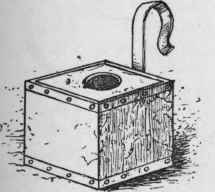
Fig. 63. Inkstand.
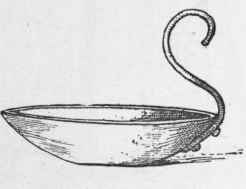
Fig. 64. Ash Tray.
Another kind of receiver, patera, or saucer, or ash tray, is very easily made by taking a piece of sheet metal, square, round, elliptical, or, in fact, of almost any form or size, and hammering it into a shallow or deep scoop, or concave form, or cup, or basin. To this a handle or handles may be riveted, so as to make of it a basket or give it the Roman lamp form, Fig. 64.
A cylinder or cannon-shaped receptacle may be made into a tankard, or converted into the base for a lamp. Take a more or less square piece of sheet metal and roll it into the requisite shape, and then rivet or solder it firmly. The bottom may be a round piece, with edge turned up, into which the cylinder fits exactly, which may be soldered or riveted on. As before described, this turning the edge is easily effected on the anvil with a hammer, and there is a cheap little machine, used by every tinman, by means of which it can be done accurately, and in a minute. A handle of strip iron or nail rod can be also riveted to the can, Fig. 66.

Fig. 65. Cylindrical Receptacle.
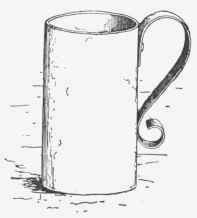
Fig. 66. Tankard.
It may here be observed that old, discoloured, Roman copper, or bronze coins, which can be bought in most curiosity shops for as little as a penny a-piece, and which are in reality often quite worthless to a collector, being as unrecognizable and as ugly as can well be, look very quaint and interesting when set into the centre of a receiver, or around the side of a cylinder or cannon tankard. If the reader will try this he will be quite satisfied with the effect (Fig. 67). To set the coins, take a strip or band of metal large enough to pass round the cylinder and lap over a quarter of an inch. While flat, mark out on it the exact size of the coins. Then within these rings mark out smaller ones, which are to be cut out. An easy way to do this is with a very strong pair of carpenter's compasses with steeled points. The difference between the two circles must be exactly broad enough to be "knocked up" and just turned a little over the edge of the coin - practise this first with thin brass or sheet tin - then set the coins, slip the band over the cylinder, and rivet or solder its ends.
Another way to produce this projection, so as to make a ring to receive and hold the coin, is as follows. Bore in a piece of hard wood a hole a very little larger than the coin; then prepare a wooden cylinder of exactly the diameter of the coin. If we place a piece of thin sheet metal, from which a round piece has been cut, exactly on the hole, put the end of the wooden roller over it, and give it a blow with a hammer, it will of course knock up the edge of the metal into a band which will just hold the coin (Fig. 68). This is the same as if you were to force your finger through a piece of paper; there would be a hole, and the paper would rise up round it on one side only. This is the better process of the two.
A candlestick is made as follows. Form a tube (of the size of a candle) of sheet metal, first make in the end three cuts or splits: after closing the tube, hammer these splits out and they will form three feet on which it rests. Add a riveted handle if needed. Bands of brass may be put on, if it be of iron, for an ornament.
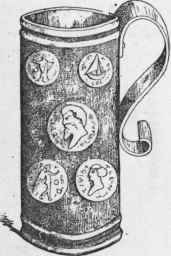
Fig. 67. Tankard inlaid with Coins.
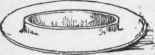
Fig. 68.
The most striking kind of sheet metal work is the one least practised. This consists of either repousse, or plain flat sheets simply outlined, which are then painted with strong, common oil-paint, or coloured by the processes described further on. Dark-green and black oil-paint take such a firm chemical hold on brass that after a few months they set almost like enamel, and can only be scraped away with great difficulty. They can be cleaned, when hard, like the metal itself. The pattern may be thus blacked, or only the ground, or both alternately (as in Fig. 70). Work of this kind is very beautiful, and extremely effective.
To ornament brass work with black bands, or to fill up hammered or repousse hollow places, use a mixture of sulphur and ammonia. It has an unpleasant smell, but sets as hard as enamel, and takes a polish. This mixture of sulphur and ammonia is very black. When used to fill lines or other cavities in silver it has the appearance of what is called niello.
To give copper a rich green rust, apply sulphate of copper dissolved in water. Green figures may thus be produced on the burnished copper surface.
Nitric, or sulphuric, or muriatic acids, and even strong vinegar may be employed to rust copper, brass, or iron.
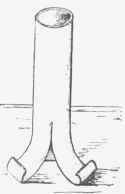
Fig. 69.
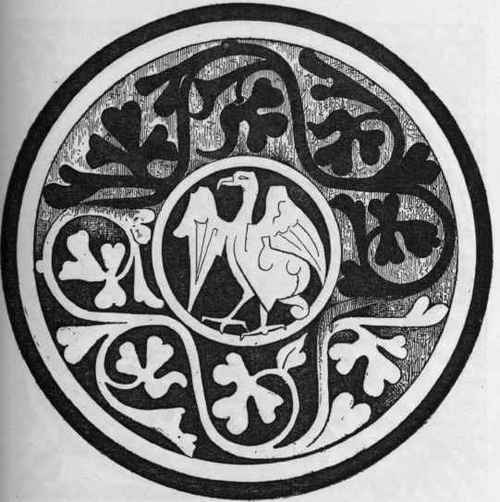
Fig. 70. Salver or Plaque of Coloured Brass. [The pattern may either be outlined or reproduced in repousse.]
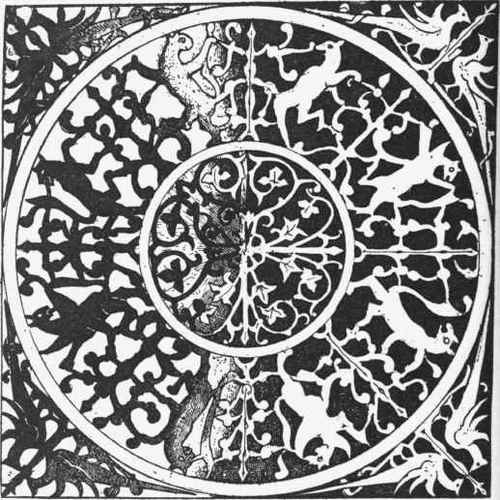
Fig. 71. From the Baptistery, Florence. Pattern outlined on Metal and filled in in Niello.
Bronzing may be applied to brass - especially grounds - very often with good effect. There are so many methods of doing this that the student may be most practically recommended to ask for information of those who sell the great variety of colours in metal powders known as bronze. There are also boxes of these colours sold with all necessary utensils and directions. In "Repousse Work for Amateurs," by L. L. Haslope, which I commend to all students as containing much practical information, the author gives us a hitherto unpublished recipe, the use of a solution of bichloride of platinum in rain water. This is applied to the work with a brush, or the brass is immersed in it till a sufficient effect has been produced; it is then washed in water, dried in sawdust, and lacquered. It will pass from yellow to deep blue if the latter colour is required : wash at once. If left in the solution long enough it will become a fine black, which is also secured in the same way. This is an expensive recipe. Bronzing is also effected by mixing
Sulphate of iron.....2 oz.
White arsenic . . . . . . I oz.
Spirits of salts.....20 (fluid) oz.
This is applied in the same manner. Care should be used not to inhale the fumes of this mixture.
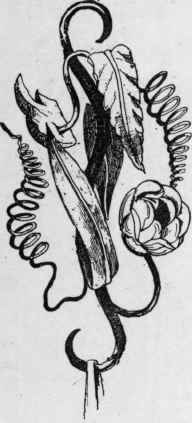
Fig. 72. Lamp Hook (Florentine).
Continue to:


My Books

