


Ellipse
Description
This section is from the book "A Practical Workshop Companion For Tin, Sheet Iron, And Copper Plate Workers", by Leroy J. Blinn. Also available from Amazon: A Practical Workshop Companion For Tin, Sheet Iron, And Copper Plate Workers.
Ellipse
Fig. 81. To find the Centre and the two Arcs of an Ellipse.

Let ABCD be an ellipse, it is required to find its centre; draw any two lines, as EF and GH, parallel and equal to each other; bisect these lines as in the points I and K, and bisect IK as in L from L, as a centre, draw a circle cutting the ellipse in four poins, 1,2,3,4, now L is the centre of the ellipse; but join the points 1, 3, and 2,4; and bisect these lines as in M and N; draw the line MN, and produce it to A and B, and it will be the transverse axis draw CD through L, and perpendicular to AB, and It will be the conjugate or shorter axis.
Fig. 82. To find the Radius and Versed Sine for a given Frustrum of a Cone.
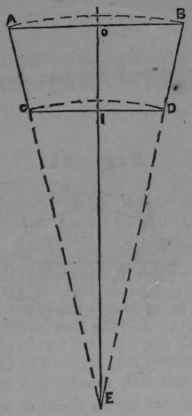
Multiply the slant height by one-half the diameter of the large end, and divide the product by one-half the difference of the two ends, and the quotent is the radius; the versed sine is found by multiplying the altitude by one-half the diameter of the large end; and dividing the product by one-half the difference of the two ends; then substract the quotent from the radius, and the remainder is the versed sine.
The diameter AB equal 12 inches; CD equal 8 inches; the slant height DB equal 10 inches, required the radius 10 X 6 = 60 ÷ 2 = 30 inches radius.
The diameter AB equal 12 inches; CD equal 8 inches; the altitude I 0, 9.79 inches required versed sine, 9.79 X 6 = 58.74 ÷
2 = 29.37; 30 = 29.37 = .63 versed sine.
Continue to:


My Books

