


Practical Geometry
Description
This section is from the book "A Practical Workshop Companion For Tin, Sheet Iron, And Copper Plate Workers", by Leroy J. Blinn. Also available from Amazon: A Practical Workshop Companion For Tin, Sheet Iron, And Copper Plate Workers.
Practical Geometry
Geometry is the science which investigates and demonstrates the properties of lines on surfaces and solids; hence, Practical Geometry is the method of applying the rules of science to practical purposes.
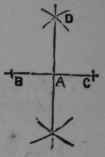
From any given point, in a straight line, to erect a perpendicular; or, to make a line at right angles with a given line.
On each side of the point A, from which the line is to be made, take equal distances, as AB, AC; and from B and D as centres, with any distance greater than BA, or CA, describe arcs cutting each other at D; then will the line AD be the perpendicular required.
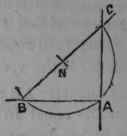
When a perpendicular is to be made at or near the end of a given line.
With any convenient radius, and with any distance from the given line AB, describe a portion of a circle, as BAC, cutting the given point in A; draw, through the centre of the circle N, the line BNC; and a line from the point A, cutting the intersection at C, is the perpendicular required.
To Do The Same Otherwise
From the given point A, with any convenient radius, describe the arc DCB; from D, cut the arc in C, and from C, cut the are in B; also, from C and B as centres, describe arcs cutting each other in T; then will the line AT be the perpendicular as required.
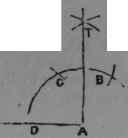
Note. - When the three sides of a triangle are in the proportion of 3, 4, and 5 equal parts, respectively, two of the sides form a right angle; and observe that in each of these or the preceding problems, the perpendiculars may be continued below the given lines, if necessarily required.
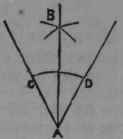
To Bisect Any Given Angle
From the point A as a centre, with any radius less than the extent of the angle, describe an arc as CD; and from C and D as centres, describe arcs cutting each other at B; then will the line AB bisect the angle as required.
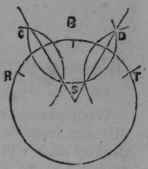
To Find The Centre Of A Circle Or Radius, That Shall Cut Any Three Given Points, Not In A Direct Line
From the middle point B as a centre, with any radius, as BC, BD, describe a portion of a circle, as CSD; and from R and T as centres, with an equal radius, cut the portion of the circle in CS and DS; draw lines through where the arcs cut each other; and the intersection of the lines at S is the centre of the circle as required.
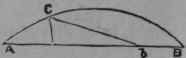
To Find The Length Of Any Given Arc Of A Circle
With the radius AC, equal to 1/4 th the length of the chord of the arc AB, and from A as a centre, cut the arc in C; also from B as a centre, with equal radius, cut the chord in B; draw the line CB; and twice the length of the line is the length of the arc nearly.
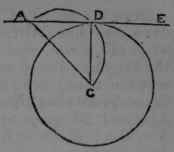
Through any given point, to draw a tangent to a circle.
Let the given point be at A; draw the line AC, on which describe the semicircle ADC; draw the line ADB, cutting the circumference in D, which is the tangent as required.
Continue to:


My Books

